Total Pageviews

Showing posts with label British Columbia. Show all posts

Thursday, May 24, 2012

Peter Janni’s Silver Chimney


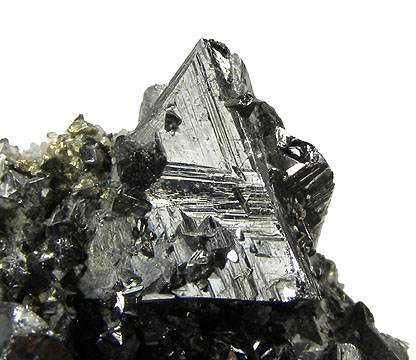
Tetrahedrite
Photo by Rob Lavinsky


This story sounds almost like it is untrue, but if you’ve ever worked for an old country contractor you know you can’t tell them anything.  The principal character in this tale was a one Peter Janni that was born in Italy in 1874 that eventually came to America to work on the railroad.  Eventually he fetched up in Northport, Washington where he proceeded to buy a limestone quarry just south of the town.  Janni sold limestone all over the state of Washington out of his quarry.

This quarry is located in the tetrahedrite zone in northern Stevens County.  The ore deposits are found in vugs and a structure called a chimney where narrow veins of galena bearing large percentages of silver are sometimes found.  In 1953 the quarry workers at Janni’s quarry found such a chimney that measured roughly 5 x 6 feet on the second level of the quarry.

The workers followed the chimney down and shipped almost forty tons of ore to the lead refinery owned by the CM&S Company in Trail, British Columbia.  Once they had reached down the chimney for fifteen feet Janni came over to where they were working and told the men to, “Cover the damn thing up.”  The men pleaded with Janni to let them continue following the chimney, but Janni refused telling them, “Maybe someday we will dig her up again.”

Nobody has any idea what got into Janni’s head that day, but according to some old timers still living in Northport this rich chimney is still in the quarry where it is it is buried under tons of limestone still on the second level.

The Lost Gold Ledge in Danville, Washington


Mt. Baker, Washington
Photo by Adam Lindsay


The town of Danville, Washington nestled right up against the Canadian border had a checkered past to say the least.  It started as Nelson, Washington, but the railroad changed its name to avoid confusion with Nelson, British Columbia.  The town had a store with entrances opening into both countries that the authorities closed down because of suspected smuggling.  The heyday of the town came with prohibition when many of its residents worked as guides for the whiskey smugglers guiding them over back-country trail out of sight of the revenuers so they could smuggle Canadian whiskey into the United States.  Once prohibition was over the town slowly faded away.

Before prohibition though in 1912 a prospector named John Falconer was working in the town during the summer as a laborer.  At some point a vicious thunder storm hit the area and a bolt of lightening set fire to a tree on the hillside southeast of the town.  Falconer rode a horse out of town along a game trail to put the fire out before it spread.  On the way it started raining and somewhere along the trail his horse trod on a rock sticking up from the ground.

By the time he reached the blazing tree the rain had put out the fire, so with nothing more he could do there he started back to town.  When he reached where his horse had scrapped the soil from a rock he could see it was full of pyrite so he stopped to get the rock.  It was not until several months later that Falconer realized the rock was full of gold not pyrite.  The gold slab was worth over $1,000 that contained over 50 troy ounces of gold that at the time was selling for $20.67 per ounce.

Around Danville the old timers called it “the golden plate” and thought it was only a small part of a gold ledge.  Falconer and his wife hunted for the place where his horse struck gold, but never could find the place again.

Since then many have looked for Danville’s golden ledge in the hills south east of the town but have never found it either.

It makes sense that there is gold there because it is close to the Cascade Mountains that supplied the heat necessary for the formation of gold deposits.  Two volcanoes that could have supplied the gold deposit are Mt. Baker in Washington and Mt. Garibaldi in British Columbia.


Thursday, November 10, 2011

Gold Occurrences in British Columbia

It is near Mt. Robeson where the Fraser River rises that was the scene of a gold rush in 1859.   Tobi87


It was in Yale, British Columbia on the banks of the Fraser River where I first learned about British Columbia gold there were several flour sized flakes gold in the bottom of my gold pan. From what I understand this flour sized gold is characteristic of the Fraser River. For the benefit of the reading audience it takes approximately 40,000 of these to weigh a troy ounce (31.1 g).  At the time there was a terrific thunder shower coming up, and I worked the pan out in about two minutes leaving the proprietor of the gold panning site completely mystified because he had already seen the Connecticut greenhorn could work so fast, he already seen the plates on my car.  He didn't know I had been a prospector most of my life. The Fraser River was the site of a gold rush in 1859, and there is still gold to be found in the Fraser River system.  There are also jade boulders found with the gold in the river.

Yale, British Columbia during the Freaser River Gold Rush in 1859


British Columbia also contains the southern terminus of the Tintina Gold Belt in the northern part of the province. This appears to be the largest gold belt in the world since it is traceable all the way from northern British Columbia, through the southwest corner of the Yukon Territory and sweeping all the way across Alaska for a distance of 1200 km where it finally ends in the Pacific Ocean just above Anchorage, Alaska.

The first discovery of gold by Whiteman was at Gold Harbor on the west coast of Moresby Island near the Haida village of Tasa in 1850 where it was discovered on Mitchell Inlet, an arm of Gold Harbor.  This discovery touched off a brief gold rush in 1851.  This led to the area being declared the Colony of the Queen Charlotte Islands.  The British government didn’t want the islands to be overrun by American Miners even though the gold deposits proved to be superficial in nature, and there are stories about the American miners being harassed by the local Haida warriors.  Later the area became the site of a modern mine for iron rather then gold.

Like all the beaches in the Pacific Northwest of the United States and Canada The beaches do contain flour gold in payable amounts sometimes covering the beaches with enough gold so they attract the locals trying to get as much of this gold as possible before the next tide washes it away until the next big storm that may wash up enough gold to be noticeable again.  In the same area the mountains of the coastal range including the British Columbia Batholith have had several producing gold mines and numerous showings of gold.

There is another gold producing area on the western slopes of the Rockies and the rivers and streams draining them.  This area was made famous during the Fraser River Gold Rush and the later Caribou Gold Rush. 

Gold is not the only source of mineral wealth in the province because it also contains world class deposits of jade that are mined both in-situ and as boulders of jade found in numerous rivers.  The area around Cache Creek has produced both gold and jade.  British Columbia is also noted for producing large quantities of copper, lead and silver.

British Columbia has vast deposits of mineral wealth throughout its length and breadth with many deposits yet to be discovered.  There are numerous mines that are accessible only by air especially in the northern part of the province.

Wednesday, January 19, 2011

Gold Occurrences in Alaska

Gold is found throughout Alaska, and the resources are as vast as the land itself. One of the prominent features found in Alaska is the Tintina Gold Province (TGP) an arching curve that extends all the way from northern British Columbia, the southwestern part of the Yukon Territory and crosses the entire state of Alaska where it finally vanishes into the sea northwest of Anchorage. This gold belt has produced several gold rushes over the years probably the most famous is the Klondike Gold Rush that occurred in the late 1890s.

A gold dredge working on the TGP
Photo by Chris Lot

The TGP covers roughly 150,000 km² that is bounded on the north by the Kaltag Tintina fault and on the south by the Farewell-Denali fault. Geologically it could be considered a suture zone where one tectonic plate collided with another one. Throughout most of this vast area you can only find a few roads one of which is the famous Alcan Highway that goes to Fairbanks. The apex of the TGP arc is just about centered on Fairbanks, Alaska. Altogether the TGP is one of largest gold provinces in the world at 1200 km long and about 200 km wide.

The Tintina Gold Belt superimposed on a Landsat image.   USGS

The regional climate that is associated with the TGP is generally subarctic that includes several different physiographic regions and ecoregions like that Yukon-Tanana upland, the Yukon River low lands and the Kuskokwin Mountains.

Geologically Alaska is made up of several different terranes with the Tintina gold belt being only one of many. Although the TGP is the largest one in Alaska gold can be found throughout the state. Most of the Gold that has been recovered in the TGP to date has been placer gold, but new methods of mining and metallurgy have allowed some previously known deposits to be brought online.

Virtually all of the known gold deposits in the state have already been staked, but it is still possible in the state of Alaska to buy or lease a claim. There is a lot of information about doing this on the Internet. We put into our web browser, “Mining claims for sale in Alaska” and had more than 9,600,000 hits.


In addition to the gold deposits found in the TGP that also contains many other deposits of Volcanogenic Massive Sulfide (VGM) minerals. Some of the other metals that are produced in the TGP include copper, lead, zinc and tungsten.