Total Pageviews

Showing posts with label quartz veins. Show all posts

Monday, March 7, 2011

The Geology of Hydrothermal Quartz Veins that are Gold Bearing

When you first look at a quartz vein in a rock it looks like a very narrow vein but in reality a quartz vein develops into a sheet like body of quartz or other mineral that is carried in the cracks and fissures in the rock by a hot aqueous solution that is deposited through precipitation. The flow of water involved in this mechanism is usually hot water that is due to hydrothermal circulation making a great deal of the water being defined as supercritical.

A gold bearing quartz vein that has been eroded from rock.  Note the staining of the quartz from mineral bearing water as an indicator for gold.  On the right hand side there is a small section of a vein showing its sheetlike character.
Photo by Peripitus

According to geologists veins are usually thought of as being from the result of hot water precipitating the growth of crystals on the walls of cracks and fissures that are found in the rock. The crystal growth itself is usually oriented at 90° from the surface of the walls of rock in a cavity that leaves the crystals sticking out into the open space. Quartz is only one of these minerals there are many others among them gold that precipitates with the other minerals according to its solubility.

Quartz veins in a rock, notice that in this case the rock shows staining.

The reason why in these crystals grow in the 1st Pl. is because nature abhors a vacuum, and an effect of open-space in a body of rock is a vacuum. Veins usually grow on rocks at a considerable depth below the surface of the earth whose distance is measured in kilometers below the surface. There are actually two mechanisms that can form the veins of crystalline minerals, they are: open-space filling and crack-seal growth.

One type of open space filling is exemplified by epithermal vein systems mainly in stock works, in griesens and in some skarns. For this type of deposit to occur some type of confining pressure is required such as being married to a depth of 3 to 5 km. Many of these veins are capable of exhibiting a colloform, agate like appearance having sequential selvedges of various minerals that radiate out from nucleation points on the vein walls that appear to fill the available open space it rocks. You can often find evidence of boiling water in the form of vugs, cavities or geodes.  In some cases you could even find crystal lined Alpine Fissures.

There is an alternate way that the formation of these veins can be formed by hydraulic fracturing that may create a breccia filled with various types of vein material. Breccia deposits of this nature can be very expensive farming the shape of tabular dipping sheets, diatremes or in some cases along controled boundaries exhibiting latterally extending mantos that are often found in areas that have been thrust faulted, more competent sedimentary layers, or even in cap rocks.

The mineral rhodochrosite on quartz another indicator mineral for gold.
Photo by Rob Lavinsky

A second cause of veining is the so-called crack-seal method where the confining pressure is too great or when brittle, ductile, rheological conditions are met were vein formation occurs using crack seal mechanisms.

One thing about crack seal things they tend to form quite rapidly during the deformation of the rocks by precipitation of minerals within the fractures. Geologists feel that this happens quite swiftly when measured in geological time, because pressures and deformation mean there are large open spaces that cannot be maintained. The space of one of these systems is usually measured in millimeters or even micrometers were the veins can grow once that despite the reopening of the growth surfaces of the vein.
As a whole veins require hydraulic pressure that is in excess of hydrostatic pressure to cause hydraulic fractures or hydro-fracture breccias that need open spaces or fractures or they require some open spaces or fractures within the rock mass. In all cases were expelled were breccias are formed you can measure the plane of extension within the rock mass providing you give or take a sizable bit of error.

Thursday, January 20, 2011

Gold Occurrences in Rhode Island

Gold occurrences in Rhode Island are not the subject of many reports, however there is the story of the Durfee Hill Gold Mine in Glocester, Rhode Island where there are reports of the remains of a stamping mill and cyanide vats on the site.  There are also some mine shafts that are sunk into the ground nearby.  There are no apparent reports of gold in quartz veins. There are however, reports of gold with pyrite in the quartz veins. The reports of the latter is from Kent County, to the west of Warwick.

Gold bearing pyrite crystals in quartz.
Photo by Rob Lavinsky

Gold that occurs in Rhode Island in three different types of deposits:

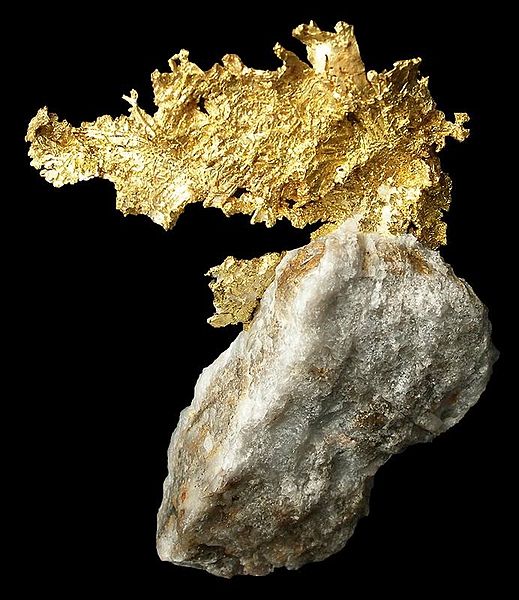
One type of gold is found in veins of hydrothermal deposits where the gold often occurs as the native metal in quartz veins.

The second type of gold is often found in his placer deposits in sand and gravel on the beds of streams or on beaches fronting on the ocean. Gold is often panned from this type of deposits by taking advantage of its great density in relation to other minerals. Gold is 19.3 times as dense as water and most of the minerals that occurs with our only three times as dense as water. Placer gold can be found in virtually any stream or river in the world in quantities large enough to see what it looks like.

Gold in quartz.
Photo by Rob Lavinsky

In a 1927 issue of the American Mineralogist by Lloyd Fisher and Charles G. Doll of Brown University in volume 12, pages 427 to 436 you can find a listing of the different minerals that are found in the state of Rhode Island.

This is what they said about the area around Durfee Hill, “Glocester (Durfee Hill) epidote, molybdenite, pyrite and phyrottite are present.


The third type of deposits are found in generally associated with pyrite and other metal sulfides where the gold actually appears as a thin film between the crystals of sulfide. 

Another area where gold was then reported in the past is around Johnstown where there are also some old mine workings were a dibase dike cuts across the granites and schists. This is another area that still has old cyanide vats and sluice boxes. When the local chemists reports that the locality has shown a trace of platinum group metals in the mine tailings.

Finally there has been Gold reported at the old South Foster gold mine locality where gold was produced mainly from pyriteferous quartz veins.  There are said to be still visible at this locality four open pits that are now filled with water along with the ruins of a large stamp mill.

One of the areas in Newport, Rhode Island, Purgatory Cliffs, has attracted the attention of the author because the cliffs are made out of a quartz pebble conglomerate with crystals of magnetite in the binding material between the pebbles. There is often an association between gold and magnetite. Another area is found in the black sands of the beaches in southern Rhode Island west of Narragansett Bay.

Although these last places are strictly speculative the geology is right for finding gold, and as far as that goes the entire set of rocks along the western side of Rhode Island where borders with Connecticut is another area that geologically is a good place to search for gold especially in placer deposits in the streambeds of the area.