Total Pageviews

Showing posts with label carlin trend. Show all posts

Friday, April 22, 2011

Gold Occurrences in Idaho

According to the latest news about gold mining in Idaho, Premium Exploration Inc. (CVE:PEM) have focused their efforts on emerging gold district in Idaho in an area known as the Idaho Gold Project this is a district sized property that is seen over 13,000 m of recent drilling. This area is found in the Orogrande shear zone is a significant regional structure and also the conduit for multiple zones of gold mineralization. In many respects it is similar to the gold deposits found in the Carlin trend of Nevada. At present the Idaho Gold Project is 100% owned by Premium. At the present time Premium is working on an updated resource estimate along with a comprehensive 25,000 m drilling program.


A Yankee Fork Stamp Mill used to process gold and silver ore at the Custer Mine in Idaho.
Photo by Tinosa


The so-called Idaho Gold Project is located in Central Idaho as an epithermal deposit in the Cretaceous Idaho batholith and Precambrian basement rock where it is the conduit for alteration and extensive mineralization. It is also gone through several intrusions of rhyolite, dacite and trachyte during the Eocene. 

There was a considerable amount of placer and lode gold in the area from the 1860s until the 1930s. During that time it produced over 8,000,000 ounces of gold, and had over 20 historic mines. It wasn't until the 1970s however before modern mining and exploration techniques occurred within the area.

In 1940 report was good to go on their Idaho, C.A. Bottlfsen that was titled, “Mining Activity on the North Fork of the Clearwater River Area.” This report generated a considerable amount of interest in the area of the Clearwater River as well as Clearwater and adjoining counties in Idaho. This area is drained by the gold bearing Clearwater River and its tributaries.


The Argo Gold Mine and Mill in Idaho Springs.


The gold prospecting in Idaho usually lasts from roughly April 1 to November 1, clever if there's an open winter the prospecting season can be extended. The availability of water to carry on prospecting activities often dwindles after mid-June unless the prospector carries water to the prospecting site.

It isn't for nothing that Idaho was called the Gem State because it is the producer of many gemstones as well as gold and silver. Up to this point most of the gold that has been produced in Idaho comes from the upper part of the panhandle where it is found that placer deposits containing many gold nuggets.  The town of Murray is one of the best places to prospect, and because nuggets are so common you should come with a metal detector.

There was a time of Murray on a hotel owner wanted to go prospecting, but decided it was too cold outside. His solution was to cut a hole in one of the bedroom floors where he then go down 30 feet to bedrock to get at The gold. Another mine in the area of Murray was named the Jackass Mine that was literally found by a miner’s donkey. This is the kind of mining lore you can expect to hear in Idaho.


Two of the areas where you’re most likely to find gold are at the forks of the Pend Oreille River However, the hottest spot in the state is Boise County that has produced over 3 million troy ounces of gold from the 300 square miles of gravel that is found in the county. It would be a good idea to check out all watercourses and gravel arroyos to the northeast of Boise and close to Idaho City.


It is interesting to find the area around Boise is in a geothermal area that supplies the city with a large quantity of geothermal heat. The same area is also a place where gold is being actively deposited in areas where the geothermal liquids dropped below 200°C. It is common to find nodules of silica when you are digging within the area that in many places appears to be waterlogged. There are also known to be diamond bearing kimberlites in the same area, so you have your choice between gold and diamonds.


Boise County is not the only place where you can find gold in Idaho. The following counties are also listed for placer gold mining: Ada, Adams, Bingham, Blaine, Bonneville, Camas, Clearwater, Custer, Elmore, Idaho, Kootenai, Letah, Lemhi, Nez Perce, Owyhee, Power, Shoshone and Valley. It would be a good idea to check the watercourses and gravel arroyos found in these counties.
Aside from the gold that is found along the Clearwater River and its tributaries this river also produces star garnets that produce a star effect when cut en cabochon. The only other place where garnets like this are found is some locality in India. Jasper is found here also with at least one of the mines open to the public is the jasper mine at Willow Creek.

Idaho produces large quantities of precious opal of both faceting and cabochon grade. that displays a considerable play of color. One largest opal mines in the United States is located in northeastern Idaho called the Spencer Opal mine it is largest in the state.

Information about these mineral deposits in Idaho is available from different state and federal agencies. Sometimes you can find local history books to discover what kind of minerals were mined in a particular town.

The type of mining that went on in Idaho makes the use of a metal detector practically a necessity. Different manufacturers actually produce metal detecting instruments that are capable of detecting gold. Many of the gold nuggets that have been found are actually the result of metal detectors. A particularly good area to investigate is old mine tailings from dredge operations like the one in Boise County. 

We recently became a dealer for the Garrett line of metal detectors and other gold mining equipment including gold pans and gold panning kits.  Please watch for future announcements about the Garrett line of products.

Monday, April 18, 2011

Detrital Gold Deposits

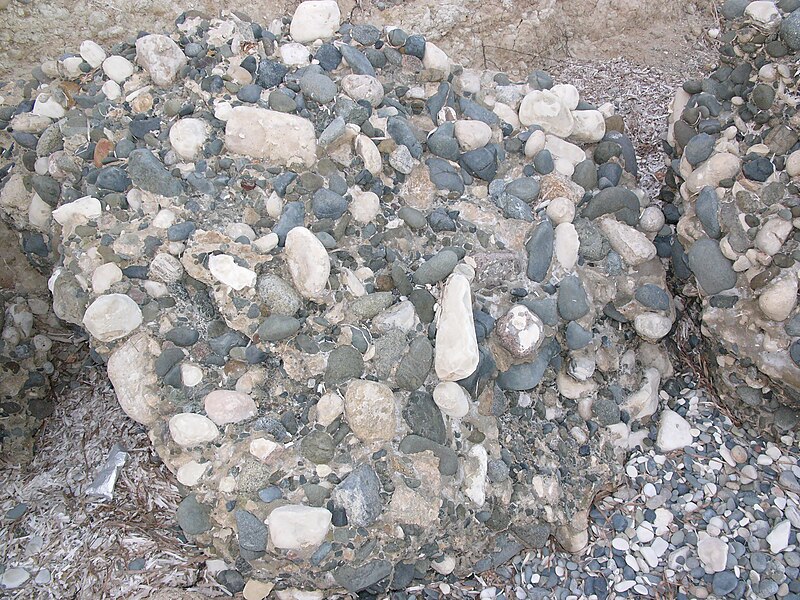
Maybe you have heard of the Witwatersrand in South Africa if you haven't yet is the world's largest deposits of gold that since its discovery in 1886 has produced over 40% of the total gold supply ever mined in the world. This makes it the most glaring example of a detrital gold deposit in the world. The type of rock hosting this vast deposit is conglomerate that until about a year ago the source of its gold was unknown. By working with an isotope of iridium a team of geologists was able to pinpoint the source of this gold In eroded highlands delayed to the north.

Conglomerate the gold in this rock is usually found in the cement holding the pebbles together.
Photo by Hannes Grobe

The Witwatersrand is not the only deposit of conglomerate in the world that contains gold. In the area around Timmins Ontario there are also mines that produce gold from ancient conglomerates of Archean age between 2.8 M2 .6 billion years old. It is not only gold that these ancient conglomerates are apt to contain a common Association in rocks of this type are uranium mineralization. This is been taken advantage of at Elliot Lake, Ontario where some of the largest uranium mines in the world are found. The same deposits also contain significant amounts of rare earth elements to the point that the mining company Pele Mountain Resources (TSX-V ~ GEM) headquartered in Toronto, Ontario. At their Eco Ridge Mine in Elliot Lake, Ontario they are actively searching for both uranium minerals and rare earth minerals. The conglomerate at the Eco Ridge Mine also contains some gold.

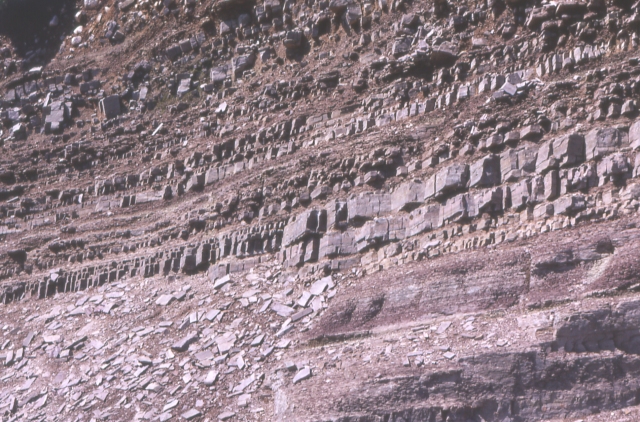
Sandstone in a red bed that has been cemented and stained by iron oxide.
Photo by Anne Burgess

Ancient conglomerates are not the only place where gold can be found in sedimentary rocks as detrital gold is also found in many types of sandstone as small grains, and can even be found in fine-grained shale as microscopic particles that are too small to be seen with the naked eye. This kind of gold was never recovered until recently when Newmont Mining developed the gold deposits of the Carlin Trend in northern Nevada.

A closeup of the Marcellus Shale found in the eastern United States.  Aside from holding a vast amount of natural gas the Marcellus Shale sometimes contains gold in very fine specs that are invisible to the naked eye.
Photo by Lvklock

Most of those miners that are working with placer gold deposits in the rivers and streams of the world or along the beaches are also dealing with a type of detrital gold deposit in the form of specs of gold to have been eroded from hard rock and have been swept down river by the action of running water to where we can find them in the gravel deposits of the stream bed.

Conglomerate is nothing other than stream gravel that has become fossilized over time; just about any time you find conglomerate when you are prospecting it is a good idea to have a very careful look at the deposit. This also applies to sandstone and shale since they are also sedimentary rocks that have been produced by the action of running water.

Sunday, July 18, 2010

The Carlin Trend in Nevada has invisible gold

One of the premier gold producing areas in the United States is the Carlin Trend of northern Nevada. This small area covering 6 by 35 kilometers produces more gold then any other area in the US. The gold here is found associated with pyrite crystals in sizes ranging from single ions to masses containing only a few atoms of gold. This kind of gold is invisible to the naked eye and is not detectable to an ordinary microscope but becomes visible under an electron microscope.

This was country that was heavily prospected during the nineteenth century by typical prospectors with a gold pan and donkey. Although some small amount of placer gold was found these prospectors had no idea of what they were walking over since they couldn’t see much gold there. The Carlin type gold deposit is a recent phenomenon that was discovered during the 1960s by Newmont Mining although gold deposits like this were just becoming to be known during the late 1920s.

Gold in this kind of deposit is found in limestone deposits disseminated throughout the whole deposit. The gold itself is actually found as single ions or small aggregates of gold atoms that can be seen only by the use of an electron microscope. When this type of deposit is mined it involves tearing down whole mountains. It is in a mine like this that are the home of giant machines like trucks capable of holding 350 tons of ore at once and shovels that can fill one of these trucks with three shovels full.

Getting the ore out of the mine is only the beginning of a long and arduous job because the next step in the process of producing gold is crushing all the ore into pieces that do not exceed one-quarter inch in size that is then trucked to an asphalt pad covering several acres that slopes in to the center to a drain that removes any gold charged liquid. This is called the heap leaching process.

The heap leaching process works on a simple principle that gold is dissolved in a solution of alkaline cyanide. It is this solution that drains into the center of the asphalt pad for recycling onto the heap of stone once again. The cyanide solution is sprinkled onto the top of the heap using sprinklers similar to lawn sprinklers. This solution makes several circuits through the heap dissolving a small amount of gold during each circuit.

After several months the cyanide solution is finally drawn off when it is charged with dissolved gold. The gold is usually recovered from the solution by being precipitated using powdered zinc. The precipitate falls out of solution collecting on the bottom of the vat as a black powder where it is removed for further processing. The cost of recovering gold using the heap leaching process is about $320 per ounce.

References:

Carlin type gold deposits, Steve Castor, Nevada ureau of mines and geology, http://www.smedg.org.au/oct01.html

Heap Leaching, Wikipedia, http://en.wikipedia.org/wiki/Heap_leaching