Total Pageviews

Showing posts with label conglomerate. Show all posts

Saturday, May 5, 2012

How to find hard rock gold


Gold in Quartz
Photo by Rob Lavinsky


Unlike placer gold hard rock or lode gold is much more expensive to locate, but under the right conditions isn’t impossible.  Most lode deposits are found by following placer gold deposits in a stream until the deposit suddenly chokes off then following float up hill until you finally find the Mother Lode.  Most lode deposits are always shedding float that goes downhill in an ever widening fan of the host rock.

Although gold can be found in virtually any rock type its usual home is in white, milky quartz that is readily distinguished from the host rock as termed in the mining industry “gangue.”  The white rock stands out so often pieces of it can be observed washing down mountainsides from its source with the naked eye or by using binoculars.

Although most hard rock gold is found in quartz veins that are usually readily visible, and the thinner the vein often the more gold it contains.  Another prime target for hard rock gold is the rock conglomerate where the biggest of all gold deposits are found in the Witwatersrand in South Africa.  These deposits have produced around 40% of all the gold that has ever been mined.  Deposits of this type also contain uranium and rare earth elements in payable amounts making it entirely possible to find deposits of this nature with a Geiger counter.  The gold/uranium deposits at Elliot Lake, Ontario are of this nature.
Quartz pebble conglomerate a likely place to find gold
Photo by Wiki-Schack


In many parts of the world it is extremely hard to see float because the area is covered with deep overburden so it is necessary to use other methods of finding hard rock gold; one of the most popular is using aeromagnetic maps or other geophysical methods like ground resistivity.  Aeromagnetic maps work on the principle that gold often occurs associated with the mineral magnetite or other iron bearing minerals like ilmenite causing the prospector to carefully examine the area around magnetic highs on an aeromagnetic map.

An analog multimeter that can be used for several different parameters in geophysical prospecting
Photo by KENPAI


Ground resistivity is one of many different geophysical techniques use to find ore deposits based upon the amount of underground corrosion that takes place in an orebody.  This is done using a multimeter that has high impedance and a strand of wire.  For convenience most of these rigs have 1,000 feet of wire mounted on a reel.  In use an area 1,000’ x 1,000’ is measured out on the land.  Parallel lines are drawn on its surface with readings taken from 100 feet apart to 10 feet apart along the lines.  The highest readings are connected with a line, and each successive lower reading until a map that resembles a topographic map is generated.

Any number of different parameters can be measured using this method, but the best explanation of their use is explained in a book about practical geophysics.  Parasinis authored a book on the subject that is still available today in the 1960s.

Monday, April 18, 2011

Detrital Gold Deposits

Maybe you have heard of the Witwatersrand in South Africa if you haven't yet is the world's largest deposits of gold that since its discovery in 1886 has produced over 40% of the total gold supply ever mined in the world. This makes it the most glaring example of a detrital gold deposit in the world. The type of rock hosting this vast deposit is conglomerate that until about a year ago the source of its gold was unknown. By working with an isotope of iridium a team of geologists was able to pinpoint the source of this gold In eroded highlands delayed to the north.

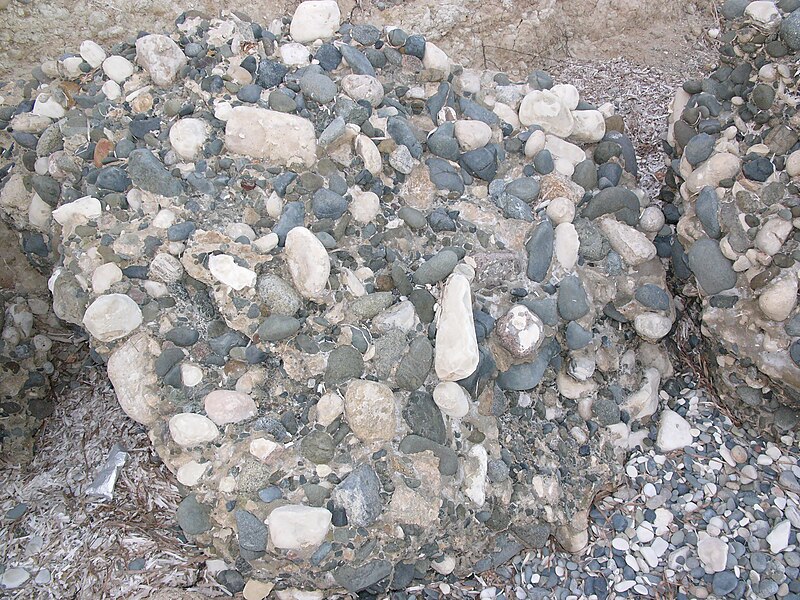
Conglomerate the gold in this rock is usually found in the cement holding the pebbles together.
Photo by Hannes Grobe

The Witwatersrand is not the only deposit of conglomerate in the world that contains gold. In the area around Timmins Ontario there are also mines that produce gold from ancient conglomerates of Archean age between 2.8 M2 .6 billion years old. It is not only gold that these ancient conglomerates are apt to contain a common Association in rocks of this type are uranium mineralization. This is been taken advantage of at Elliot Lake, Ontario where some of the largest uranium mines in the world are found. The same deposits also contain significant amounts of rare earth elements to the point that the mining company Pele Mountain Resources (TSX-V ~ GEM) headquartered in Toronto, Ontario. At their Eco Ridge Mine in Elliot Lake, Ontario they are actively searching for both uranium minerals and rare earth minerals. The conglomerate at the Eco Ridge Mine also contains some gold.

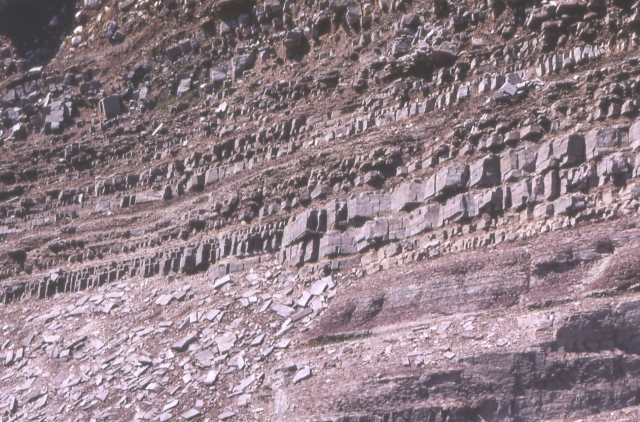
Sandstone in a red bed that has been cemented and stained by iron oxide.
Photo by Anne Burgess

Ancient conglomerates are not the only place where gold can be found in sedimentary rocks as detrital gold is also found in many types of sandstone as small grains, and can even be found in fine-grained shale as microscopic particles that are too small to be seen with the naked eye. This kind of gold was never recovered until recently when Newmont Mining developed the gold deposits of the Carlin Trend in northern Nevada.

A closeup of the Marcellus Shale found in the eastern United States.  Aside from holding a vast amount of natural gas the Marcellus Shale sometimes contains gold in very fine specs that are invisible to the naked eye.
Photo by Lvklock

Most of those miners that are working with placer gold deposits in the rivers and streams of the world or along the beaches are also dealing with a type of detrital gold deposit in the form of specs of gold to have been eroded from hard rock and have been swept down river by the action of running water to where we can find them in the gravel deposits of the stream bed.

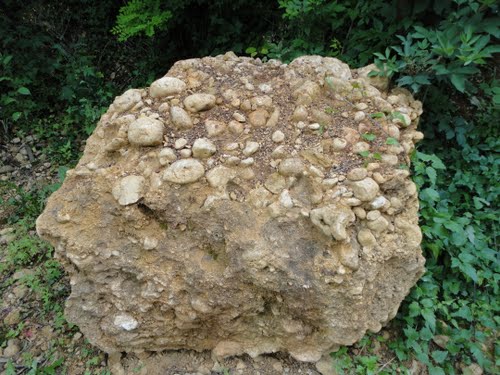
Conglomerate is nothing other than stream gravel that has become fossilized over time; just about any time you find conglomerate when you are prospecting it is a good idea to have a very careful look at the deposit. This also applies to sandstone and shale since they are also sedimentary rocks that have been produced by the action of running water.

Saturday, April 16, 2011

Gold Occurrences in North Dakota

Detrital gold has been found in two different occurrences within the state of North Dakota. One of these occurrences is in northern Manitoba over 500 miles north of North Dakota that was brought in by the glacier that receipt of about 12,000 years ago. This formed placer deposits that are scattered across the state. The other gold that is found in North Dakota had an entirely different origin coming from conglomerate that was washed down from the Black Hills of South Dakota. It was subsequently eroded, and brought to the surface by the action of the Sheyenne River where it is now found as cemented gravel. Although the deposits of this sort are most common in the bed of the Sheyenne River it is also found as a cap rock on many of the buttes and ridges found throughout the state.

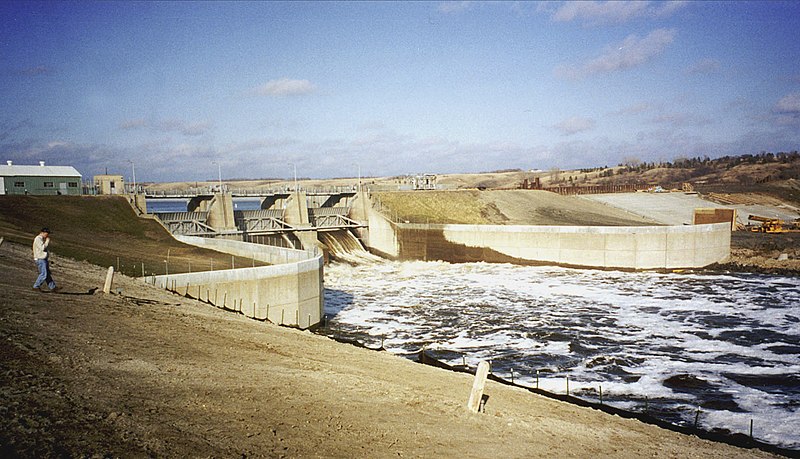
Baldwin Dam on the Sheyenne River in North Dakota.  This river contains detrital gold that is weathered from conglomerates that were washed down from the Black Hills of South Dakota

Conglomerate and other sedimentary rocks are not especially rare places in which detrital gold is found. This is gold that has weathered out of older crystalline rocks and carried away by the action of running water to be deposited as placer gold in stream gravel that later become cemented in place for me in a fossilized placer deposit. The largest gold deposit on earth, the Witwatersrand of South Africa, is gold in a conglomerate matrix. It is been recently discovered that the source for the gold in this deposit came from outwash in braided stream channels from an ancient mountain range. The geologists who pinpointed the origin of this gold used the half-life of an isotope of iridium that was found with the gold. This also explains why the gold was found in stringers throughout the deposit.

It is common to find uranium associated with this type of deposit as well as rare earth elements (REE). It is older of this type that is mind that Elliot Lake, Ontario for its uranium content. This is one of the largest uranium deposits in North America.

The first gold rush in North Dakota was in an area called glacial Lake Souris. This discovery of gold was made about 6 miles north of Fort Ransom in Ransom County. They are still finding small amounts of placer gold there today. It's like the old saying goes, gold is where you find it.

Tuesday, March 1, 2011

Gold in Quartz Pebble Conglomerates

Over 40% of the gold in the world is produced in the Witwatersrand of South Africa that is an ancient bed of conglomerate. It is only been in the past year that the source of the school's been discovered proving it to be a fossilized placer deposit formed when the gold a eroded from even older mountains where it was deposited in an ancient sedimentary basin. Today is the Witwatersrand is the home to some of the deepest mines in the world that either approach or exceed 13,000 feet in depth. Ancient conglomerate deposits are not limited to South Africa as some of the deposits in the area around Timmins, Ontario are hosted in conglomerate too.

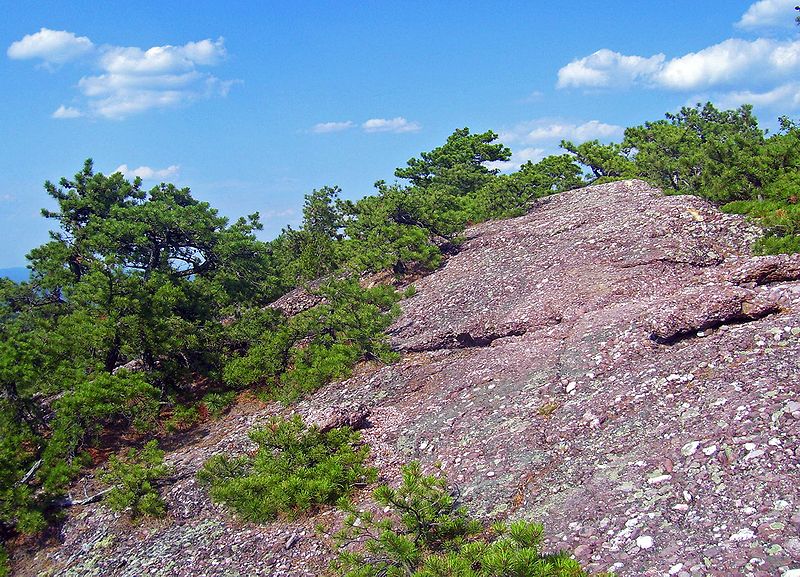
Conglomerate rock in as natural setting.
Photo by Daniel Case

Although gold was discovered in just about any type of rock that is found on Earth prospecting in quartz conglomerates is a pretty good bet. In the eastern United States quartz pebble conglomerates are commonly found in the Queenstown Delta as exemplified by the Schwangunk Ridge of New York and New Jersey. There have been reports of sparse gold deposits associated with this ridge in both states.

There are two different ways that gold can be deposited in conglomerate. One of the ways is by direct precipitation from hydrothermal waters where it forms a primary deposit. The second way gold can be deposited in a conglomerate is as a fossilized placer deposit where the gold has eroded from ancient mountains.

Closeup of conglomerate that sometimes is called "Puddingstone."
Photo ny Roy Parkhouse

Although gold is not found in every conglomerate it is a good idea to check them all for the presence of gold especially if the quartz pebbles show any sign of staining either yellow or green. This is a sure sign that metal bearing hydrothermal waters have penetrated the conglomerate. There are several other interesting minerals found in conglomerate like uranium, thorium and rare earth metals. Conglomerates can also be the host of other metals such as iron, copper, lead and zinc.