Total Pageviews

Friday, April 22, 2011

Meguma Gold of Nova Scotia, Canada

Meguma gold is why I live in the United States instead of Nova Scotia because during the Goldrush that occurred in Nova Scotia in the 1860s my great grandfather as a young man was prospecting for gold in a place where he shouldn’t been prospecting on the Queensland.  The Queensmen took a dim view of these proceedings, and old stories handed down in my family were to the effect that the Queensmen wanted to invite him to a “necktie party” he was to be the guest of honor. Needless to say he left Nova Scotia quite hastily for New York where he worked as a miner at the Tilly Foster iron mine.

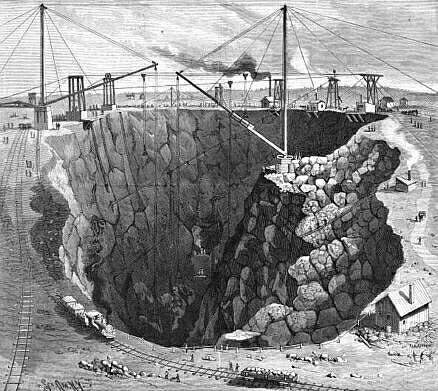
The Tilly Foster Iron Mine in Brewster, NY as it appeared in the 1880s.  This is the mine my great grandfather worked in when he arrived in the US from Canada.


The Meguma terrane is one of the suspect terrenes that is exposed in the southern part of Nova Scotia when it became attached to the North American craton during the Appalachian orogeny where it is joined in Nova Scotia along the Minas Fault Zone that runs east and west across Nova Scotia from Chedabucto Bay to Cobiquid Bay and the Minas Basin. Throughout the area there are a number of granite intrusions that range in age from Devonian to Carboniferous. Although the extent of the Maguma is not clear there are many geologists who believe that a magnetic anomaly that runs along the coast of Cape Cod in Massachusetts may represent a suture zone between the Maguma and Avalon terrenes.

Unlike the Avalon terrane since been definitely associated with land across the Atlantic Ocean the Maguma terrane the Maguma terrane remains a mystery that has not been associated with any land on the other side of the Atlantic Ocean. Even today there are many competing theories as to their origins that are prevalent among geologists. Many of these theories seem to feel that it was separated from Gondwana although there are plenty of other competing theories that it may have been a part of Portugal and Spain.

This is the Ccharbon Mine at Glace Bay NS where my great grandfather worked as a mine rigger before he came to the States.  The product being mined was bituminous coal.  


This area appears to be of interest geologically not only to students of geological history, but because the attendant metamorphism has produced gold deposits that were mined extensively during the latter part of the 19th century, and which remain even today as a source of potentially viable gold deposits.

One geologist that is a friend of mine had for his first assignment in the field as a geologist after graduating from college had to make an assessment on one of these old gold mines. It appeared that the Nova Scotia highway departmental head used the tailings from the mine to pave the roads in the area. His final report to the Mining Company stated that, “The roads in Nova Scotia are paved with gold.”

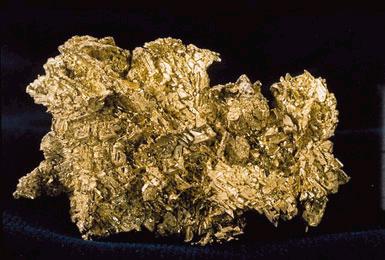
Gold crystals found on quartz.
Photo by Rob Lavinsky


Gold founded the Maguma terrane according to geologists that have made it a study represent concentrations of a wide variety of gold bearing quartz veins that are found in lower Paleozoic metaturbidites that are found in Southern Nova Scotia where there have been over 30 deposits of this type. Extensive studies of the fluid inclusions found in the quartz indicate that the mineralization occurred at about 370 million years ago that was related to widespread incursion of both mafic and felsic magnetism into the crust at the same time when a sub vertical shear zone was developing. This was during a time that post dated the Acadian Orogeny making them at least partially exotic to the Maguma group. Much of the mineralization in the group is considered to be either late stage magmatic fluids, then infiltrated the Maguma groups that are sedimentary rocks as the sole source of vein components that invalidated earlier sources of hydrothermal fluids.


Thursday, April 21, 2011

Gold Occurrences in Montana

Most of the Gold in Montana is found in the western half of the state where it was discovered in 1852 on Gold Creek in Powell County. Very rich deposits were found in 1863 in Creek near Virginia City created a gold rush. Since that discovery Montana has produced over 17,752,000 ounces of gold that is ranked as the seventh largest gold producing state in the United States. Most of the gold produced in Montana is a byproduct of the copper industry. Some of the best places to prospect for placer gold in Montana are located in Broadwater County on the eastern slopes of the Elkhorn Mountains in the rivers and streams that flow toward the east.

Elkhorn Mountain in Montana. Placer gold is found in the rivers draining the eastern slopes of the Elkhorn Mountains.
Photo by Fraser Harris

There is a great deal of information about mining for gold in Montana from the Bureau of Mines and Geology located at Montana Tech in Butte, Montana. The state is one of the signatories to the Mining act of 1872 that recognizes the right to file a claim on public lands belonging to either the state or federal government.

Western Montana is divided into two sections the Northwest and the Southwest in the northwest part of the state gold is found mainly in recent glacial moraines. During the early days when gold was selling for $20 per ounce of gold deposits found here were not considered to be economic although it was always possible to find gold. With today's prices the gold in these glacial moraines may become economically viable at $1500 per ounce.

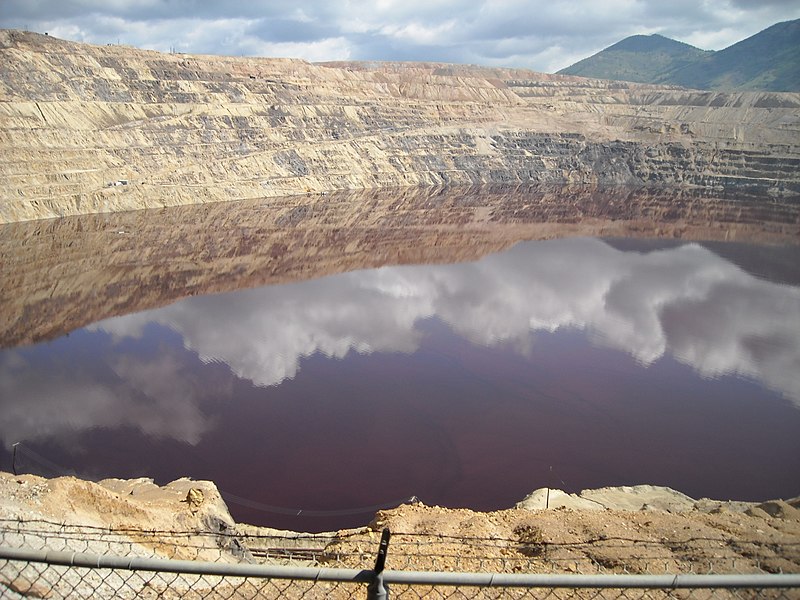
The Berkley Pit in Butte Montana an abandoned copper mine where gold was produced as a byproduct.
Photo by Cybergrl

Most of the gold in this thing however is found in the southwestern part of the state where many of the rocks are of Archean age is similar to those in the Abitibi region of Canada were mostly gold was laid down between 2.8 and 2.6 billion years ago.

Some of the greatest mines in the United States are located in western Montana there were copper mines many of them produced gold as a byproduct from refining copper. The greatest of these copper mines was the Anaconda Mine located near the city of Anaconda. This mine was discovered right after the Civil War by an Irish prospector that was looking for gold, and found copper instead.
The Anaconda mine was actually named because of a newspaper headline the Irishman saw while he was serving in the Union Army near the end of the Civil War. The headline read, “Grant encircles Richmond like a giant Anaconda.” Both the mine and the city were named after this giant snake found in the Amazon basin.

Gold is found throughout Western Montana wherever there are mountains. The best place to look for placer gold is in the rivers and streams draining those mountains. According to one source is doubtful that the old time prospectors ever found all the gold that is deposited there. There are now many prospecting tools that were unavailable to the early prospectors, one of the most useful of these is the metal detector.

The metal detector that is capable of detecting gold in hard rock or placer deposits. The best tool for finding gold is one that the old time prospectors were very familiar with it is the gold pan. To this day no one has ever devised a better the way of discovering gold deposits.

Aside from gold prospecting Montana also affords the prospector the chance to find sapphires along the Missouri River. There are many areas along this river that are open to fee prospecting. In addition there are several other localities in the state where you can find various gemstones for a fee.

Wednesday, April 20, 2011

Gold Goes above $1500 per Ounce

From Moneymax.com


Gold Rises Above $1,500 to Record on Weaker Dollar, Inflation Fears

Wednesday, 20 Apr 2011 10:45 AM


Read more: Gold Rises Above $1,500 to Record on Weaker Dollar, Inflation Fears 

Gold Occurrences in South Dakota

Before it closed in 2002 the Homestake Mine in Lead, South Dakota was the deepest gold mine in North America. It had operated almost continuously since 1874 where the gold was found in association with cummingtonite schist. The depressed price of gold at the time the mine was closed in 2002. The mine has been since converted by the National Science Foundation into an underground laboratory devoted to the search for neutrinos and other subatomic particles from space.

Until the recent discoveries of large gold deposits in the Carolinas and Georgia South Dakota had the distinction of being the eastern most state that was a large producer of gold. It also has the distinction of having a war between the Indians and Whites over the gold deposits in the Black Hills, an area that was considered sacred by the Sioux. This led to the Battle of Little Bighorn in eastern Montana where the 7th Cavalry under George Armstrong Custer was virtually wiped out by the Sioux warriors.

Airforce One flying over Mt. Rushmore in the Black Hills of South Dakota

Within a year of the Battle of Little Bighorn the Black Hills were swarmed with thousands of gold seekers. Although gold was known to occur in the Black Hills it was not a safe place for white men to venture because it was considered as sacred ground by the Sioux. The gold discoveries came fast and furious until he finally culminated in the discovery of the Homestake mine in 1876.

During the early days of the gold rush in the Black Hills mostly action was centered around Deadwood where the famous Western gunfighter Wild Bill Hickok was gunned down while playing poker holding the dead men hand of aces and eights.  It wasn't too long before gold was discovered on the other side of the mountain in Lead that was developed into the Homestake mine. The mine is now owned by Barringer Gold and they have not decided to reopen gold-mining here, but there were plenty of other gold mines in the Black Hills that over the years also produced gold.

Crystalline Gold from South Dakota

There are still plenty of opportunities for small-scale miners in the Black Hills, but you have to keep in mind that the early prospectors were pretty thorough in their search for gold. What they lacked were some of the modern devices for finding gold that we now have. These new devices make it possible to find gold that the old-time prospectors missed. Placer gold can be found in many of the rivers and streams of the Black Hills as well as rivers that lead out of the Black Hills.

Another place where metal detector comes in handy is prospecting in rivers and creeks. Every year more gold is eroded from the banks of creeks that finds its way into the water courses. This does not mean that you shouldn’t overlook the use of more conventional tools like gold panning kits and dredges for mining placer gold.
The other gold that is present here is what is termed lode gold that is found throughout the bedrock of the central Black Hills. This is an area of pre-Cambrian rock that was thrust up through the sedimentary rocks that surround it by earth actions in four different geologic episodes in the past.
Erosion from the rocks of the Black Hills has reached as far east as Minnesota in the form of a conglomerate. Gold is often associated with conglomerates as fossilized placer deposits. The conglomerates east of the Black Hills may prove to be another area containing gold. The largest gold mining district in the world is the Witwatersrand in South Africa that has produced more gold than all the other mining districts in the world combined is also hosted by an ancient deposit of conglomerate.

Tuesday, April 19, 2011

Gold Nugget forming Bacteria

During the late 1970s and new theory was put forward about the formation of gold nuggets with this theory stated that they were formed by a pair of bacterium; one of these was named Cupriavidus metallidurans and the other was named Delftia acidovorans either of which was capable of fixing gold from a solution of gold tetrachloride that is a compound that is highly toxic to ordinary bacteria.

Bacteria under an electron microscope NASA

Cupriavidus metallidurans and a similar bacterium Delftia acidovorans have the ability of precipitating gold from a solution of this chemical.  The gold often aggregates as a nugget that is made from their waste products. No wonder the Aztecs used to call gold the excrement of the gods.

It is a well-known fact that there are some bacterium that get their endorsement from metals the most common is the iron fixing bacteria that produce bog iron ore or form a thin film on the surface of swampy areas that looks like an oil slick, but when you touch the film it breaks up into a rectangle shaped fragments. There are some metal fixing bacterium that are being used today for remediating contaminated industrial Sites. There are specific bacterium for all the heavy metals including one for copper that is now being used to produce about 25% of the copper being mined in the world using the heap leach process.

The large Mojave nugget weighing 156 ounces that may have been formed by bacterial action.
Photo by Chris Ralph 

There is an Australian geologist claims he is found some convincing evidence of gold fixing bacteria colonies that are in better then gold nuggets. He is further convinced that he is seeing these bacteria structures under an electron microscope that were not the result of anything he did.

A geologist with the United States Geological Survey first postulated this idea in the 1970s, but he later claimed that many of the structures he saw were from his washing the gold samples with an acid solution before he observed them under an electron microscope.

It hasn't reached the proportions of a cottage industry yet although for many years it was felt that gold feeding bacteria in rivers and streams that fixed the gold ions in the water creating gold nuggets. To our knowledge there have been no enterprising souls that are they lately to start doing this yet although if it is true there are probably more than one that is at least thinking.


Monday, April 18, 2011

Nancy Twinkie sees Green and finds Platinum

After a few prospecting and rock hounding trips it was apparent that Nancy Twinkie was going to become a seasoned prospector and it wasn't just for gold. On the road from Chester Massachusetts to Middlefield you drive by a long stretch of serpentinite along the road where the builders had blasted the road out of the side of a mountain. The serpentine that came off that mountain during the 19th century was used as ship’s ballast by an enterprising ship captain that originally came from Chester.

This is a piece of uncut jade that resembles the serpentine found in Chester, Massachusetts.

In a previous voyage he had taken some of the serpentine to China, and the Chinese jade carvers fell in love with the stuff because it looked just like jade and was easier to car because it was softer. For it while there was a brisk trade in the serpentine, and several shiploads found their way to China where it was carved then exported back to the United States and the rest of the Western world as Soochow jade.

Just about in the center of this exposure of serpentine a small stream came down off the mountain, and although at different times I had stopped alongside this road cut to pick up some samples of serpentine myself, and quickly discovered that it was fine cutting material for making cabochons that were greenish incolor and displayed some interesting patterns.

A platinum nugget of the same color of what we found in our gold pans.
Photo by Rob Lavinsky

On one of our rock hounding trips into the Berkshires Nancy Twinkie and me stopped at this small stream to see if it contained any gold. Because serpentine is derived from metamorphosed oceanic crust that in some places is called greenstone there was a pretty good probability that we may find some gold. We didn't, but what we did find were some very small flakes of silvery metal that although we never tested these flakes to see what they really were there is a good possibility that they were platinum. Serpentine is what they call an ultra-mafic rock in which platinum is known to occur; so there is a good possibility that was what we found that day.

Gold associated with belts and greenstone in many places in the world where they produce gold; one of these so called greenstone belts is the Abitibi gold belt in Québec and Ontario is one of the great gold producing areas on earth. You might say that Nancy Twinkie saw the greenstone, serpentine, and probably found platinum.

Detrital Gold Deposits

Maybe you have heard of the Witwatersrand in South Africa if you haven't yet is the world's largest deposits of gold that since its discovery in 1886 has produced over 40% of the total gold supply ever mined in the world. This makes it the most glaring example of a detrital gold deposit in the world. The type of rock hosting this vast deposit is conglomerate that until about a year ago the source of its gold was unknown. By working with an isotope of iridium a team of geologists was able to pinpoint the source of this gold In eroded highlands delayed to the north.

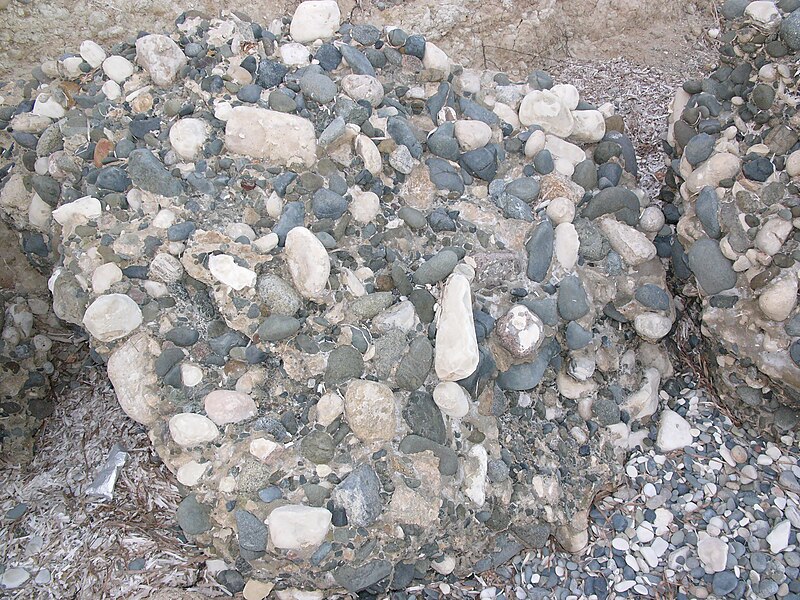
Conglomerate the gold in this rock is usually found in the cement holding the pebbles together.
Photo by Hannes Grobe

The Witwatersrand is not the only deposit of conglomerate in the world that contains gold. In the area around Timmins Ontario there are also mines that produce gold from ancient conglomerates of Archean age between 2.8 M2 .6 billion years old. It is not only gold that these ancient conglomerates are apt to contain a common Association in rocks of this type are uranium mineralization. This is been taken advantage of at Elliot Lake, Ontario where some of the largest uranium mines in the world are found. The same deposits also contain significant amounts of rare earth elements to the point that the mining company Pele Mountain Resources (TSX-V ~ GEM) headquartered in Toronto, Ontario. At their Eco Ridge Mine in Elliot Lake, Ontario they are actively searching for both uranium minerals and rare earth minerals. The conglomerate at the Eco Ridge Mine also contains some gold.

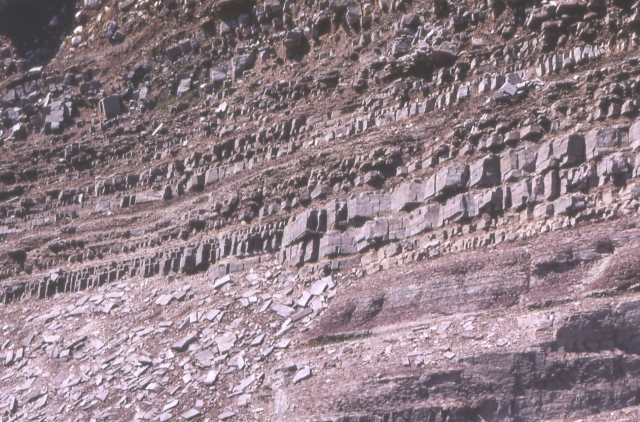
Sandstone in a red bed that has been cemented and stained by iron oxide.
Photo by Anne Burgess

Ancient conglomerates are not the only place where gold can be found in sedimentary rocks as detrital gold is also found in many types of sandstone as small grains, and can even be found in fine-grained shale as microscopic particles that are too small to be seen with the naked eye. This kind of gold was never recovered until recently when Newmont Mining developed the gold deposits of the Carlin Trend in northern Nevada.

A closeup of the Marcellus Shale found in the eastern United States.  Aside from holding a vast amount of natural gas the Marcellus Shale sometimes contains gold in very fine specs that are invisible to the naked eye.
Photo by Lvklock

Most of those miners that are working with placer gold deposits in the rivers and streams of the world or along the beaches are also dealing with a type of detrital gold deposit in the form of specs of gold to have been eroded from hard rock and have been swept down river by the action of running water to where we can find them in the gravel deposits of the stream bed.

Conglomerate is nothing other than stream gravel that has become fossilized over time; just about any time you find conglomerate when you are prospecting it is a good idea to have a very careful look at the deposit. This also applies to sandstone and shale since they are also sedimentary rocks that have been produced by the action of running water.