Total Pageviews

Showing posts with label heap leaching. Show all posts

Saturday, November 26, 2011

Gold Occurrences in Honduras

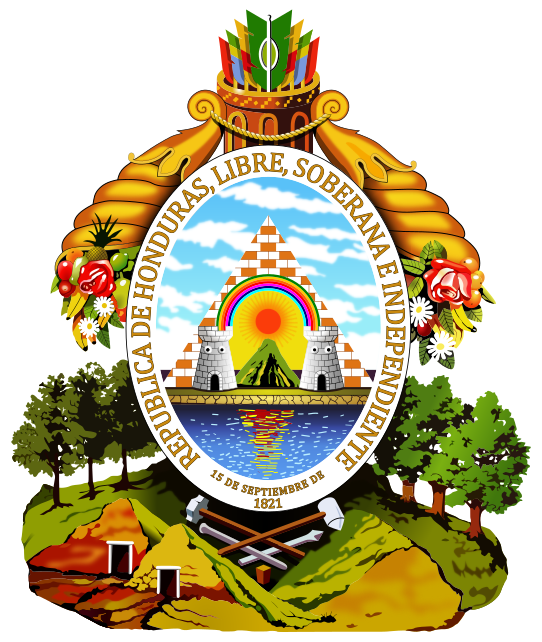
Coat of Arms for Honduras. Note the crossed hammers and chisels along with the mine entrances in the lower left corner.


Honduras is the largest and most rugged country in Central America. It was little explored until the 1960s because of the dense jungle, steep slopes and deep ravines.  Lack of roads was another contributing factor to the lack of exploration. Volcanic activity is another.  Volcanism is a rather recent occurrence in Honduras like the other countries of Central America having started as recently as 11 million years ago and still continues today.  It is this volcanic activity that carried gold and other polymetallic ore deposits in its wake.

As part of the volcanic arc of Central America, Honduras contains many volcanoes both active and extinct; it is this volcanic activity that brought with it the deposits of gold and other minerals that are found here today.  The area including Honduras has undergone a considerable amount of activity associated with subduction zones that were building volcanic arcs Honduras was part of one of several island arcs originally.  The country was finally accreted to southern Mexico, but there was still a gap between North and South America.  This gap was only closed within the past five million years when Panama was formed allowing a land bridge between the Americas.

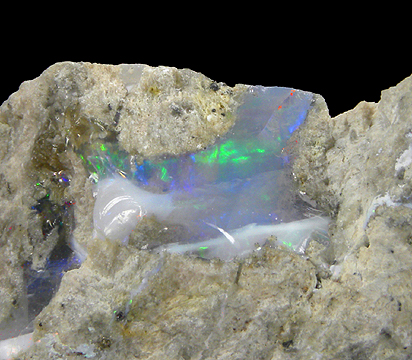
Gold isn't the only thing found in Honduras this precious opal came from the Gracis O Dios mine there.
Photo by Rob Lavinsky


Although the situation has improved Honduras to this day is largely unexplored presenting plenty of opportunities for exploration for gold that is present on both placer and lode deposits. There are several gold mines in Honduras where mining is mainly carried out by foreign interests that principally use the heap leaching process with cyanide.  The nature of the mines also lowers the water table.  Cyanide can be neutralized with a solution of laundry bleach or Clorox. 

In some cases whole villages were relocated to new sites that although they provided housing for the inhabitants they failed to provide plots of land where crops could be raised or animals pastured. The findings of an investigatory group were published in the paper, “The Price of Gold: Gold Mining and Human Rights Violations in Honduras.”  The result was made by presenting the Honduran Government with the needs of improving the regulatory needs as pertained to gold mining.

Due to its mainly volcanic origin there is plenty of gold in Honduras waiting to be discovered because although exploration conditions improved during the 1960s there is still plenty of territory that hasn’t been explored yet.  Gold is still there for the taking!


Tuesday, April 19, 2011

Gold Nugget forming Bacteria

During the late 1970s and new theory was put forward about the formation of gold nuggets with this theory stated that they were formed by a pair of bacterium; one of these was named Cupriavidus metallidurans and the other was named Delftia acidovorans either of which was capable of fixing gold from a solution of gold tetrachloride that is a compound that is highly toxic to ordinary bacteria.

Bacteria under an electron microscope NASA

Cupriavidus metallidurans and a similar bacterium Delftia acidovorans have the ability of precipitating gold from a solution of this chemical.  The gold often aggregates as a nugget that is made from their waste products. No wonder the Aztecs used to call gold the excrement of the gods.

It is a well-known fact that there are some bacterium that get their endorsement from metals the most common is the iron fixing bacteria that produce bog iron ore or form a thin film on the surface of swampy areas that looks like an oil slick, but when you touch the film it breaks up into a rectangle shaped fragments. There are some metal fixing bacterium that are being used today for remediating contaminated industrial Sites. There are specific bacterium for all the heavy metals including one for copper that is now being used to produce about 25% of the copper being mined in the world using the heap leach process.

The large Mojave nugget weighing 156 ounces that may have been formed by bacterial action.
Photo by Chris Ralph 

There is an Australian geologist claims he is found some convincing evidence of gold fixing bacteria colonies that are in better then gold nuggets. He is further convinced that he is seeing these bacteria structures under an electron microscope that were not the result of anything he did.

A geologist with the United States Geological Survey first postulated this idea in the 1970s, but he later claimed that many of the structures he saw were from his washing the gold samples with an acid solution before he observed them under an electron microscope.

It hasn't reached the proportions of a cottage industry yet although for many years it was felt that gold feeding bacteria in rivers and streams that fixed the gold ions in the water creating gold nuggets. To our knowledge there have been no enterprising souls that are they lately to start doing this yet although if it is true there are probably more than one that is at least thinking.