Total Pageviews

Showing posts with label cyanide. Show all posts

Tuesday, June 12, 2012

Outlaw Gold


Illegal Gold Mining in Africa


Outlaw Gold is not something left over from the days of the Wild West it is an illegal method of mining gold that goes on today. It is especially prevalent in the countries of South America also this practice can be found all over the world. It is often used in financing rebellions and terrorism on a global scale.  It's not only goal these illegal miners are seeking they also hunt out diamonds and other precious commodities including trees and raising illegal cattle.

It isn’t the uncontrolled damage they do to the earth itself, but it is also the collateral damage by destroying the rain forest and polluting the earth with the chemicals they use for recovering gold.  These highly dangerous chemicals include cyanide and mercury that are released into the environment.  These chemicals are used commonly by outlaw miners, than released then they are released as contaminants.

One of the areas being badly affected is the Amazon rainforest in Brazil, Columbia, Ecuador, Guyana, Peru and Venezuela where large areas are being laid waste.  With large areas are being mined by outlaw gold miners being driven by the ever increasing price of gold as investors try to find shelters in commodities rather then the stock market.  Gold futures have recently traded for over US$1,600 for delivery in December.  Gold recently reached a record high on September 22, 2011 of US$1,923.70 per troy ounce. (31.1 grams/ounce).  Many gold experts expect gold to rise to US$2,000 per ounce by years end.

Outlaw gold mining has increased in the rain forests of the Amazon Basin and other parts of the world that have mineral riches to the extent that in many places in the world the situation has gotten out of control.  In some of the areas affected the increase of illegal mining activity has rose six fold in recent years.  Brazil it the exception to the rule since they have better law enforcement policies.  It is still a problem for Brazil, however with no easy solution.  Most of the damage is caused by drilling and blasting causing deforestation and the use of mercury by the miners that pollutes both the air and water of the affected area. 

The large mining companies are not to blame for this situation, rather it is the outlaw companies that do not apply modern mining methods and in many cases are quite primitive.  As a consultant to a mining operation in South America I am only too well aware that in just the practice of blasting many of these operators are working like it was still the 19th century where a blast is initiated with a cigar and length of fuse.  There are far better methods for this then a stogie.

Tuesday, February 14, 2012

Recovering Gold with Cyanide


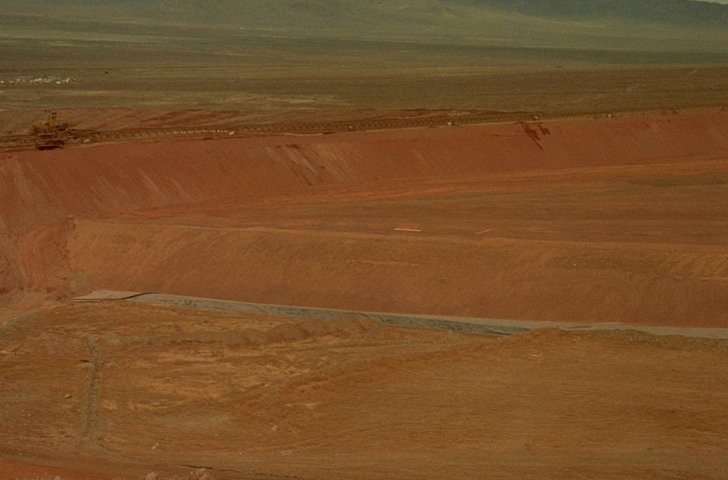
A heap leach pile for extracting gold with cyanide in Elko, Nevada
Photo by USGS


How do you like that one of my relatives invented the MacArthur-Forrest process for recovering gold in the process that is more commonly known as the cyanide process.  This is one of the many techniques used to recover gold from low grade ore that works by dissolving gold and other metals is a solution of water and cyanide that causes gold to become water soluble.  Chemically this is called a water soluble coordination complex that is the most commonly used technique to recover gold.

Fifteen percent of the cyanide produced is used for gold recovery the balance is used in other industrial processes for such things as adhesives, plastics and insecticides.  Although both sodium and potassium cyanide are used the most commonly used is calcium cyanide.  Because of its extreme toxicity cyanide has been outlawed in many countries, but efforts are being made to replace its use in mining by less toxic chemicals.  One of these is sodium ferricynide that has been used under the name “hypo” in photography to dissolve silver in photographic materials.  Hypo also dissolves gold, but not as rapidly as cyanide.

Gold mining uses cyanide for both the MacArthur-Forrest Process for which it was originally developed and for the later heap leaching process that was developed for recovering gold from disseminated ore like that found in the Carlin Trend in Nevada.  In the MacArthur process the gold ore is first ground into a powder in a ball mill, a large tumbling barrel where the grinding action is provided by large steel balls.  The ore is then transferred to a vat where it is mixed with cyanide solution and agitated with compressed air.

The other place where cyanide is used is the Heap Leach Process here the ore is ground to ¼ minus and heaped up in huge piles usually covering several acres.  A solution of cyanide is sprinkled onto the pile with sprinklers where it seeps down through the heap dissolving the gold in the process.  This process goes on for a considerable time with the cyanide solution being recirculated several times until all the gold is dissolved.

In both processes the gold is precipitated from the pregnant solution with powdered zinc although in some cases it is recovered using activated charcoal filters.  The powder is black because it contains more then gold that is cast into a Dore bar and sent on for further refining to remove the impurities.

Saturday, November 26, 2011

Gold Occurrences in Honduras

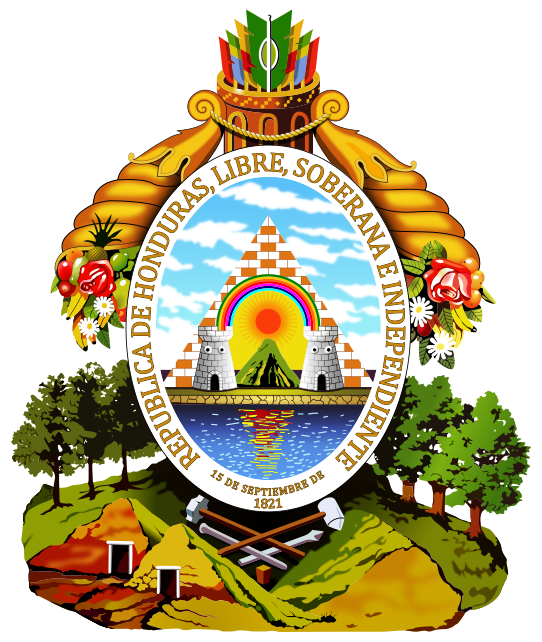
Coat of Arms for Honduras. Note the crossed hammers and chisels along with the mine entrances in the lower left corner.


Honduras is the largest and most rugged country in Central America. It was little explored until the 1960s because of the dense jungle, steep slopes and deep ravines.  Lack of roads was another contributing factor to the lack of exploration. Volcanic activity is another.  Volcanism is a rather recent occurrence in Honduras like the other countries of Central America having started as recently as 11 million years ago and still continues today.  It is this volcanic activity that carried gold and other polymetallic ore deposits in its wake.

As part of the volcanic arc of Central America, Honduras contains many volcanoes both active and extinct; it is this volcanic activity that brought with it the deposits of gold and other minerals that are found here today.  The area including Honduras has undergone a considerable amount of activity associated with subduction zones that were building volcanic arcs Honduras was part of one of several island arcs originally.  The country was finally accreted to southern Mexico, but there was still a gap between North and South America.  This gap was only closed within the past five million years when Panama was formed allowing a land bridge between the Americas.

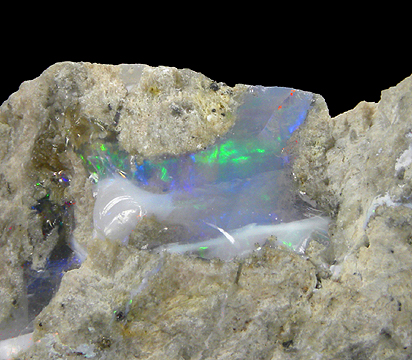
Gold isn't the only thing found in Honduras this precious opal came from the Gracis O Dios mine there.
Photo by Rob Lavinsky


Although the situation has improved Honduras to this day is largely unexplored presenting plenty of opportunities for exploration for gold that is present on both placer and lode deposits. There are several gold mines in Honduras where mining is mainly carried out by foreign interests that principally use the heap leaching process with cyanide.  The nature of the mines also lowers the water table.  Cyanide can be neutralized with a solution of laundry bleach or Clorox. 

In some cases whole villages were relocated to new sites that although they provided housing for the inhabitants they failed to provide plots of land where crops could be raised or animals pastured. The findings of an investigatory group were published in the paper, “The Price of Gold: Gold Mining and Human Rights Violations in Honduras.”  The result was made by presenting the Honduran Government with the needs of improving the regulatory needs as pertained to gold mining.

Due to its mainly volcanic origin there is plenty of gold in Honduras waiting to be discovered because although exploration conditions improved during the 1960s there is still plenty of territory that hasn’t been explored yet.  Gold is still there for the taking!