Total Pageviews

Showing posts with label Western world. Show all posts

Thursday, April 21, 2011

Gold Occurrences in Montana

Most of the Gold in Montana is found in the western half of the state where it was discovered in 1852 on Gold Creek in Powell County. Very rich deposits were found in 1863 in Creek near Virginia City created a gold rush. Since that discovery Montana has produced over 17,752,000 ounces of gold that is ranked as the seventh largest gold producing state in the United States. Most of the gold produced in Montana is a byproduct of the copper industry. Some of the best places to prospect for placer gold in Montana are located in Broadwater County on the eastern slopes of the Elkhorn Mountains in the rivers and streams that flow toward the east.

Elkhorn Mountain in Montana. Placer gold is found in the rivers draining the eastern slopes of the Elkhorn Mountains.
Photo by Fraser Harris

There is a great deal of information about mining for gold in Montana from the Bureau of Mines and Geology located at Montana Tech in Butte, Montana. The state is one of the signatories to the Mining act of 1872 that recognizes the right to file a claim on public lands belonging to either the state or federal government.

Western Montana is divided into two sections the Northwest and the Southwest in the northwest part of the state gold is found mainly in recent glacial moraines. During the early days when gold was selling for $20 per ounce of gold deposits found here were not considered to be economic although it was always possible to find gold. With today's prices the gold in these glacial moraines may become economically viable at $1500 per ounce.

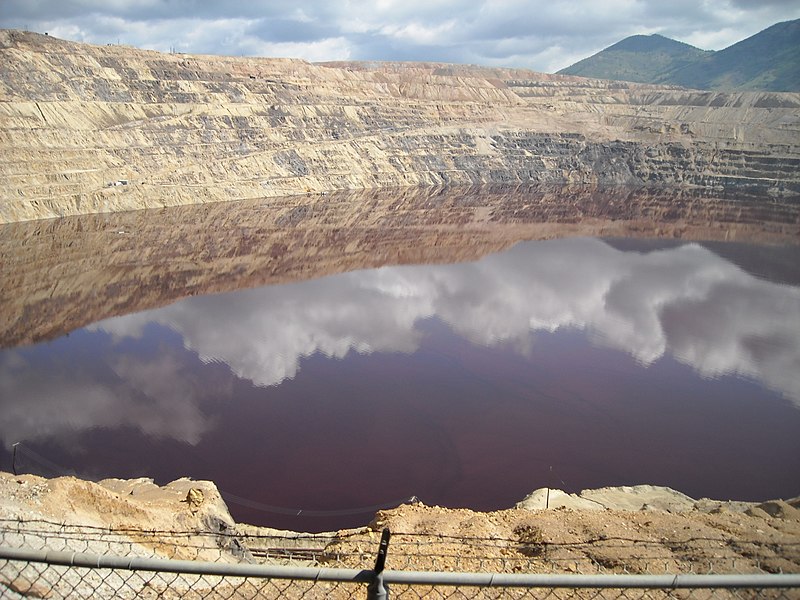
The Berkley Pit in Butte Montana an abandoned copper mine where gold was produced as a byproduct.
Photo by Cybergrl

Most of the gold in this thing however is found in the southwestern part of the state where many of the rocks are of Archean age is similar to those in the Abitibi region of Canada were mostly gold was laid down between 2.8 and 2.6 billion years ago.

Some of the greatest mines in the United States are located in western Montana there were copper mines many of them produced gold as a byproduct from refining copper. The greatest of these copper mines was the Anaconda Mine located near the city of Anaconda. This mine was discovered right after the Civil War by an Irish prospector that was looking for gold, and found copper instead.
The Anaconda mine was actually named because of a newspaper headline the Irishman saw while he was serving in the Union Army near the end of the Civil War. The headline read, “Grant encircles Richmond like a giant Anaconda.” Both the mine and the city were named after this giant snake found in the Amazon basin.

Gold is found throughout Western Montana wherever there are mountains. The best place to look for placer gold is in the rivers and streams draining those mountains. According to one source is doubtful that the old time prospectors ever found all the gold that is deposited there. There are now many prospecting tools that were unavailable to the early prospectors, one of the most useful of these is the metal detector.

The metal detector that is capable of detecting gold in hard rock or placer deposits. The best tool for finding gold is one that the old time prospectors were very familiar with it is the gold pan. To this day no one has ever devised a better the way of discovering gold deposits.

Aside from gold prospecting Montana also affords the prospector the chance to find sapphires along the Missouri River. There are many areas along this river that are open to fee prospecting. In addition there are several other localities in the state where you can find various gemstones for a fee.

Monday, April 4, 2011

Imperial Russian Gold

Although it was little known in the western world there were great gold rushes in Russia at about the same time. Historically there was little gold that was mined in Russia until the 17th century; most of the gold that appeared in Russia was imported from other countries. However by the end of the 17th century there were about 140 hard rock gold deposits that were known in the country. Many of the Tsars and other nobles sent expeditions to search for gold, silver and other metals in the outskirts of their vast empire, but because they lacked sufficient knowledge about gold mining most of their efforts ended in failure.

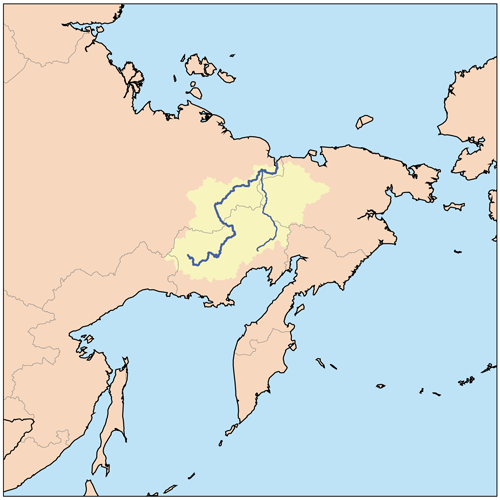
This is a map of the Kolyma Basin in the Far East of Russia

Most of the knowledge about mining in Russia came from the efforts of Peter the Great who came to power in June 1685. Among the people with whom he spoke on his expedition to the West were some Austrian miners from whom he learned a certain amount of Western mining techniques. To give Peter credit he tried to organize geological exploration in Russia that was then a very backward nation. He also attracted experts from Western Europe that was a very important factor in the discovery of gold.

Gravel Banks along a river in Russia

The first deposit of precious metals was discovered on the eastern side of Lake Baikal where the Russians opened the Nerchinsky Mine for the production of silver in 1702. It was 10 years later when a Russian chemist named Ivan Makeev discovered the presence of gold in the silver ore.  It was 17 years later in 1719 when this mine produced the first gold bullion. It was also in 1719 when Peter the Great produced a legal document called, “The Mining Privileges” that stimulated gold exploration in Russia.

By the year 1737 gold was discovered in several places in the Russian Empire, one of these places was on the north shore of the White Sea. It was in 1745 the gold was discovered on the eastern flank of the Ural Mountains in Siberia.  It took two years to verify that gold was actually discovered before they were able to open the first Russian gold mine.  At the time gold was still a state monopoly, and the majority of the Russian population was still being held in serfdom by the nobles which greatly curtailed exploration efforts.

Map of Russia

It wasn't until 1803 before the first gold deposit was found on the western slope of the Ural Mountains to finally convince the Russian government they should unchain the serfs for prospecting for gold that was then open to anyone with royalties payable to the State Bank.

This unchained the Russian population and it wasn't too long before Russia became a force to be reckoned with in the production of gold. The total production of gold in Russia between 1719 and 1800 totaled 22,491.1 kg. Most of the gold that was produced in Russia came from hard rock mines rather than placer deposits. When placer deposits were first discovered in Russia the miners treated them the same way as they did lode gold that unfortunately for the miners was not viable even though the presence of gold was known in river sediments for almost a century. It would be another hundred years before the Russian miners discovered how to separate this gold.

It was during this period of exploration for gold that a young girl discovered a gold nugget in the basin of the Nerva River, and when she told authorities about the discovery instead of receiving a reward she was giving a severe whipping told to keep her mouth shut. There were other examples of people finding gold who received the same treatment, and at least one of them died as a result. It was later when a talented mining engineer named, Lev Brusnitsyn discovered that this gold could be recovered in a sluice box. The Russians also invented their version of a gold pan that looks like a large wooden dish.

It was right after the Russian Revolution in 1917 with a Russian geologist named Yuri Bilibin discovered the vast gold deposits in the Far East section of Russia in the Kolyma Basin that eventually became the infamous Gulag's of the mid-20th century. This is the place where many political and war prisoners were worked to death mining gold.

Bilibin was also one of the founders of the Theory of Metalogeny and Global Tectonics that codified the modern method of finding gold and other minerals in specific geological settings. Today most gold was discovered in the so-called suture zones where one tectonic plate has collided with another forming a mountain range.