Total Pageviews

Showing posts with label North America. Show all posts

Wednesday, August 31, 2011

Gold Occurrences in the Norumbega Fault System of the Northeast Coast of North America

Nubble Light on Cape Neddick in York Maine.  The light is on the Norumbega Fault as evidenced by the intrusions of gabbro that were emplaced during the late Cretaceous, and the earlier intrusions of grano-diorite.  The light itself and the near shore are one of these intrusions found in the Kittery formation of southern Maine.
Photo by Michael Murphy


Like its better known cousin on the west coast the San Andreas Fault the Norumbega Fault System ranges along the coast from New Hampshire through Maine to the eastern coast of New Brunswick in Canada.  This is a fault system that has been little known until recent decades although it has displayed a history of gold deposits since the late 1800s.  Across the border in New Brunswick there has been a great deal of exploration recently with several extensive deposits of gold and other metals having been found.  It has only been in recent years that it has started receiving the attention that has been accorded its southern relative the Brevard Zone, but the latter has been the scene of gold mining in the early 19th century with some of the mines remaining open until the advent of World War II.  A recent drilling program undertaken at one of these old mines in South Carolina has discovered proven reserves exceeding 3,000,000 ounces/ton of gold.

As part of a project undertaken by the Geological Survey of Canada (GSC) in southwestern New Brunswick that is one of the most important gold occurrences in the Province as of 1999.  Because of ground cover and lack of outcrops little is known of the geology of this district except it is hosted in volcanic and subvolcanic rocks that occur on Poplar Mountain.  The gold in this deposit is accompanied with arsenopyrite.

A quartz vein in grano-diorite.
Photo by Walter Siegmond


This fault is the second largest fault system in the northern Appalachians exceeded by the Ordovician Fault System that under various names goes from Staten Island New York to Newfoundland where it enters the sea at Baie Verte NF.  When the continents broke apart during the Jurassic the same fault continues through the British Isles and into the mountains of western Norway.  Both of them mark the suture zones between land masses that were moved by tectonic forces.

Gold deposits and other metals have been discovered along both suture zones.  The most active place at the present time is in New Brunswick.  Another hotspot is in Wales in the British Isles.  Little exploration has occurred for decades because of the difficulty in using ordinary exploration methods on this terrain due to heavy groundcover.

One of the best places to look for mineralization is where two faults join at right angles like the Lake Char and Honey Hill faults do in Connecticut.  Both of these faults are a southern extension of the Norumbega Fault System.  Another area of interest is where the City of Worchester MA is located.  If you don’t think there is any gold in the Norumbega Fault System we recently found a deposit that assayed 5.9 on/ton gold and 1.1 oz/ton Platinum.  I am not disclosing its location, so you can go and find your own.

Wednesday, April 20, 2011

Gold Occurrences in South Dakota

Before it closed in 2002 the Homestake Mine in Lead, South Dakota was the deepest gold mine in North America. It had operated almost continuously since 1874 where the gold was found in association with cummingtonite schist. The depressed price of gold at the time the mine was closed in 2002. The mine has been since converted by the National Science Foundation into an underground laboratory devoted to the search for neutrinos and other subatomic particles from space.

Until the recent discoveries of large gold deposits in the Carolinas and Georgia South Dakota had the distinction of being the eastern most state that was a large producer of gold. It also has the distinction of having a war between the Indians and Whites over the gold deposits in the Black Hills, an area that was considered sacred by the Sioux. This led to the Battle of Little Bighorn in eastern Montana where the 7th Cavalry under George Armstrong Custer was virtually wiped out by the Sioux warriors.

Airforce One flying over Mt. Rushmore in the Black Hills of South Dakota

Within a year of the Battle of Little Bighorn the Black Hills were swarmed with thousands of gold seekers. Although gold was known to occur in the Black Hills it was not a safe place for white men to venture because it was considered as sacred ground by the Sioux. The gold discoveries came fast and furious until he finally culminated in the discovery of the Homestake mine in 1876.

During the early days of the gold rush in the Black Hills mostly action was centered around Deadwood where the famous Western gunfighter Wild Bill Hickok was gunned down while playing poker holding the dead men hand of aces and eights.  It wasn't too long before gold was discovered on the other side of the mountain in Lead that was developed into the Homestake mine. The mine is now owned by Barringer Gold and they have not decided to reopen gold-mining here, but there were plenty of other gold mines in the Black Hills that over the years also produced gold.

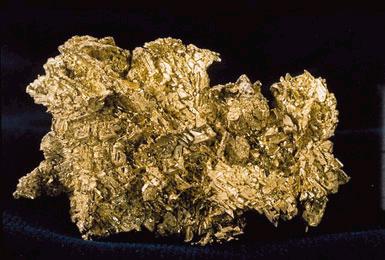
Crystalline Gold from South Dakota

There are still plenty of opportunities for small-scale miners in the Black Hills, but you have to keep in mind that the early prospectors were pretty thorough in their search for gold. What they lacked were some of the modern devices for finding gold that we now have. These new devices make it possible to find gold that the old-time prospectors missed. Placer gold can be found in many of the rivers and streams of the Black Hills as well as rivers that lead out of the Black Hills.

Another place where metal detector comes in handy is prospecting in rivers and creeks. Every year more gold is eroded from the banks of creeks that finds its way into the water courses. This does not mean that you shouldn’t overlook the use of more conventional tools like gold panning kits and dredges for mining placer gold.
The other gold that is present here is what is termed lode gold that is found throughout the bedrock of the central Black Hills. This is an area of pre-Cambrian rock that was thrust up through the sedimentary rocks that surround it by earth actions in four different geologic episodes in the past.
Erosion from the rocks of the Black Hills has reached as far east as Minnesota in the form of a conglomerate. Gold is often associated with conglomerates as fossilized placer deposits. The conglomerates east of the Black Hills may prove to be another area containing gold. The largest gold mining district in the world is the Witwatersrand in South Africa that has produced more gold than all the other mining districts in the world combined is also hosted by an ancient deposit of conglomerate.