Total Pageviews

Saturday, April 16, 2011

Gold Occurrences in North Dakota

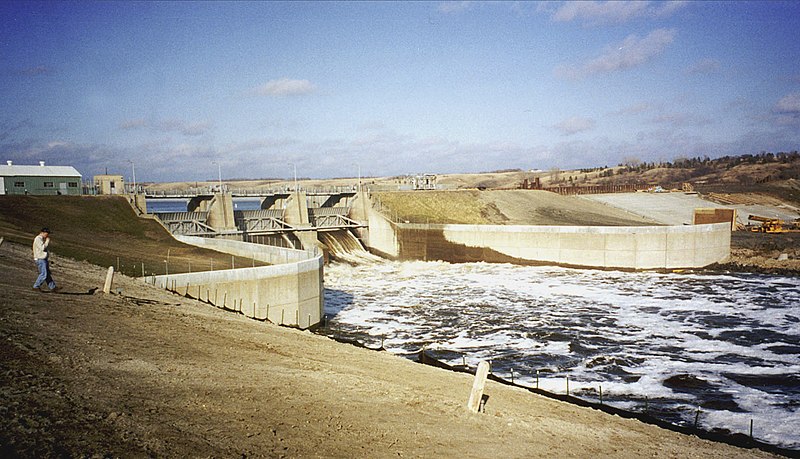
Detrital gold has been found in two different occurrences within the state of North Dakota. One of these occurrences is in northern Manitoba over 500 miles north of North Dakota that was brought in by the glacier that receipt of about 12,000 years ago. This formed placer deposits that are scattered across the state. The other gold that is found in North Dakota had an entirely different origin coming from conglomerate that was washed down from the Black Hills of South Dakota. It was subsequently eroded, and brought to the surface by the action of the Sheyenne River where it is now found as cemented gravel. Although the deposits of this sort are most common in the bed of the Sheyenne River it is also found as a cap rock on many of the buttes and ridges found throughout the state.

Baldwin Dam on the Sheyenne River in North Dakota.  This river contains detrital gold that is weathered from conglomerates that were washed down from the Black Hills of South Dakota

Conglomerate and other sedimentary rocks are not especially rare places in which detrital gold is found. This is gold that has weathered out of older crystalline rocks and carried away by the action of running water to be deposited as placer gold in stream gravel that later become cemented in place for me in a fossilized placer deposit. The largest gold deposit on earth, the Witwatersrand of South Africa, is gold in a conglomerate matrix. It is been recently discovered that the source for the gold in this deposit came from outwash in braided stream channels from an ancient mountain range. The geologists who pinpointed the origin of this gold used the half-life of an isotope of iridium that was found with the gold. This also explains why the gold was found in stringers throughout the deposit.

It is common to find uranium associated with this type of deposit as well as rare earth elements (REE). It is older of this type that is mind that Elliot Lake, Ontario for its uranium content. This is one of the largest uranium deposits in North America.

The first gold rush in North Dakota was in an area called glacial Lake Souris. This discovery of gold was made about 6 miles north of Fort Ransom in Ransom County. They are still finding small amounts of placer gold there today. It's like the old saying goes, gold is where you find it.

Wednesday, April 13, 2011

How to make a Single Jack Stone Drill for Prospecting for Gold

A Single Jack Stone drill was extensively used by miners and stonemasons during the 19th century, but today using one is almost a lost art, and to my knowledge they are not even being manufactured today. They received extensive use in the days before air drills that were operated by compressed air were invented. A single jack stone drill looks like a chisel with a rounded end that is very effective for drilling holes in stone. It is surprising how fast one of these drills will penetrate stone.

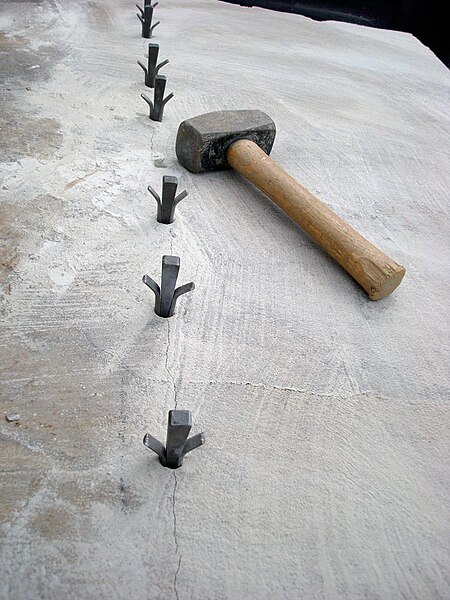
A line of drilled holes in rock with feather wedges in place for splitting the stone.  Notice the hairline crack extending between the holes. The hammer shown is a regular striking hammer not a Nevada Long Striker.  Along the line of holes every few holes one is left empty allowing space for the crack to develop.

In use a stone drill is repeatedly struck on its upper end with a heavy short handled hammer. A popular style of this kind of hammer was one that was called a “Nevada long striker.” that had a slightly longer head than usual allowing for greater force to be applied to the upper end of the Stone drill.

A stone drill of this sort can be easily made from a star drill that is available at most hardware and mason supply stores by grinding off two of the opposing flutes on the drill. This should be done with a grinding wheel to which plenty of coolant is applied while grinding so as not to remove the temper from the star drill. 

If the temper is removed in the process is easy to restore by heating the tip of the drill with a propane torch until the steel turns a light yellow color that is then plunged into water to make it hard again.

A stone drilling contest that was popular among miners in the past and today.
Photo by Javier Mediavilla Exquibela
A regular star drill is designed for drilling masonry that is softer than many of the stones encountered while prospecting. Because of the increase in the area of the face of the drill it is virtually useless for drilling stone. Admittedly, a star drill can be used for this purpose only requires about four times the effort.

It is much easier to drill into rock with a small sized stone drill rather than a larger one. The resulting drill hole can be enlarged by using a larger drill as a reamer. Sometimes to drill on hole several drills of different size are used.

In use the drill is held in one hand while it is being struck on the upper end with a stone hammer that is held in the other hand. Each time the drill is struck in has to be rotated about a quarter turn making it ready for the next stroke. Part of drilling with one of these drills is removing the rock dust from the hole periodically. This rock dust may be discarded, or in some cases if you are hard rock prospecting panned to see if it contains gold or other valuable minerals.

A single Jack Stone drill is especially useful when the prospector is working in remote areas where it is not feasible to bring an air drill with you. Drilling holes into rock has many uses in the field; the most obvious one is for planting explosives. The rock dust can also be used as a sample to determine the content of the rock being drilled. Finally if you drill a line of holes about 6 inches between the holes with the use of a device called a feather wedge it is possible to split rocks in a relatively straight line.

This method of splitting rock is commonly used by stonemasons even today; you can always recognize these split stones by the drill marks that go into the stone for several inches to hold a feather wedges.

Federal Land Grab Defunded by Congress


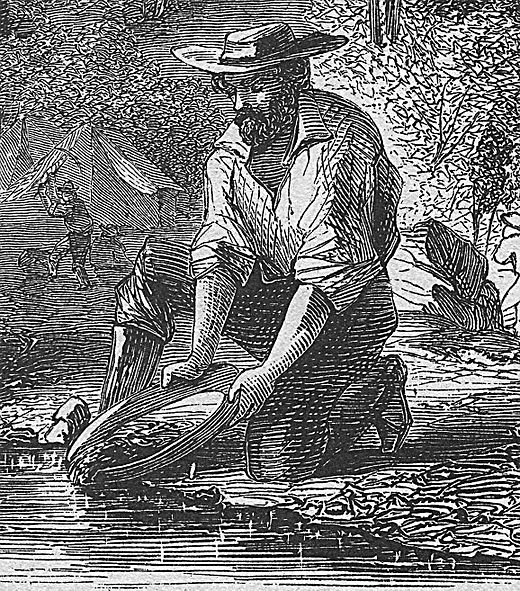
Gold panning during the California Goldrush in 1849

It was not my intention to make this blog political, but developments have made it so.  Although Congress has defunded the recent land grab by the Department of the Interior the events leading up to the recent actions still prevail.  By their lights what they were doing was considered good; unfortunately the Road to Perdition is paved with good intentions.

The real problem is an ever widening chasm between town and country that has affected the mining industry for centuries.  Agricola devoted the first chapter of his book, Re de Metallica to this problem, his book was written 500 years ago.  The problem has existed for hundreds of years.  The  solution to this problem is education; for the past half century it has been taught in our schools that mining is unfriendly to the environment, and in many cases it has been.  For the most part the general public’s perception of the mining industry has been negative.

It doesn’t make any difference whether you are a major mining company or a weekend prospector it behooves you to make an effort to try to change the public’s perception of the mining business.  I know that there are several trade organizations that are trying to reach out to the public about the mining industry, but in many cases it appears that what they are doing is “Preaching to the choir.”

If some serious effort isn’t made to change the public’s perceptions about the mining industry you can be sure this isn’t the only effort to block the mining industry because those trying to do so will be back with another scheme.

Sunday, April 10, 2011

13,500,000 Acre Land Grab by the US Government


The road to Perdition is often paved with good intentions, but this often leads straight to unintended consequences so be it with the latest land grab attempt by the federal government.  From what I understand the government already owns three out of ten acres of land in the United States why di they need more?  This time the land grab goes by the nice name of the “Antiquities Act,” but its purpose is designed to ban mining and prospecting designating them as National Monuments.  The proposed Land Grab will affect the entire gold mining and prospecting community, so we urge everyone to contact their Congressmen to protest against this land grab.  You might ask yourself, “Who really owns this land, we all do?

Towns in Connecticut where Gold has been Reported

Although today there isn’t much interest in the gold that has been found in Connecticut, but during the 19th century there was more interest in mining in the state.  This listing of gold is from a booklet published by the Connecticut Geological and Natural History Survey in 1951 as Bulletin No. 77 by Julian A. Sohon and edited by Alexander N. Winchell a mineralogy professor at Yale.  For many of us that are interested in geology and minerals this thin booklet has acted as a bible for many years; today it is out of print, but is available in the reference section of many libraries throughout the state.

The Connecticut State Capital's Dome that reportedly is covered by gold that was mined in Connecticut.

This is a list of the towns reporting gold in addition the author has found gold in additional towns in western Connecticut, these towns will be marked with an *.

Barkhamsted*              Bristol              Cheshire           Cobalt              E. Hampton

East Litchfield* Glastonbury*    Harwinton*      Litchfield          Middletown

Munro                          Montville          Mt. Caramel     New Britain*    New Hartford*

New Haven                  Newtown         Portland*         Ridgefield         Sandy Hook

Southbury                     Thomaston*     West Haven     Woodbury

If you see any streets or roads in your travels then have the name “mine” in them you had better find out why. A good example of this is the town of Canton where there was really a silver mine in the 19th century just north of Route 44. There is a full write up about the old silver mine in the history of Canton that is kept at the Canton Historical Society. You can gather a great deal of material about old mines and the mineral resources of Connecticut by reading town histories.

Although gold is a metal that attracts many people it is not the only mineral that is found in Connecticut that exceeds the value. Virtually every river in the state contains a small amount of gold capable of being recovered with a gold pan.

Friday, April 8, 2011

How to make a Geopolymer Crucible for Refining Gold

You can easily make a crucible for refining gold by using an ancient technology that was allegedly used to build some of the stone blocks used in the pyramids of Egypt. This technology was rediscovered in the 20th century by a chemical engineer from France named Joseph Davidovits who named it geopolymer. This material can take the place of both conventional concrete and many ceramics, but for the purpose of gold prospecting we shall limit this discussion to making high-temperature crucibles.

Pouring gold from a crucible
Photo by Allen Drebert

The activator fluid is made from 32% sodium hydroxide dissolved in water. The solution also contains 32% sodium silicate. The sodium hydroxide solution is made first by dissolving 32 g of sodium hydroxide in 100 ml of water that is allowed to sit overnight. The activator solution also requires 250 ml of a 32% solution of sodium silicate that can be mixed the next morning.

The completed activator solution contains 100 ml of the sodium hydroxide solution, and 250 ml of the sodium silicate solution mixed together. The activator solution has to be mixed with a pozzolan material of which there are several you can use:

Coal fly ash
Volcanic ash
Ground glass
Ground brick

Coal fly ash and volcanic ash and do not have to be ground, but the other materials have to be ground as fine as possible. The nice thing about making crucibles from this formula is it doesn't take much to make a workable crucible.

The process works like this:

To three parts of pozzolan material and six parts of sifted sand add enough of the activator fluid so that it makes a paste that has “zero” slump when it is mixed. Because of the highly corrosive nature of this mixture you should wear rubber gloves whenever you are handling the material.

The easiest pozzolan material for most people to acquire is either ground glass or a ground-up brick. Glass can be extremely difficult to grind unless you heat it first to red heat with a torch, and plunge it immediately into cold water. This makes it much easier to grind, and glass is one of the most readily accessible pozzolan materials.

The mixture is kneaded into a clay like mass that is then applied to a mold. Coat the surface of the mold with a film of vegetable oil so the crucible will not stick when you try to remove it. The mold should be made of wood that has been coated with a layer of shellac before being used. In a pinch you can use an ordinary drinking glass for a mold providing you cover it with a film of vegetable oil first.

The mold should be covered with about 1/4 inch of the geopolymer material that is allowed to set overnight before removing it from the mold. After the crucible is removed from the mold that is ready for use.

If you have difficulty in making the geopolymer material into a clay like mass you can add one part of calcined clay. It doesn't take much to make a single crucible and we usually use a teaspoon to measure the amounts we need. 

Getting the fixings together for this can present some problems, but the most difficult are getting the sodium hydroxide that is usually sold under its common name “lye” in hardware stores as a drain cleaner. Do not use any other drain cleaning compounds for this project. The other chemical that is hard to find his sodium silicate that also has a common name “waterglass.” If this chemical is not available locally it can be ordered from Sheffield Pottery in 1 pound quantities. Sheffield ships all over the United States and Canada.

It was probably a variation of this formula that the Japanese used to stop the leak in the nuclear reactor that was damaged by the earthquake and tsunami that struck Japan on 11 March 2011.

You can read much more about the science of geo-polymers and Pozzicrete and by going here!

Monday, April 4, 2011

Imperial Russian Gold

Although it was little known in the western world there were great gold rushes in Russia at about the same time. Historically there was little gold that was mined in Russia until the 17th century; most of the gold that appeared in Russia was imported from other countries. However by the end of the 17th century there were about 140 hard rock gold deposits that were known in the country. Many of the Tsars and other nobles sent expeditions to search for gold, silver and other metals in the outskirts of their vast empire, but because they lacked sufficient knowledge about gold mining most of their efforts ended in failure.

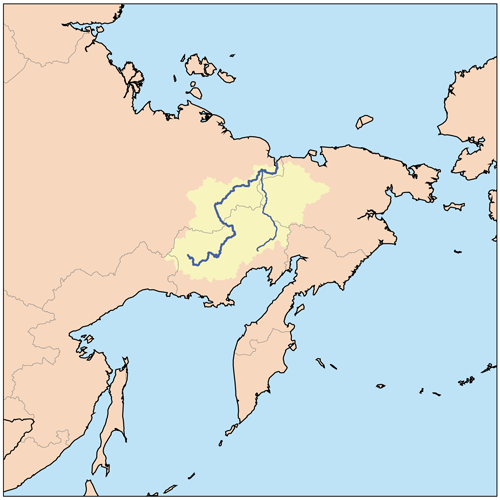
This is a map of the Kolyma Basin in the Far East of Russia

Most of the knowledge about mining in Russia came from the efforts of Peter the Great who came to power in June 1685. Among the people with whom he spoke on his expedition to the West were some Austrian miners from whom he learned a certain amount of Western mining techniques. To give Peter credit he tried to organize geological exploration in Russia that was then a very backward nation. He also attracted experts from Western Europe that was a very important factor in the discovery of gold.

Gravel Banks along a river in Russia

The first deposit of precious metals was discovered on the eastern side of Lake Baikal where the Russians opened the Nerchinsky Mine for the production of silver in 1702. It was 10 years later when a Russian chemist named Ivan Makeev discovered the presence of gold in the silver ore.  It was 17 years later in 1719 when this mine produced the first gold bullion. It was also in 1719 when Peter the Great produced a legal document called, “The Mining Privileges” that stimulated gold exploration in Russia.

By the year 1737 gold was discovered in several places in the Russian Empire, one of these places was on the north shore of the White Sea. It was in 1745 the gold was discovered on the eastern flank of the Ural Mountains in Siberia.  It took two years to verify that gold was actually discovered before they were able to open the first Russian gold mine.  At the time gold was still a state monopoly, and the majority of the Russian population was still being held in serfdom by the nobles which greatly curtailed exploration efforts.

Map of Russia

It wasn't until 1803 before the first gold deposit was found on the western slope of the Ural Mountains to finally convince the Russian government they should unchain the serfs for prospecting for gold that was then open to anyone with royalties payable to the State Bank.

This unchained the Russian population and it wasn't too long before Russia became a force to be reckoned with in the production of gold. The total production of gold in Russia between 1719 and 1800 totaled 22,491.1 kg. Most of the gold that was produced in Russia came from hard rock mines rather than placer deposits. When placer deposits were first discovered in Russia the miners treated them the same way as they did lode gold that unfortunately for the miners was not viable even though the presence of gold was known in river sediments for almost a century. It would be another hundred years before the Russian miners discovered how to separate this gold.

It was during this period of exploration for gold that a young girl discovered a gold nugget in the basin of the Nerva River, and when she told authorities about the discovery instead of receiving a reward she was giving a severe whipping told to keep her mouth shut. There were other examples of people finding gold who received the same treatment, and at least one of them died as a result. It was later when a talented mining engineer named, Lev Brusnitsyn discovered that this gold could be recovered in a sluice box. The Russians also invented their version of a gold pan that looks like a large wooden dish.

It was right after the Russian Revolution in 1917 with a Russian geologist named Yuri Bilibin discovered the vast gold deposits in the Far East section of Russia in the Kolyma Basin that eventually became the infamous Gulag's of the mid-20th century. This is the place where many political and war prisoners were worked to death mining gold.

Bilibin was also one of the founders of the Theory of Metalogeny and Global Tectonics that codified the modern method of finding gold and other minerals in specific geological settings. Today most gold was discovered in the so-called suture zones where one tectonic plate has collided with another forming a mountain range.