Total Pageviews

Showing posts with label gold prospecting. Show all posts

Tuesday, May 15, 2012

The Lost Arch Gold Diggings


A Natural Arch similar to that found in the Turtle's Range of California.
Photo by Library of Congress Prints


We first became familiar with the story of the Lost Arch Gold Diggings by reading an account of the story in the Earth Science Digest a publication that has been long out of print that coupled with tales of my great grandfather’s gold prospecting and mining in eastern Canada in the 1860 fired my imagination for the lure of gold that remains to this day.

The story begins in the northern part of the Turtle Range that lies east and south of a range called the Old Woman’s Mountain on the Colorado River in California.  The Lost Arch Diggings have the distinction of being twice found and twice lost because some strange acts of Providence.

Jim Fish and a prospector that had arrived in California with the first gold rush in 1848 were on their way from Nevada to California in an old-fashioned buckboard drawn by a team of stringy bay horses.  While crossing the Colorado River they had filled their water barrel from the river.  From there they continued to make their slow search for hidden wealth.  They had been looking for gold for months already with little luck.

Two days after crossing the river Fish discovered their barrel was leaking, and when they turned the barrel so the bung-hole was pointing downwards barely two canteens of water flowed out.  Although Fish’s discovery was un-nerving it was a situation that was only to familiar to anyone that was used to traveling through the mountains.  When his partner returned, it is said his name was Crocker, he told him the bad news, so it was decided they would spend a day looking for water in the vegetation covered gulches they saw in the mountains.  

After spending a restless night early the next morning they set off on their search.  “Crocker went up one canyon while I took another, the one to the right,” recounted Fish to some friends from San Bernardino, California some months later.  He went on, “The main canyon deployed into a gulch on the right and I decided to follow this through the hot sun and down among the rocks so far that not a breath of air seemed to pass through the cleft. On and on I went, over stones larger than a house, around smooth and slippery boulders where water had certainly been at one time, but where then not a trace showed.

“My feet were lagging; my shins were barked and aching, for in the rush I had neglected to be careful. Turning a sudden corner in the gulch, I came upon a natural bridge that spanned the canyon. It was so odd, so regular in the outline of an arch that I could only stand and admire it. Beneath its shade, the most cooling place in the hell-hole, I found a large sandy area and there sank down to rest.

“While idly scratching the sand, its peculiarity attracted my closer attention. I got down on my knees and started to blow the dust away, and before me I had a great pocket of precious metal, gold that averaged the size of wheat grains. I filled several pockets with the heavy grains and, with all thought of thirst forgotten, hurried excitedly down the canyon to impart the news of the find to Crocker.”

After arriving at the buckboard Fish had to wait for several hours before Crocker showed up again.  Crocker finally showed up hours later despairing that he hadn’t found any water where he went.  At that moment gold was the last thing on their minds because all their thoughts were their quest for water, and the nearest water was in the Colorado River two days distant.

After a harrowing trip to the river they finally reached it only to have Crocker die a few days later and left Fish in a state of shock that took three months of recovery before Fish could set out for the Turtle’s again.  After expending all his money on a fruitless search Fish gave up the quest.

In 1900 a German prospector whose name was probably Peter Kohler came back from the Turtle’s came back from them with a tale of rediscovering the Lost Arch, but because he had been a naturalist in the Old Country he didn’t have a thought about any gold there, he was completely lost in the beauty and strangeness of the setting.  He had never hears Fish’s story of the gold so he missed the chance of a lifetime.

Later a prospector named John Packer searched in vain for ten years without finding a trace of the Lost Arch Diggings.  The desert is a strange place that has the capability of changing its face in the blink of an eye; perhaps a flash flood destroyed the arch and its usefulness as a landmark.

Saturday, December 17, 2011

You don’t want to meet this guy while prospecting; a 15 foot diamondback rattlesnake


The world's largest diamondback rattlesnake. Look at the sheriff's leg for a size comparison .


At fifteen feet this might be a new world’s record for the largest poisonous snake in the world.  This nightmarish monster was recently caught in St. Johns County, Florida by the St. Johns Sheriffs Department.  This snake was so big it looked more like a boa constrictor or python then a rattlesnake.  This snake weighed around 170 pounds and is capable of swallowing a two year old child or one of your pets.  The only poisonous snakes in the world that even approach this monster in size are the Bushmaster of Central and Northern South America or the King Cobra of Southern Asia.  This snake is capable of striking for a distance of seven and a half feet with venom so powerful one bite is capable of killing 50 men. A bite from this snake is like having two quarter inch curved screwdrivers driven into your flesh. This huge diamondback was caught near the St. Augustine Outlet in a new subdivision of KB homes just south of Jacksonville, Florida

The fangs of the largest rattlesnake. The blade on the knife is four inches long.


Rattlesnakes of this size are unusual, but it was in 2009 that one almost this big was caught in Alabama that was fourteen feet long, and weighed over 100 pounds.  There are surly other monsters like this lurking around in the southeastern United States.  The Eastern Diamondback is found as far north as North Carolina, and as far west as the Mississippi River.  The snake is usually not as long averaging from 3.5 to 5.5 feet long although in one study an average length of 5.6 feet was found.  According to the Guinness Book of Records as of 2009 the longest eastern diamondback on record was 7.6 feet.  it is estimated this snake had been living since the late 1980s making you wonder if more of them are around, what they have been eating. how many others are there around like them and where are their offsprings or kin.

These snakes habitat is dry upland grassy areas although at times they can be found on dry hammocks in coastal wetlands.  The author once encountered a whole hammock full of them in the Everglades.  The eastern diamondback is an excellent swimmer so they may be encountered in swamps, lakes and rivers.

Another view of the largest rattlesnake showing a clear view of its head.


You may be wondering why this was included in Gold Mining & Prospecting this is because its habitat includes parts of the eastern goldbelt that extends through the southeast from Maryland to Alabama.  This is the scene of the first Goldrush in the United States and because of recent exploration activity is becoming one of the hottest areas in North America for finding gold.  You wouldn’t want to meet one of these guys on a prospecting trip because they could completely ruin your day.  Even the little ones could, and there are at least three other poisonous snakes in the southeast United States, the Copperhead, the Coral Snake and the Cotton Mouth.  Look out!

Followup: Further research on this story reveals it isn't true.  Although the rattlesnake was a large specimen of its species what gave it its apparent size was because the photographer taking the pictures was closer to the snake then the sheriff was.  Even if it wasn't 15 feet long a diamondback rattlesnake is still the largest and most poisonous snake in North America and should be respected.

In a further followup with Molly Davis a spokesperson with the St. John's County, Florida Sheriffs Department although the snake wasn't 15 feet long is was however a giant specimen nonetheless of an Eastern Diamondback.  The snake hunter who wasn't allowed to keep live specimens killed the rattlesnake because of its proximity to a housing development.  It was in some shrubbery at the entrance to the development where the snake was found.

This was an extremely dangerous animal with any member of the rattlesnake demanding much respect. It should be remembered that the newly born members of the rattlesnake clan are the most poisonous.

Tuesday, September 6, 2011

Gold Occurrences in Manitoba

Gold in Quartz.
Photo by Rob Lavinsky
There are several gold mining companies that are presently exploring for gold or mining it in Manitoba. The provinces also been the site of many gold rushes the earliest of which occurred in the southeast corner of the province where the abutts Ontario. This part of the province is part of the Canadian Shield as well as northern Manitoba where there are several operating gold mines.

The southern part of the province as well as the other Prairie Provinces is covered with a sequence of glacial lake sediments that are derived from glacial Lake Agassiz about 10,000 years old. Today, Lake Winnipeg is just a small part of Lake Agassiz. The gold deposits in the province are mostly found north of the Lake District where you encounter the ancient rocks of the Canadian Shield. It is these rocks that contain gold except for a narrow area in the far eastern part of the province. Gold and other valuable minerals are founded this area of the Canadian Shield.

The southern portions of these three provinces are the home to oil and natural gas; they also contain minable amounts of gypsum, potash and salt because they were covered by an ancient sea that bisected North America from the Gulf of Mexico to the Arctic Ocean. The Williston Basin extends into these provinces that also contain portions of the Bakken and Three Forks Formations.
Gold is found in northern Manitoba where rocks of the Canadian Shield are exposed. There is mining for gold and other metals in this part of the province. It isn’t only gold that they find. There are deposits of copper and nickel that are mined around the area around Flin Flon.
Manitoba is huge, it is almost as large as Texas so there is plenty of territory where you are able to prospect plus you have a provincial government that is quite friendly to the exploration and mining industries.
A good share of the exploration that is occurring in the province is between Rice Lake and Red Lake in Ontario. These two lakes are only 60 km apart and are both on the same continental fault. Although gold was discovered at Rice Lake in 1916 there were only a few mines that operated to the five hundred foot level. The deposits that have been discovered recently are all below the 1,000 feet.
Like a lot of other places in Canada it is often useful to prospect in the shadow of an existing mine. To find these old mines you are going to have to spend some time in the library researching them. Another good source of information about gold and other mineral localities is available from your provincial government.

Wednesday, August 24, 2011

Gold Occurrences in Ontario


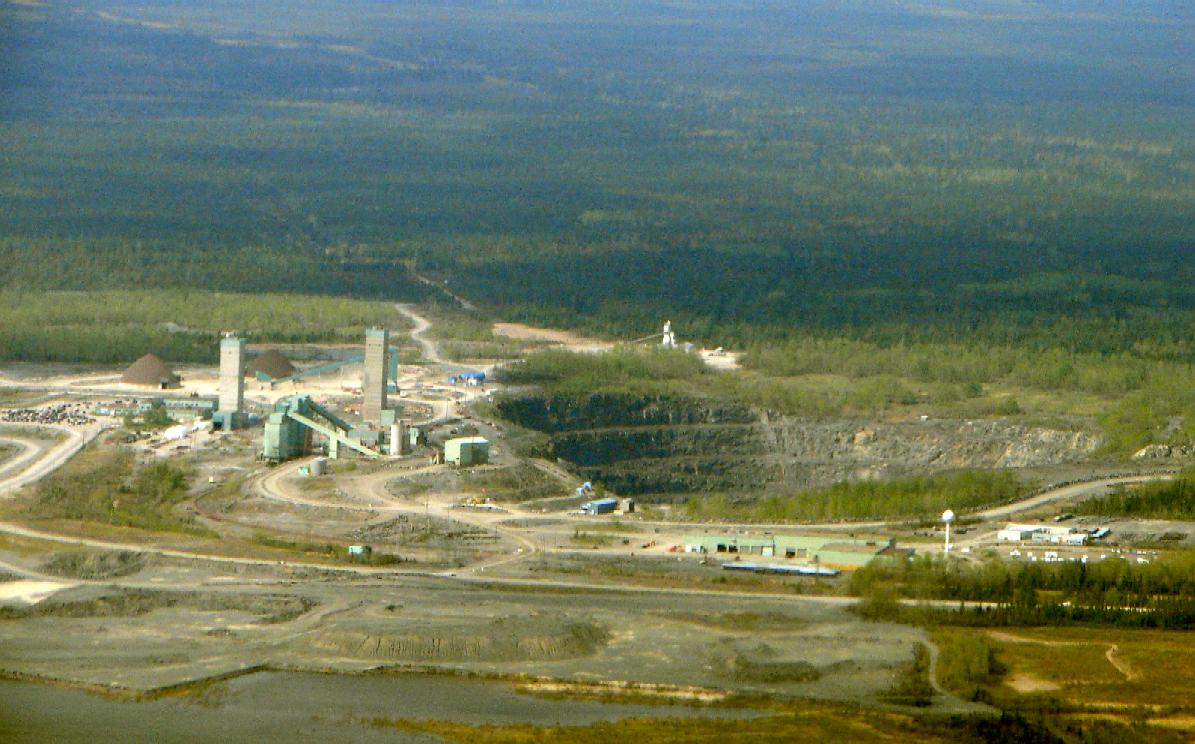
Kidd Creek Mine in Timmins Ontario   P199


The City of Timmins lies about 600 miles north of New York City it is common knowledge to most Americans that the Gold Rush happened in California in 1849, but a far larger gold rush occurred in Porcupine Ontario fifty years later.  Porcupine was later incorporated into the Township of Timmins, but Porcupine still exists complete with a Tim Horton’s shop.  One of the mines, the Dome Mine is still producing gold over a century later from a vast open-pit mine.  The other mines are now closed, but in West Timmins they have recently discovered one of the largest gold deposits of the past century.  It appears they haven’t written the last chapter in the book about Timmins Gold.

Most of the gold found in Ontario is found in the so-called Greenstone Belts the largest of which is the Abitibi reaching all the way from Wawa on Lake Superior into Quebec past Val D’or.  From this one Greenstone Belt there are more then 160,000,000 ounces of gold that have been mined since its discovery in 1909.  This is only one of several Greenstone Belts in the province that has produced gold. 

Gold bearing belts are found in several other localities in Northern Ontario with other notable occurrences at Cochrane, Red Lake, Hemlo, Marathon and so many other places that prospecting for gold in Ontario is practically the same thing as carrying coals to Newcastle. Many of the VMS mines in Ontario produce gold as a byproduct.  One example of this kind of deposit is found in the Kidd Creek Mine to the east of Timmins that was the site of a famous discovery in 1963.  Most of the gold that has been found in Ontario is from hard-rock deposits.

Somebody has said that there has never been a single nugget of placer gold that has been found in the province.  According to an open file report by the Ontario Geological Survey there appears to be a considerable amount of float gold present in the glacial drift of Ontario.  It is probable that placer deposits have not had enough time to develop since the glacier melted.  At any rate the report covers about two hundred pages listing all kinds of places where placer gold and indicator minerals for kimberlites have been found in Ontario.  You can access this document online by going here.

According to the author’s prospecting friends in Ontario all the prospecting done in the province is in hard rock. With the amount of gold that has been discovered that really makes sense. It could be possible that what has worked in the past will work in the future. The possibility of placer mining has not happened because of the scarcity of alluvial gold. Although the Abitibi region of Ontario holds many lode mines, placer deposits are practically non-existent. The glaciers of the past million years took the gold laden soil south and deposited it in states across the American mid-west. These are from New York to Illinois.
Most of the gold of Ontario is found associated with the greenstone belts of the Abitibi and Superior Provinces that span the whole province from Manitoba to Quebec. It is thought that the gold was mobilized from the greenstones that are metamorphosed basalts by hot water. It was deposited in quartz veins that are often found near fault systems.
Another place that gold is found in Ontario is in beds of ancient conglomerate. An example of this type is a large piece of conglomerate on display on the lawn of the library in Timmins. This is probably an ancient placer deposit that has been fossilized. The stones in this piece show little or no sign of having been metamorphosed. It is an example of an Archean sedimentary rock.
Some of the other regions of Ontario that have produced gold is the area around Wawa and Marathon. The Western part of the province is also promising country to prospect. Prospecting in Ontario is not just limited to looking for gold. There is at least one active diamond mine in the James Bay Lowlands, as well as diamond bearing kimberlites found in several places in the province.
Diamonds are often found in the same rivers and streams that carry gold in their sand and gravel deposits. The largest diamond that was ever found in North America was found in a placer deposit.
There are plenty of other minerals that can be found in Ontario as well. These minerals might not be as glamorous as searching for gold, but in many ways they are more important in the modern world. Among them are copper, lead, zinc, nickel, iron, lithium, beryllium, niobium, tantalum and the rare earth elements. The platinum group metals are often found associated with copper, cobalt and nickel.
If there is anyplace where people have looked in Ontario for mineral wealth they have found it. The province maintains a very active geological survey that holds vast amounts of knowledge concerning the mineral wealth of Ontario.

Sunday, July 3, 2011

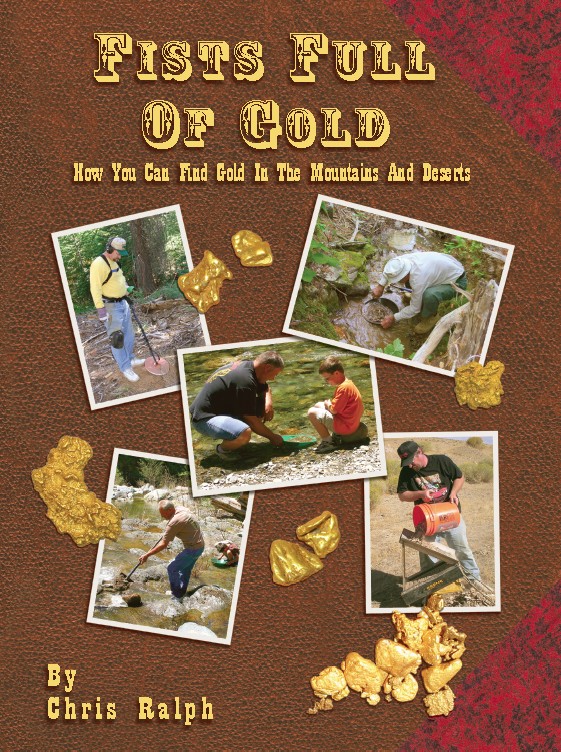
Fists Full of Gold


Chris Ralph the associate editor of the Mining and Prospecting Journal claims there is still plenty of gold out there for the taking.  The title of his book is “Fists Full of Gold” because he hopes that will be what you have after reading his book.  He has put years of experience in writing this book making it the most comprehensive prospecting book that has ever been written. The focus of the book is to teach you how to find gold deposits and what to do after you have. A lot of information is included in this book that simply can’t be found in other books about prospecting. There is plenty of basic information for beginning prospectors, more information for more advanced prospectors and plenty of information for those prospectors that have decades of experience.  The book holds plenty of the latest technology and up-to-date methods for finding gold.


The book will teach you the skills of being a prospector in an entirely different and unique way that is explained in any other book. Equipment is not the only thing that is explained in this book that also explains the methods of using that equipment. Will the most important things that is covered in this book is where to look for gold, and how to recover the gold. The book was designed to be the only prospecting book you'll ever need, or will ever outgrow. Fists Full of Gold contains more than 360 pages for 225,000 words devoted to the world of prospecting. The book is longer than any other two or three books devoted to prospecting and gold. It's all written in words the average reader can understand that has no training in either geology, prospecting or mining.


The basics of prospecting and finding gold, including:
    The fact that there is lots of gold is still out there to be found
    How to use a gold pan, including crevicing, mossing and sniping for gold
    How to get the best recovery out of your sluice box or highbanker
    How to use a suction dredge to find and recover paystreaks
    How to operate a dry washer for gold
    An extensive section on metal detecting, perhaps the best on the market
Building your own equipment: including building your own:
    Portable sluice box
    Lightweight suction dredge
    Desert dry washer
How to operate a small scale commercial mining operation
How to deal with and get the most out of your black sands
How to get the best prices for your gold, specimens and nuggets
A full coverage of the geology of gold and silver mineral deposits:
    All about minerals and how to identify them
    Minerals associated with gold deposits
    Rocks: what they are and how to identify them
    Basic geology for the prospector in an understandable form
    A detailed explanation of placer geology and how paystreaks form
    A detailed explanation of hard rock geology and how gold deposits form
    How to recognize many types of hard rock gold and silver deposits
How to do research to find your own rich concentrations of gold:
    Using and understanding topographic maps, aerial photos and GPS
    Where to find little known sources of information on gold deposits
    How to use geology maps to find gold
Signs and indicators of gold deposits that you want to look for in the field
    How to read and interpret signs of old timer workings
    How to recognize geologic indicators of gold mineralization
How to prospect for commercial deposits of gold and silver
Mining law and how to stake and maintain your own claim
Platinum placers and deposits – How to prospect for them
Diamonds in placers – How to recognize them
Maps of where to find gold in the US and Australia


Plus hundreds of photos, diagrams and illustrations to explain the concepts presented in the book.


Price USD $29.95   Shipping included!


Please allow 4 to 6 weeks for delivery  


Connecticut residents please add 6.35% sales tax. 


Friday, May 13, 2011

Nancy Twinkie goes Shopping for Prospector’s Supplies

It finally came to pass that Nancy Twinkie became so hooked on gold prospecting she decided that she should own her own prospecting gear.  So on one Saturday morning when it was raining off we went to a rock shop that carried the kind of gear she wanted.  It was quite a drive to the rock shop since the nearest one to where we lived in Connecticut was about forty-five miles away on the other side of the Connecticut River in East Hampton.  Although Connecticut isn’t exactly rock hounding country there are enough to support a few rock shops; this one is the largest in the state. 

While I was talking to the owner Nancy was poking around in the store for what she wanted, and they had enough of fixings to satisfy her wants.  The first thing she bought was a gold panning kit that included two pans one was 14 inches in diameter and the other was 10 inches.  The kit also had a 14 inch classifier along with a pair of tweezers, a small magnifying glass, and a snuffer bottle for snuffing up small flakes of gold from a goldpan.  There were even a couple of plastic vials to hold the gold.

Then she bought a folding shovel like the kind you use in the army to dig a foxhole.  Although many people would call this a folding shovel I learned the hard way that it is also known in certain quarters as a “hip spoon.”

Nancy went whole hog that day, and bought some other gear for rock hounding.  This collection included a 22 ounce Estwing rock pick, a four pound Estwing cracking hammer, a 1 inch chisel about a foot long, and a bull point of the same length. 

After collecting this gear we stopped at one of those Big Box stores and bought a pair of work boots and a zipper overnight case to carry all this gear in.  The goldpans didn’t fit, so she also bought a backpack.  That finished her collection, so with that we spent the rest of the day rock hounding. 

This is the part of Connecticut where there are several large pegmatite mines many of which have some really rare minerals, so we went to the Strickland Quarry for collecting.  (At the time Strickland was open for collecting, but has since morphed into a golf course, and is closed to collectors.)

After parking the truck we noticed there was a large boulder composed mostly of cleavelandite just on the edge of the parking area.  From the looks of that boulder it probably weighed more then two tons.  By examining the boulder I could see the blades of cleavelandite sticking out in all directions.  Knowing this was one of the signs that there might be pockets inside the boulder we decided to see what was inside and went to work on the boulder with my 8 pound sledge.   

It didn’t take long to find out that the sledge hammer wasn’t going to work so I went back to the truck for a single jack stone drill and a striking hammer.  This was some mining equipment I had inherited from my great grandfather along with some ¾ inch feather wedges. 
A single jack drill it pretty easy to use, and you can drill a hole with one in a hurry by hitting its upper end with a four pound hammer. Each time you strike the drill you have to rotate the drilling steel a quarter turn so that every time the cutting edge of the drill is cutting into a new part of the stone.  We had to make four holes into the rock that were about six inches deep to hold the feather wedges.  It probably took agout 15 minutes to drill the holes and set the feather wedges.  After the wedges were set and tapped into place the boulder was split in half in less then a half hour from when we started drilling. 

Feather wedges can still be bought at mason supply stores, but old fashioned stone drills are no longer sold.  However you can make your own from a star drill by grinding off two of the flutes, or by grinding a radius on the cutting edge of a cold chisel.

Once we were inside the boulder there were many interesting specimens as the pegmatite was an LCT type.  In some of the cavities we found nice specimens of columbite,  but the best specimen was a nice crystal of blue beryl.  Most of the specimen was badly flawed, but there were some areas that were faceting grade that would probably have made gems weighing more then 10 carets.  That stone is still in Nancy’s private collection! 

Tuesday, May 10, 2011

Gold Occurrences in Nevada

The Goldstrike Mine in the Carlin Trend of Nevada   USGS


Placer gold has been found in 14 of the 17 counties in Nevada in the form of either commercially viable deposits, or deposits that are potentially viable. Most of these deposits are located in the northern and western part of the state. Many of these deposits were worked out by early prospectors, but there are many areas in the state were overlooked that can still afford a working wage if they are developed. It is especially important to hunt out areas where virgin gold can be found that were never mined in the past.

Much of Nevada is so arid that the early prospectors had several different methods of dry washing their gold bearing gravel. One of the biggest problems they had in processing placer gold was the presence of lots of caliche, a type of hardened sub-soil that attains the hardness of concrete. 

It is felt by many that the discovery of gold is an ongoing process with much of the gold still waiting to be discovered.  By drilling in the basin and range province of the United States exploration geologists are finding even richer deposits of gold then there are in the Carlin Trend.  It is claimed that prospecting in the state is exciting because there is so much undiscovered mineral wealth present, and it isn't all gold.

Placer Gold
Photo by Nienetwiler


Nevada is also the home of unique deposits of finely disseminated gold that was discovered in the 1960s by Newmont Mining Company who developed a method for extracting the gold. For the most part these cool deposits are found in an argillaceous limestone that has been subject to enter thermal alteration. This is the famous Carlin trend of cool deposits where the gold is so fine it can only be seen with electron microscope, and at times goals of the limestone was represented by a single ion.

Gold of this sort is mined using the heap leaching method of recovering the gold values. He teaching consists of piling up a heap of crushed stone about a quarter inch in diameter and treating it with a weak solution of an alkali salt of cyanide. The heap is piled up on a watertight floor that slightly slopes towards the center and all the pregnant liquor from the gold leaching process is directed to a sump where it is collected for treatment to recover the gold.

Although there are several different techniques used on the ore one of the most common is treating the pregnant liquor with powdered zinc. The gold in the liquor chemically replaces the sink it is collected as a black powder that is further refined into pure gold.

Nevada also produces many gemstones including precious opal and turquoise. The precious opal comes mainly from the Virgin Valley, and the author used to buy some really beautiful turquoise from the area around Crescent Valley.

Wednesday, April 13, 2011

How to make a Single Jack Stone Drill for Prospecting for Gold

A Single Jack Stone drill was extensively used by miners and stonemasons during the 19th century, but today using one is almost a lost art, and to my knowledge they are not even being manufactured today. They received extensive use in the days before air drills that were operated by compressed air were invented. A single jack stone drill looks like a chisel with a rounded end that is very effective for drilling holes in stone. It is surprising how fast one of these drills will penetrate stone.

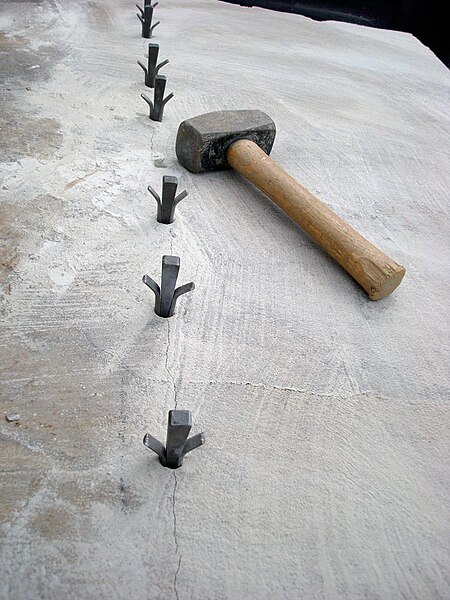
A line of drilled holes in rock with feather wedges in place for splitting the stone.  Notice the hairline crack extending between the holes. The hammer shown is a regular striking hammer not a Nevada Long Striker.  Along the line of holes every few holes one is left empty allowing space for the crack to develop.

In use a stone drill is repeatedly struck on its upper end with a heavy short handled hammer. A popular style of this kind of hammer was one that was called a “Nevada long striker.” that had a slightly longer head than usual allowing for greater force to be applied to the upper end of the Stone drill.

A stone drill of this sort can be easily made from a star drill that is available at most hardware and mason supply stores by grinding off two of the opposing flutes on the drill. This should be done with a grinding wheel to which plenty of coolant is applied while grinding so as not to remove the temper from the star drill. 

If the temper is removed in the process is easy to restore by heating the tip of the drill with a propane torch until the steel turns a light yellow color that is then plunged into water to make it hard again.

A stone drilling contest that was popular among miners in the past and today.
Photo by Javier Mediavilla Exquibela
A regular star drill is designed for drilling masonry that is softer than many of the stones encountered while prospecting. Because of the increase in the area of the face of the drill it is virtually useless for drilling stone. Admittedly, a star drill can be used for this purpose only requires about four times the effort.

It is much easier to drill into rock with a small sized stone drill rather than a larger one. The resulting drill hole can be enlarged by using a larger drill as a reamer. Sometimes to drill on hole several drills of different size are used.

In use the drill is held in one hand while it is being struck on the upper end with a stone hammer that is held in the other hand. Each time the drill is struck in has to be rotated about a quarter turn making it ready for the next stroke. Part of drilling with one of these drills is removing the rock dust from the hole periodically. This rock dust may be discarded, or in some cases if you are hard rock prospecting panned to see if it contains gold or other valuable minerals.

A single Jack Stone drill is especially useful when the prospector is working in remote areas where it is not feasible to bring an air drill with you. Drilling holes into rock has many uses in the field; the most obvious one is for planting explosives. The rock dust can also be used as a sample to determine the content of the rock being drilled. Finally if you drill a line of holes about 6 inches between the holes with the use of a device called a feather wedge it is possible to split rocks in a relatively straight line.

This method of splitting rock is commonly used by stonemasons even today; you can always recognize these split stones by the drill marks that go into the stone for several inches to hold a feather wedges.

Sunday, April 10, 2011

Towns in Connecticut where Gold has been Reported

Although today there isn’t much interest in the gold that has been found in Connecticut, but during the 19th century there was more interest in mining in the state.  This listing of gold is from a booklet published by the Connecticut Geological and Natural History Survey in 1951 as Bulletin No. 77 by Julian A. Sohon and edited by Alexander N. Winchell a mineralogy professor at Yale.  For many of us that are interested in geology and minerals this thin booklet has acted as a bible for many years; today it is out of print, but is available in the reference section of many libraries throughout the state.

The Connecticut State Capital's Dome that reportedly is covered by gold that was mined in Connecticut.

This is a list of the towns reporting gold in addition the author has found gold in additional towns in western Connecticut, these towns will be marked with an *.

Barkhamsted*              Bristol              Cheshire           Cobalt              E. Hampton

East Litchfield* Glastonbury*    Harwinton*      Litchfield          Middletown

Munro                          Montville          Mt. Caramel     New Britain*    New Hartford*

New Haven                  Newtown         Portland*         Ridgefield         Sandy Hook

Southbury                     Thomaston*     West Haven     Woodbury

If you see any streets or roads in your travels then have the name “mine” in them you had better find out why. A good example of this is the town of Canton where there was really a silver mine in the 19th century just north of Route 44. There is a full write up about the old silver mine in the history of Canton that is kept at the Canton Historical Society. You can gather a great deal of material about old mines and the mineral resources of Connecticut by reading town histories.

Although gold is a metal that attracts many people it is not the only mineral that is found in Connecticut that exceeds the value. Virtually every river in the state contains a small amount of gold capable of being recovered with a gold pan.

Saturday, March 26, 2011

Learn how to Prospect for Gold

Panning for Gold


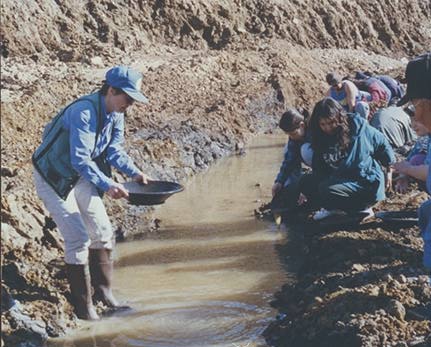
We are going to teach a class on prospecting for placer and lode gold at the Log House Restaurant on US Route 44 in Barkhamsted, Connecticut on May 21, 2011 starting at 9:00 AM and lasting until 3:00 PM.  This class will give you information about both placer and lode gold prospecting methods.  Emphasis will be on placer gold although a great deal of information will also be taught concerning lode gold in NW Connecticut that has some of the most complicated geology in the world.

In addition to the classroom studies we will spend part of our time in the field examining some of the situations and places where gold can be found.  We will also teach you some of the tricks of the trade. 

Each participant in the class will receive a Garrett Gravity Trap Gold Panning Kit, Model #1651-300 as part of his tuition fee.  This is a $29.95 value.

Please make all checks payable to John Carter.  Payments can be made by check or money order or by credit card via PayPal at: geotekllc@gmail.com 

Address:

John Carter
11 Meeting House Rd.
Suite 21a
Barkhamsted, CT 06063
Tel:  860-469-4804
Cell: 860-605-0475

About your instructor:

John Carter has been an avid prospector since childhood having prospected extensively in the gold bearing areas of Canada notably in the Abitibi Gold Province of Quebec and Ontario.  He also has prospected for placer deposits throughout New England and Maritime Canada.  John holds a degree in geology and has been a guest lecturer at the New School in New York, and Northwestern Connecticut Community College in Winsted, CT.  John has also been an army drill sergeant, so watch your step or he will write your name down.  He underwent 8 levels of instruction in the Army Instructors School, and is rated an expert in instruction. 

About the area:

Northwestern Connecticut contains some of the most complicated geology in the world, and although the gold deposits are sparse they are enough for you too see what gold looks like.  The paucity of placer deposits in the area may have been caused by the last period of glaciation having swept most of the potential gold and carried it further south to Long Island.  There has been at least one gold rush in East Litchfield when they were building the railroad bridge across Spruce Brook in 1849.  We had our own 49ers, but gold has also been found in Leadmine Brook in Thomaston, and along the Naugatuck River from Winchester South.  Gold is also found in the Farmington and Housatonic Rivers and their tributaries. 

Lode gold in the area:

Lode gold has also been found in the general area of Northwestern Connecticut by John Carter in East Litchfield during the construction of Rt. 8.  The fact that there are few reports of lode gold here is more apt to be related to lack of looking rather then lack of gold. Finding lode gold is much more difficult then finding placer gold.

Registration Form

Cutoff Here

Name: ________________________________

Address 1: _____________________________

Address 2. _____________________________

City: __________________________________

State: ___________ Zip: ___________

Tel: _________________

E-mail: _________________________

Please enclose registration fee or E-mail registration form to geotekllc@gmail.com