Total Pageviews

Showing posts with label california. Show all posts

Wednesday, June 13, 2012

How to Build a Gold Rocker Box:


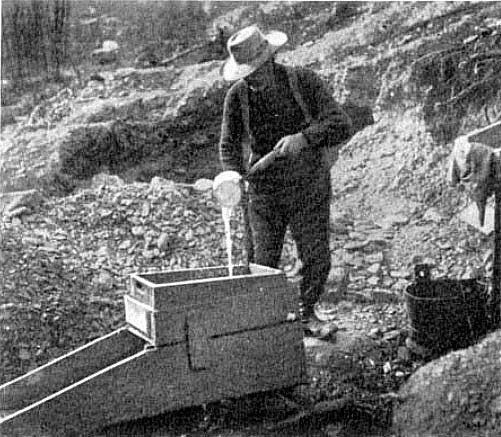
A gold rocker box in use


A gold rocker box is a device that efficiently recovers gold from river sand and gravel that is capable of processing more gold per hour then a gold pan.  Its invention was during the Georgia Gold Rush that predated the California Gold Rush by several years.  During the days of the Forty-Niners the rocker box was considered more important then the gold pan.  It was also important during the Klondike Goldrush because the miners were able to use the rocker box on higher stream banks because it used far less water then the conventional gold pan.

The Gold Rocker Box was a slightly more complex way of producing gold that could easily be built in the field by the average miner from rough sawn lumber.  It also had the advantage of being usable by one man.  It was built in two parts; the upper part was a box that acted as a grizzly separating the larger stones from the lower part where the smaller sand and gravel went to be processed. 

In essence the lower part was a sluice box from four to five feet long, and about a foot wide.  This part of the box was equipped with a set of cleats along the bottom of the sluice to catch the gold particles, and let the lighter load of gravel run out the lower end of the sluice box as waste.

The upper part of the gold rocker was a shallow wooden box with a one half inch screen that acted as a grizzly to remove the larger stones from the gravel that was passed through it on the way to the sluice box.  The miner discarded the larger stones, but first examined them to be sure he was not throwing out any gold nuggets.

A piece of canvas that went from the back of the upper box that was attached to the lower box assured that the gravel was properly dispersed into the sluice box.  This device has survived the test of time as the big dredges often used a rocker box to finish off the concentrate of gold and other stream heavies.

To build a rocker you start by building the upper box first this is about eighteen inches by twelve inches in size, and about four inches deep.  Then a lower sluice box is constructed that is from four to five feet long, a foot wide, and about four inches deep.  The upper box is attached to the lower box with four one x twos that are about a foot long.  A piece of canvas is attached to the rear of the upper box, and is angled down to the lower box and attached at the point where the upper box ends.  The lower box is equipped with a series of wooden cleats that catch the gold from the gravel that is being passed through. 

There is also some kind of a one x two attached to both of the boxes so that the miner is able to rock the device back in forth sideways while he is pouring water in through the upper box.  The whole device is elevated from the ground with a set of legs about four inches high that are attached to the sides of the lower box.  These legs are joined together by a wooden frame that is attached to the bottom of the legs.

In use the upper box is filled with gravel by the miner, then he pours water by the dipper full washing the gravel down into the lower box.  As he adds the water he rocks the whole device back and forth so the gravel falling through the grizzly is spread evenly in the lower box, and is thoroughly washed.  The gold, if any, collects behind
 the wooden cleats in the bottom of the lower box to be removed after a large quantity of gravel has passed through the device.  The larger stones that stay on top of the grizzly in the upper box are discarded, but examined first so you don’t throw away any gold nuggets.

The rocker box finds many uses in prospecting as it is able to separate any heavier material from lighter.  It is used for the panning of platinum group metals as well as the heavier gemstones like diamonds and sapphires.

References:


Tuesday, May 15, 2012

The Lost Arch Gold Diggings


A Natural Arch similar to that found in the Turtle's Range of California.
Photo by Library of Congress Prints


We first became familiar with the story of the Lost Arch Gold Diggings by reading an account of the story in the Earth Science Digest a publication that has been long out of print that coupled with tales of my great grandfather’s gold prospecting and mining in eastern Canada in the 1860 fired my imagination for the lure of gold that remains to this day.

The story begins in the northern part of the Turtle Range that lies east and south of a range called the Old Woman’s Mountain on the Colorado River in California.  The Lost Arch Diggings have the distinction of being twice found and twice lost because some strange acts of Providence.

Jim Fish and a prospector that had arrived in California with the first gold rush in 1848 were on their way from Nevada to California in an old-fashioned buckboard drawn by a team of stringy bay horses.  While crossing the Colorado River they had filled their water barrel from the river.  From there they continued to make their slow search for hidden wealth.  They had been looking for gold for months already with little luck.

Two days after crossing the river Fish discovered their barrel was leaking, and when they turned the barrel so the bung-hole was pointing downwards barely two canteens of water flowed out.  Although Fish’s discovery was un-nerving it was a situation that was only to familiar to anyone that was used to traveling through the mountains.  When his partner returned, it is said his name was Crocker, he told him the bad news, so it was decided they would spend a day looking for water in the vegetation covered gulches they saw in the mountains.  

After spending a restless night early the next morning they set off on their search.  “Crocker went up one canyon while I took another, the one to the right,” recounted Fish to some friends from San Bernardino, California some months later.  He went on, “The main canyon deployed into a gulch on the right and I decided to follow this through the hot sun and down among the rocks so far that not a breath of air seemed to pass through the cleft. On and on I went, over stones larger than a house, around smooth and slippery boulders where water had certainly been at one time, but where then not a trace showed.

“My feet were lagging; my shins were barked and aching, for in the rush I had neglected to be careful. Turning a sudden corner in the gulch, I came upon a natural bridge that spanned the canyon. It was so odd, so regular in the outline of an arch that I could only stand and admire it. Beneath its shade, the most cooling place in the hell-hole, I found a large sandy area and there sank down to rest.

“While idly scratching the sand, its peculiarity attracted my closer attention. I got down on my knees and started to blow the dust away, and before me I had a great pocket of precious metal, gold that averaged the size of wheat grains. I filled several pockets with the heavy grains and, with all thought of thirst forgotten, hurried excitedly down the canyon to impart the news of the find to Crocker.”

After arriving at the buckboard Fish had to wait for several hours before Crocker showed up again.  Crocker finally showed up hours later despairing that he hadn’t found any water where he went.  At that moment gold was the last thing on their minds because all their thoughts were their quest for water, and the nearest water was in the Colorado River two days distant.

After a harrowing trip to the river they finally reached it only to have Crocker die a few days later and left Fish in a state of shock that took three months of recovery before Fish could set out for the Turtle’s again.  After expending all his money on a fruitless search Fish gave up the quest.

In 1900 a German prospector whose name was probably Peter Kohler came back from the Turtle’s came back from them with a tale of rediscovering the Lost Arch, but because he had been a naturalist in the Old Country he didn’t have a thought about any gold there, he was completely lost in the beauty and strangeness of the setting.  He had never hears Fish’s story of the gold so he missed the chance of a lifetime.

Later a prospector named John Packer searched in vain for ten years without finding a trace of the Lost Arch Diggings.  The desert is a strange place that has the capability of changing its face in the blink of an eye; perhaps a flash flood destroyed the arch and its usefulness as a landmark.

Friday, April 13, 2012

Jade and Gold


A piece of uncut jade
photo by Immanuel Giel


According to John Sinkankas (1959) there is one small deposit of jade found in an undisclosed location in California that exhibits small flecks of gold making it a rarity.  Too say the least your author has seen one polished example of this jade, and it is quite handsome being green with specks of gold throughout. 

California contains both jadeite and nephrite two distinct minerals with jadeite being a pyroxene mineral while nephrite is an amphibole intermediate between actinolite and tremolite.  They are both found in a high pressure/low temperature environment like that found in the coastal ranges of California

This geological environment is considered by many geologists to be blue schist facies.  One area near Monterrey called Jade Cove is a place where many large boulders of jade have been found in the Pacific Ocean.  These boulders are usually found covered with a tannish crust caused by weathering.  The true nature of these boulders is not seen until this crust is broken through.

A nephrite desk set by Faberage
Photo by Shakko


Jadeite is a member of the pyroxene group of minerals with a composition of sodium aluminum silicate (NaAlSi2O6).  This variety of jade is found in California and other places in the world.  The most precious form of jade called Imperial Jade by the Chinese comes from Burma.  Jadeite deposits are relatively rare.

Nephrite jade sometimes called Wyoming Jade the state gemstone was first found in the Granite Mountains in central Wyoming with the most intensive exploration taking place from 1940 through 1960, but recent activity in the jade producing areas indicate a new interest in this gem.  Most of the high-grade nephrite jade has been found in alluvial deposits in and around the Granite Mountains in central Wyoming.

A Mayan facemask made from jadeite


Other large scale deposits of this mineral are also found in Alaska and British Colombia the finest jade in the world however is that found in Wyoming.

Nephrite is calcium magnesium silicate [Ca2(Fe, Mg) 5Si8O22(OH)2. some of the nephrite found in Wyoming is colored emerald green by chromium atoms entrapped in its crystalline structure,  The normal green is caused by iron atoms and black nephrite is caused by an excess of iron.  When iron is absent the color is colorless, but appears cloudy white because of its fibrous structure.

Nephrite containing specks of gold is rare so far only known from one locality in California.  Further investigation will eventually locate further localities.

Sunday, May 8, 2011

Gold Occurrences in California


There are 13,470 gold mines or prospects according to the California Geological Survey that are located in the state. These gold mines are found in all parts of the state but the greatest concentrations are found northeast of Sacramento in the foothills of the Sierra Nevadas. Another large concentration is found in the northwestern part of the state in the Trinity and Siskiyou Counties.  An even smaller, but dense concentration is found in Calaveras, Tuolumne and Mariposa Counties.  Gold has been found in most of the counties in the state but there are a few counties mainly in the Central Valley where gold was never been reported.

Mine buildings at the Bodie California gold mine.
Photo by Thomas Kriese
Although there were scattered reports of gold being found in California before 1848 it was the accidental discovery of gold at Sutter's Mill in Colema by John Marshall.  Marshall’s discovery touched off one of the greatest mass migrations in the history of mankind. It has been estimated that more than 200,000 people migrated to California between 1848 and 1852. California was admitted to the union in 1850 as the 31st state under the Compromise of 1850.

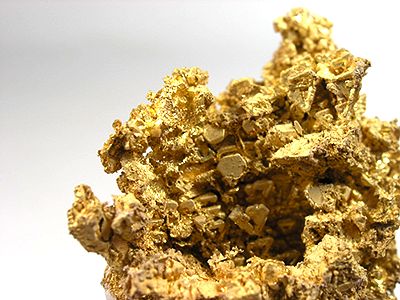
Crystallized gold from California.
Photo by Rob Lavinsky


The first mining that occurred in the beginning of the 1849 gold rush was from placer mines that were often operated by individual miners. With the discovery of the mother lode mining quickly moved underground, but it was no longer in the domain of the individual miners rather it was pooling of money required to operate lode gold mines. This new type of mining ushered in the day of large gold mining companies that made it virtually impossible for the individual miner to stay in the gold mining business. The industrialization of the gold mining business left plenty of opportunities for the individual to work as a miner in the large mines.

Although most of the placer gold was mined during the mid-19th century every spring freshet brings out a new batch of gold from the surrounding hills and mountains where it is concentrated in the rivers and streams. Although most of the gold mining in California today isn't hard rock mines a substantial portion of placer gold is still produced in the state. Much of this placer gold is produced by small-scale miners rather than the major corporations.

Hydraulicking a type of placer mining in California where high pressure water was directed against gold bearing gravel deposits.  This particular operation was at Dutch Flats, California.  Hydraulic gold mining was outlawed during the 19th century as one of the first environmental laws ever passed. 


Even though the areas that were extensively mined during the gold rush are still capable of yielding placer gold in quantities large enough to attract the small-scale miner, gold can be found in virtually all the rivers and streams in the state, as well as along the beaches of the Pacific Ocean.

Wednesday, March 9, 2011

Gold Occurrences in Alabama:

The history of mining in Alabama goes back to the early 1800s when they actually had a Goldrush that occurred 20 years before the California Goldrush. Many of the Alabama gold miners went to California because there was more gold although at one time the state had thousands of miners that were searching for gold.

The gold in Alabama is found in the Southern Gold belt that enters the state from Georgia in an area in central Alabama but is about 60 miles wide and 100 miles long. This Gold belt has the appearance of looking like an old sock, but it is a scenario where both placer and lode gold deposits are located.

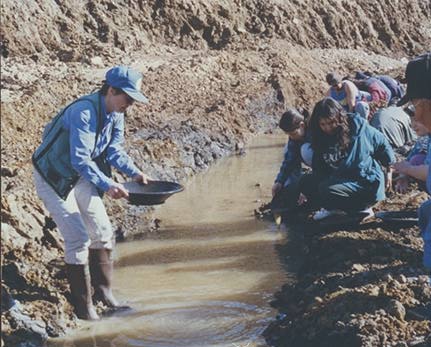
Panning for gold

There are many creeks and rivers in Alabama where you can pan for gold, but many of these places are populated with water moccasins so be extremely careful where you put your hands when you are panning for gold. A bite from one of these critters may not kill you, but it hurts like the blue blazes and will cause you to be very sick. If you have misfortune to be bitten by one of these critters don't panic and get yourself immediately to a hospital or doctor. Don't try to treat the bite yourself let the doctors deal with it they know what they're doing.

This is a cottonmouth water moccasin a highly poisonous snake found in Alabama.
The reason thay are called cottonmouths is because of the white color of the inside of their moutns.
This one is coiled and ready for action. 

Nowadays most of the mining in Alabama is being practiced by amateur prospectors that are either using a gold pan or a sluice box. Although in the past there was a considerable amount of hard rock mining that occurred at the state but now for the most part any gold production in Alabama is in the hands of hobbyists, and small-scale miners.

Gold Ore

The gold deposits in Alabama occur as part of the Southern Gold belt that reaches all away from Maryland to Alabama. The western end of the gold bearing rocks in Alabama plunge under the sediments of the Mississippi River where they reappear again in Arkansas located in the Ouachita Mountains that had its own Goldrush in the 1800s.

In addition to look regular river and creek deposits there is another type of placer gold that is mined in Alabama that occurs in what is called a saprolite this is rock that has undergone deep weathering that at times can exceed 100 feet in depth. The gold in one of these deposits can be found loose in the red clay associated with the remnants of quartz veins.