Total Pageviews

Showing posts with label gulag. Show all posts

Friday, July 13, 2012

The Geology of Gulag Gold


Gold mining prisoners in the Kolyma Basin.  They are mining placer gold that is found throughout the area.


The Gulag Ore Field or more correctly the Ducat gold/silver deposit that is located in the central part of the Balygychan-Sugoi trough that is a graben shaped depression that is located near the town of Omsukchan, Kolyma that adjoins to its north the Okhotsk – Chukota a marginal continental volcanic belt.

The deposits of gold are centered on a Cretaceous (ca. 120 million year old) volcanic dome consisting of ultra-potassic rhyolites, ignimbrites and tuff that are interlayered with black argillites.  The whole volcanic complex is intruded at depth by a late Cretaceous (ca. 85 million year old) granite that is from 1,200 – 1,300 meters below the surface.

More gold miners at work in the Kolyma Basin


There were pulses of igneous activity that caused hydrothermal activity to occur in the dome that involved large quantities of fractured, porous and highly permeable Cretaceous rhyolite sills and other steeply dipping subvolcanic bodies to be affected covering an area that covered more then 25 square kilometers.

Most of the known mineralization was later to the younger intrusion that includes tin bearing greisen-type that occurs in the contact zones of the granitic plutons. They ore deposits himself were located at a considerable distance from the granite.

Part of the Kolyma Basin is within the Arctic Circle giving it a sub-Arctic climate having very cold winters that can last for up to six months. Most of the area is covered with permafrost and tundra. During the winter temperatures range from -19°C to -38°C with even lower temperatures found in the interior. Besides gold there are also rich reserves of silver, 10, tungsten, mercury, antimony, coal, oil and peat. It has been estimated that the area contains in addition to gold 1.2 billion tons of oil and one point 5,000,000,000 m³ of gas.

This is the area whose mineral wealth was discovered by Yuri Bilibin in the 1920s that was quickly developed into the infamous Gulag prison camps by Stalin in the 1930s. There was also the area Bilibin used as the model for his theory of Metallogeny and Global Tectonics that has gained much traction sense of the world of geology.

Development began in 1932 and of Joseph Stalin the Kolyma Basin became the most notorious place for the Gulag labor camps. It has been estimated that over 1 million people died en route to the area or in the Kolyma’s between from 1932 until 1954. It was Kolyma’s reputation that caused Aleksandr Solzhenitsyn ferrite his famous book the Gulag Archipelago. In this book Solzhenitsyn came to characterize it as the “pole cold and cruelty.”

Gold and platinum were found in the Kolyma during the time when industrialization began in the USSR under Stalin’s First Five Year Plan in a period when the need for capital that would finance this economic development.  The Kolyma Basin gold was a perfect fit and development of the basin began in 1932 based on prisoner labor. 

In 1932 construction began on Kolyma Highway into the interior those that become known as the Road of Bones because of the number of people in Paris in its construction. This role eventually came to serve 80 different camps that were not have around the region of the uninhabited taiga. The first director of the Kolyma camps was Eduard Berzin who was the Cheka officer that was removed in 1937 and shot during the period of great purges of the USSR.

Far Eastern Russia geologically is North American plate that also includes Kamchatka Peninsula in northern Hokkaido Island of Japan. This being so it is probable that the gold deposits of this part of Siberia are closely related to those found in the Tintina gold belt of Alaska. It also indicates that most landmasses on Earth are really just one supercontinent with the sole exception being Antarctica.

Thursday, April 5, 2012

Global Metallogeny and Gold Deposits


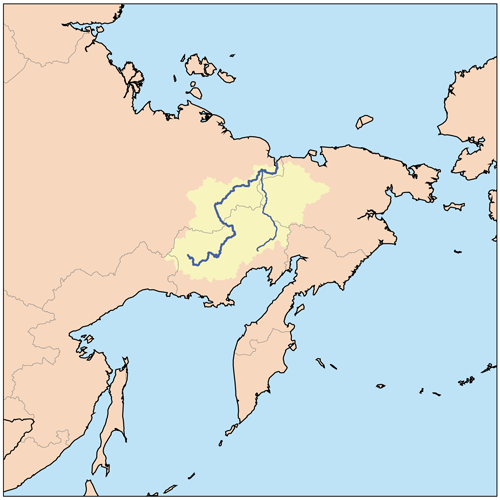
Map of the Kolyma Basin in the far east of Russia.
by Kmusser


The discovery of gold in the Kolyma Basin of the far Eastern Russia by the Soviet geologist Yuri Bilibin during the 1920s gave rise to a new science called Metallogeny and Global Tectonics. This gold producing area was later the subject of a book about the Soviet system of forced labor by Aleksandr Solzhenitsyn titled the Gulag Archipelago

In order to work three criteria have to be met, but in essence they say that mineral deposits can be found worldwide when these conditions are met.

1)      Mineral deposits are formed whenever energy is released at plate boundaries whether they are converging, diverging or transform plates.
2)      Plate tectonics are the controlling factor for the formation of mineral deposits.
3)      By reconstructing fragments of plates provide a useful tool in exploration for new mineral deposits.

In any tectonic setting for the production and accumulation of mineral deposits several requirements have to be fulfilled there has to be either a spreading center, a mountain building episode at a plate convergence or collision boundary, in craton rift centers, or cratonic basins.

The mid-Atlantic Ridge outlined by dotted lines.  This is a typical spreading center.


Deposits at Spreading Centers

In active spreading centers such as the mid-Atlantic Ridge or in the Red Sea where Africa is separating from Arabia are metallaiferous sediments on the flanks of the ridges that in many places are also marked by black smokers that contribute to the metal deposits.  Although these sediments primarily contain as sulfides iron, zinc, copper, lead, silver and gold; some deposits such as in the Red Sea containing iron, copper and zinc.

At some ridges important deposits of manganese oxide deposits are lain down.  This is especially important along the mid-Atlantic Ridge.

Another set of minerals found in ultramafic rocks that are called ophiolites are asbestos, chromite and nickel.  These minerals are found in Phanarozoic mountain belts where they are transported by tectonic movement.  The chromite is often found in Podiform deposits in ultramafic rocks most notably serpentines.  A different type of deposit of the same origin is massive sulfide deposits of iron and copper sulfides also associated with these ophiolite deposits.

A typical convergent plate margin aka a subduction zone.  


Deposits at Convergent Plate Margins

There are actually two types of convergent plate margins, one of them is where two continents are converging and the other is where two island arcs are converging metal deposits are commonly found at either type of plate margin.  The largest of these margins is the Circum Pacific Belt that contains major metallic deposits including over half the world’s production of copper.  All the metals can be found at convergent margins.

The zoning of mineral deposits in one of these zones is quite apparent with different zones being encountered the further you are away from the margin.  These varying deposits are liberated from the plate the further it descends beneath the mantle wedge with tin coming out of the slab at a depth of about 300 kilometers.  These metals come up with magmatic fluids and are concentrated in hydrothermal and magmatic fluids.  Epithermal deposits are commonly found in this regime.  Oil and gas are found associated with this type of convergent margin.  In some places hydrothermal fields are also found.


Collision Boundary Deposits
  
Collision boundary deposits are a wild mélange of differing types of mineral from a wildly differing variety of environments ranging from deposits associated with spreading centers to deposits found at plate margins.  Typical of these deposits are those found on the ocean floor that are spotted across the width of the plate that are subducted beneath the continental plate with the metal deposits being brought up into the margin by tectonic movements.  These ocean floor deposits are the primary deposits from which others are derived.

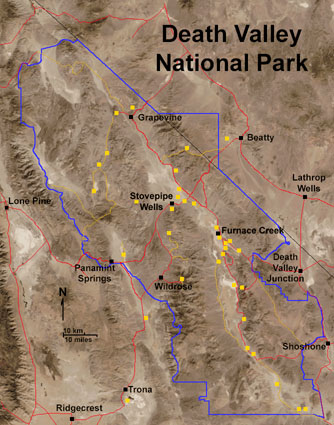
Death Vallet, California the yellow dots show the location of mines. This is a typical example of a cratonic rift system.
USGS


Cratonic Rift Systems

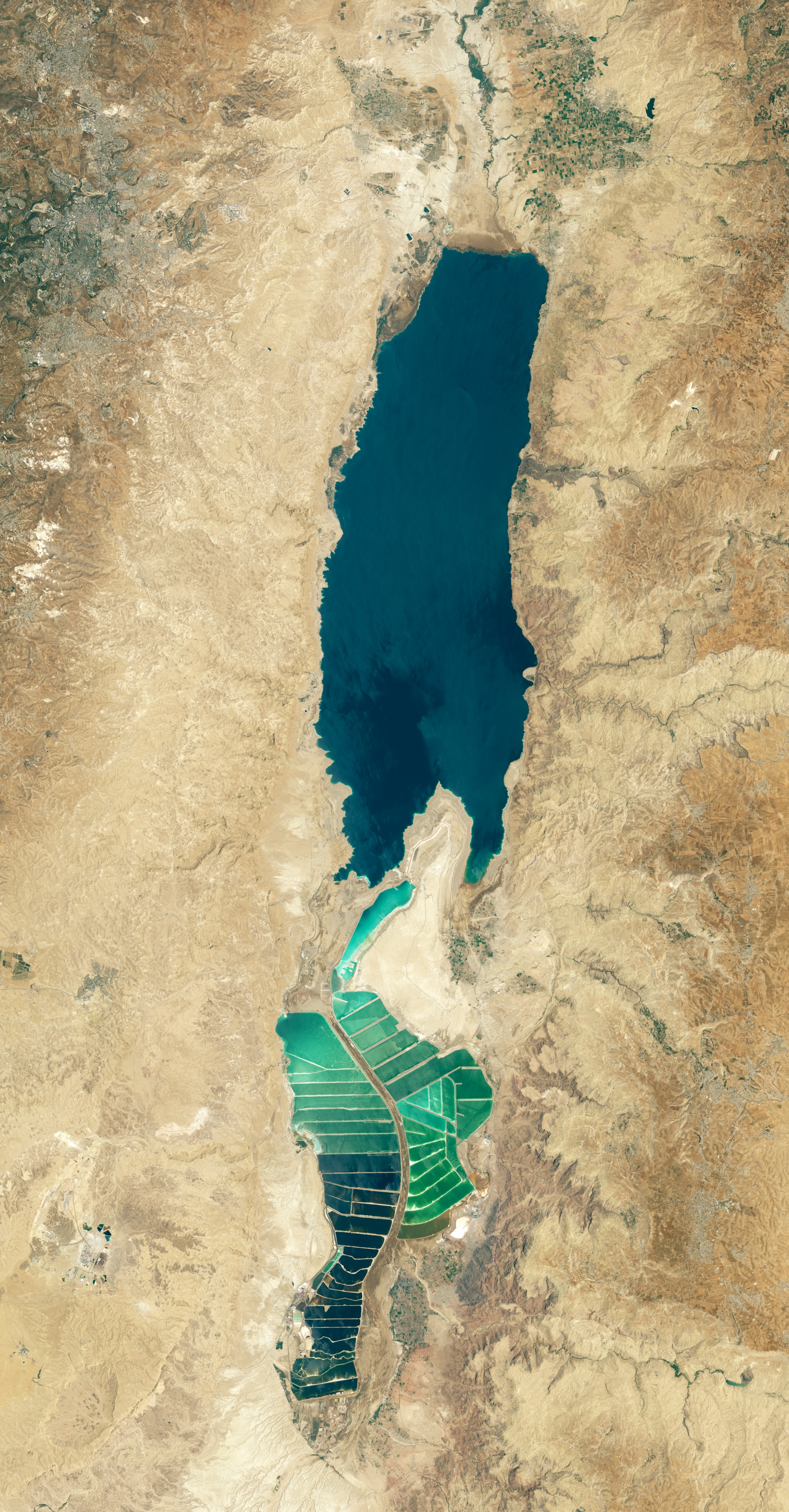
 Hot spots in the mantle of the earth cause a blister to form at the surface of the earth that causes three cracks to form on the surface two of them form an ocean and the third is called a failed arm of the sea or an aulacogen. A good example of this type of feature is the Ottawa Aulocogene in Canada.  Usually any granites emplaced during the early stages of this kind of development are rich in tin and fluorite.  Later in their development aulacogenes collect large accumulations of evaporates and other metallaiferous deposits.  In their late stages they are apt to develop deposits of fluorite, barite and carbonatites.  These can be characterized by deposits of niobium, phosphorus, rare earth elements (REE), uranium, thorium and in places tin bearing granites.  Geothermal fields also occur along rifts because of the upwelling of magma along the rifts. 

The Dead Sea from space.   NASA


Cratonic Basins

Cratonic basins are where the inflow of water from the sea causes an accumulation of organic debris from which petroleum products are derived.  The basin is also a place where evaporate deposits are laid down especially salt hence the association of salt and petroleum products.  The heat required for the transformation of organic matter is supplied by the burial of the debris under layers of sediment.  An example of a cratonic basin is Death Valley in eastern California.  One of the products of the ongoing evaporation is borax.  With continued rifting the basin usually becomes filled with water so that the circulation in the system goes from restricted to unrestricted with the depositation of organic matter ceases so does the depositation of evaporites.

Petroleum products aren’t the only thing deposited in cratonic basins like all the landforms described above gold and other metals are also deposited.  By understanding these features you have a pretty good idea of how metals are deposited so you can design an effective exploration plan.


Thursday, October 13, 2011

Why there is little or no Placer Gold in the Northern US or Canada

The answer is simple; the action of the glacier destroyed the placer gold deposits. It is hard to realize that the last period of continental glaciation lasted until about 12,500 years ago when the glaciers started to recede. The northern U.S. and Canada were covered with ice sheets that were up to two miles thick. It was the grinding action of this glacier that destroyed most placer deposits of gold.

Two exceptions to this continental glaciation can be found in Alaska and Northeastern Siberia. This whole area was largely ice free due to its arid climate during the period of continental glaciation. In Alaska this left the Tintina Gold Belt largely uncovered giving rise to two of the greatest gold rushes of modern times; the Klondike and the Fairbanks rushes. In Siberia extensive placer deposits of gold were found in the Kolyma River Basin that gave rise to the slave labor camps that were known as the Gulag. This area was above water during the glaciations and was known as Berengaria a continental landmass of continental proportions. Berengaria provided a land bridge between Asia and North America allowing the migration of animals and mankind from one to another.

Due to the grinding action in a large glacier it is doubtful that little or no gold in the northern U.S. had its origin in Canada. To be reduced to fine powder gold it wouldn’t have to travel too far in a glacier with a top figure of around 300 kilometers.

The thin placer deposits found in New England are more likely have been derived from lode deposits buried under the covering of glacial till that for the most part is around 4 meters deep and can range to well over 100 meters. We have personally observed lode gold deposits in place making it virtually possible that if you are finding placer deposits larger then gold dust that it has its origin in buried lode deposits.

In New England the glacier traveled roughly northwest to southeast. On one occasion we observed a gold nugget from a stream in western Connecticut that weighed about a pound. This nugget was barely rounded and was at least one-half quartz, a clear indication it hadn’t traveled too far from its source. For that reason we would like to have reports of any placer gold found in New England larger then flour gold. You can reach us at geotekllc@gmail.com.

Saturday, June 25, 2011

Gulag Gold

Prisoners working in the Gulag The prisoner who took this photo died short;y afterward.


It was during the 1920s when gold was first found in the Kolyma River Basin by Yury Bilibin a pioneering Soviet geologist.  It was immediately after his discovery that Joseph Stalin founded the infamous prison camps that became the notorious “Gulag” whose purpose was to supply gold to the fledgling Soviet Union.  It was in these camps where criminals and political dissidents were sent to mine gold under the most barbaric conditions.  They were Death Camps where a human life was only worth three weeks of labor and then was discarded.

Prisoners at work mining gold in the Gulag
Yury Bilibin was a young geologist, but already well known in the Soviet Union when he was picked to lead the first expedition into distant reaches of northeastern Russia as head of the First Kolymian Expedition of 1928 - 1929. This was when they discovered extensive deposits of gold that under Joseph Stalin and the Soviet Union were slave labor camps.  It was here that Bilibin developed his theories on placer gold deposits and intrusive volcanics that led to the development of the theory of Metallogeny and Plate Tectonics. In 1938 he published his famous monograph the “Principles of Placer Geology.”  For his work as one of the fathers of this science Bilibin received The Stalin Prize First Degree of the Soviet Union.

For the next 80 years this part of Russia has been extensively explored by geologists who have developed into working mines producing other metals other then gold until today it is a major mining center of Russia. Since the fall of the Soviet Union it has attracted the attention of many American mining companies.

These are the dead in the Gulag.
The Gulag was a system of forced labor camps established by Cheka in 1919 in the Soviet Union, but it wasn’t until the early 1930s that the population of these camps became significant.  By then it was under the control of the Main Directorate of Corrective Labor Camps commonly called the Gulag.  It was no longer operated by the Cheka, but now was under the NKVD, and later the KGB.  All of these organizations were parts of the secret police.  It continued to operate from 1919, but was mainly disbanded after the death of Stalin in 1953.  Parts of the Gulag continued to operate until the days of Gorbachev into the 1990s.  The fall of the Soviet Union in 1991 finally wrote “finish” to the Gulag.

This is one of the gold mining camps in the Gulag.
The prisoners in the Gulag comprised a polyglot group of including murderers, thieves and political and religious dissenters forced to work under barbaric conditions. The Soviets used Gulag Labor for many projects beside mining gold they were also used to build the White Sea – Baltic Canal, the Moscow – Volga canal, the Baikal – Amur main railroad line, a large number of hydroelectric installations, numerous industrial projects in remote areas of the Soviet Union.  It was Gulag manpower that did most of the country’s lumbering and mining for coal, copper and gold. 

Gold was what they mined in the Kolyma Basin, placer gold that was mined by prisoners. A book was published the Gulag Archipelago by Aleksandr Solzhenitsyn a survivor of the camps gives a graphic description of life in the Gulag. Solzhenitsyn was eventually released from the Gulag and exiled from the Soviet Union to settle in the United States where he made his home in Vermont.  The downfall of the Soviet Union saw Solzhenitsyn return to Russia. Today his book, the Gulag Archipelago is required reading in all the schools of Russia as a reminder of what happened in the Gulag.  Not since the days of the Roman Empire had miners labored under such conditions.