Total Pageviews

Showing posts with label deposits. Show all posts

Friday, July 13, 2012

The Geology of Gulag Gold


Gold mining prisoners in the Kolyma Basin.  They are mining placer gold that is found throughout the area.


The Gulag Ore Field or more correctly the Ducat gold/silver deposit that is located in the central part of the Balygychan-Sugoi trough that is a graben shaped depression that is located near the town of Omsukchan, Kolyma that adjoins to its north the Okhotsk – Chukota a marginal continental volcanic belt.

The deposits of gold are centered on a Cretaceous (ca. 120 million year old) volcanic dome consisting of ultra-potassic rhyolites, ignimbrites and tuff that are interlayered with black argillites.  The whole volcanic complex is intruded at depth by a late Cretaceous (ca. 85 million year old) granite that is from 1,200 – 1,300 meters below the surface.

More gold miners at work in the Kolyma Basin


There were pulses of igneous activity that caused hydrothermal activity to occur in the dome that involved large quantities of fractured, porous and highly permeable Cretaceous rhyolite sills and other steeply dipping subvolcanic bodies to be affected covering an area that covered more then 25 square kilometers.

Most of the known mineralization was later to the younger intrusion that includes tin bearing greisen-type that occurs in the contact zones of the granitic plutons. They ore deposits himself were located at a considerable distance from the granite.

Part of the Kolyma Basin is within the Arctic Circle giving it a sub-Arctic climate having very cold winters that can last for up to six months. Most of the area is covered with permafrost and tundra. During the winter temperatures range from -19°C to -38°C with even lower temperatures found in the interior. Besides gold there are also rich reserves of silver, 10, tungsten, mercury, antimony, coal, oil and peat. It has been estimated that the area contains in addition to gold 1.2 billion tons of oil and one point 5,000,000,000 m³ of gas.

This is the area whose mineral wealth was discovered by Yuri Bilibin in the 1920s that was quickly developed into the infamous Gulag prison camps by Stalin in the 1930s. There was also the area Bilibin used as the model for his theory of Metallogeny and Global Tectonics that has gained much traction sense of the world of geology.

Development began in 1932 and of Joseph Stalin the Kolyma Basin became the most notorious place for the Gulag labor camps. It has been estimated that over 1 million people died en route to the area or in the Kolyma’s between from 1932 until 1954. It was Kolyma’s reputation that caused Aleksandr Solzhenitsyn ferrite his famous book the Gulag Archipelago. In this book Solzhenitsyn came to characterize it as the “pole cold and cruelty.”

Gold and platinum were found in the Kolyma during the time when industrialization began in the USSR under Stalin’s First Five Year Plan in a period when the need for capital that would finance this economic development.  The Kolyma Basin gold was a perfect fit and development of the basin began in 1932 based on prisoner labor. 

In 1932 construction began on Kolyma Highway into the interior those that become known as the Road of Bones because of the number of people in Paris in its construction. This role eventually came to serve 80 different camps that were not have around the region of the uninhabited taiga. The first director of the Kolyma camps was Eduard Berzin who was the Cheka officer that was removed in 1937 and shot during the period of great purges of the USSR.

Far Eastern Russia geologically is North American plate that also includes Kamchatka Peninsula in northern Hokkaido Island of Japan. This being so it is probable that the gold deposits of this part of Siberia are closely related to those found in the Tintina gold belt of Alaska. It also indicates that most landmasses on Earth are really just one supercontinent with the sole exception being Antarctica.

Thursday, May 31, 2012

The Homestake Gold Mine of South Dakota


The open pit portion of the Homestake Gold Mine in Lead, South Dakota.  This is only a small part of the mine because it extends into the earth for thousands of feet making it at one time the deepest mine in the western hemisphere.
Photo by Rachel Harris


This mine traces its origins all the way back to 1876 when it was discovered by Fred and Moses Manuel, Alex Engh, and Hark Harney in April, during the Black Hills Gold Rush.  The following year it was sold to a trio of gold entrepreneurs, George Hearst, Lloyd Tevis and James Ben Ali Haggin who bought the mine from the group that discovered it for the sum of $70,000.  In October 1877 George Hearst appeared at the scene of the mine where he took active control.  All the mining equipment used at the mine had to be hauled in by oxcart from the nearest railhead in Sidney, Nebraska.  Even though the mine had a remote location by July 1878 the 80-stamp mill started to crush the ore from the mine.

The mine is located in a domal uplift that is about 100 kilometers long and 60 kilometers wide straddling the border of South Dakota and Wyoming.  The Black Hills were uplifted during the Laramide orogeny that occurred between 60 and 65 million years ago, and are an outlier of the Rocky Mountains.  The rocks exposed in this range are from 2.7 billion years old to 60 million years old.  The core of the mine is composed of Precambrian phyllite, cummingtonite schist and granite with the Black Hills surrounded by younger sedimentary rocks.  Most of the gold deposits are associated with a Precambrian banded iron formation.

Hearst and his partners sold shares in the Homestake Mine and had it listed on the New York Stock Exchange in 1879 where it is too this day as one of the longest-listed stocks on the exchange.  The stock that has been listed the longest is Con Edison, whose original name was New York Gas Light whose listing dates back to 1824.

Under their control the mine’s holdings were increased sometimes by fair means or if that didn’t work by foul means.  They bought out some of the adjacent claims, but weren’t adverse about using the courts to obtain others.  There is even evidence that one man was murdered by one of the group’s men because he refused to sell his claim to them.  The case was dropped when all the witnesses to the murder vanished.  Hearst bought out the newspaper in Deadwood to sway public opinion his way, with the editor of the opposing newspaper was beaten up while walking down a Deadwood street.  Hearst himself realized that he could be murdered and asked his partners to take care of his family if he was; in the end though it was Hearst that walked away smiling, still alive and very rich.

Although the gold ore mined at Homestake was always low grade averaging less then an ounce per ton it existed in vast quantities.  During its lifetime the mine produced 39.8 million ounces of gold along with 9 million ounces of silver.  The mine is the only one in the Lead mining district was the second largest producer of gold in the United States.  The largest producer of gold is the Carlin Trend in Nevada.

At the end of 2001 production at the Homestake ceased for several reasons including low gold prices, poor ore quality combined with high operating costs.  There had been a merger with Barrick Gold Corporation and Homestake Mining Company in mid-2001.  They agreed to keep the mine dewatered while negotiations for its further use continued with DUSEL, but progress along these lines continued at a snails pace.  As negotiations dragged on it was costing Barrick $250,000 for maintaining the pumps and ventilation system so on June 10, 2003 Barrick threw the switch and closed the mine completely.

After being closed for six years researchers at Berkeley announced that the Homestake Mine would be used as a research facility causing it be reopened for the study of neutrinos and dark matter particles.


Sunday, April 1, 2012

Meteor Strikes, Plate Tectonics and Gold Deposits


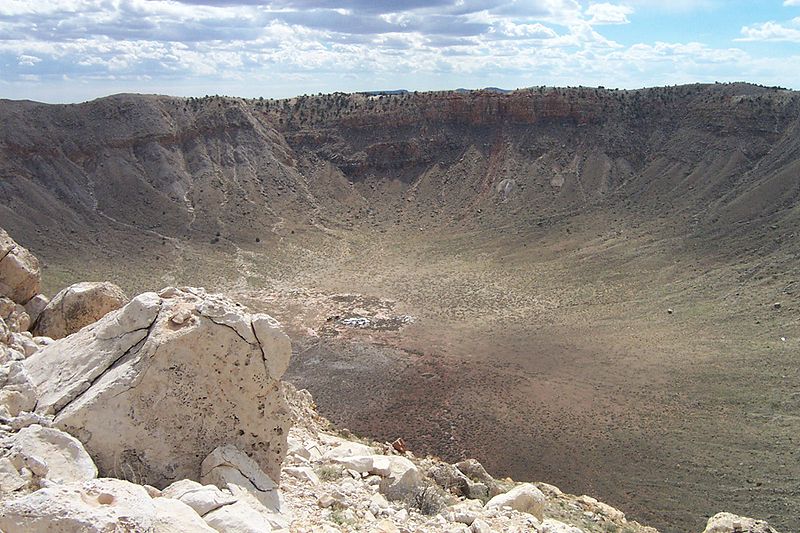
The Barringer Meteor Crater at Winslow, Arizona.  This meteor exploded on impact and left no remains other then fragments behind.  As craters go this is relatively small the crater at Sudbury, Ontario was almost 350 miles in diameter and punched through to the earth's mantle.  It was later deformed to its present size of approximately 20 X 40 miles.
Photo by 
Deborah Lee Soltesz, USGS


Although geologists know a vast amount of knowledge about the early earth the relationship between major meteor striks, plate tectonics and the depositation of gold is completely theoretical.  Perhaps we shall never know if this happened during earth’s early history unless we are unfortunate enough for it to occur again now.  The reason this has stayed a theory is because it is immensely preferable to the reality of a massive meteor strike.

The last time such an event occurred was the Chixculub event at the end of the Cretaceous over 60 million years ago that wiped out the dinosaurs smashed into the area of the Yucatan Peninsula of Mexico blasting a crater 180 kilometers in diameter, and raising tsunamis estimated to be five miles high.  The asteroid causing this event has been estimated to be 60 kilometers in diameter.  It has been estimated by geologists it took several seconds to penetrate the earth’s crust.  Today the remnants of this crater are buried under several thousand feet of sediments.

Even though plate tectonics are well it understood by geologists the root cause of the phenomena as not very well understood, Vicki Hansen of the University of Minnesota proposes a unusual but conceivable theory for the origin of plate tectonics.  Hansen suggests that a massive meteor strike that occurred about 3 billion years ago created a chain reaction leading to the plate tectonics we see today. According to the theory the early Earth was covered by a soft layer of felsic crust covering the whole earth. It is supposed in this theory that there was a massive media or strike on a weak spot in the felsic crust that rested over a mafic, molten magma beneath the crust. The meteor strike caused the mantle to erupt that in turn cause live up to spew onto the surface of the crust that solidified into a mafic crust. Finally the brittle mafic crust expanded until it was forced under the softer felsic crust. It was the resulting fragmentation and rearrangement of the Earth's surface that started the plate tectonics cycle that has persisted until today. 

An artist's rendition of the Chixulub Event that drove the dinosaurs to extinction
By 
Don Davis/NASA


Plate tectonics supply two of the heat engines necessary to create mineral deposits, namely regional metamorphism and volcanic or magmatic activity.  The third type that has only recently recognized is that caused by a major meteor strike capable of penetrating the earth’s crust. It wasn't until the true nature of the mineral deposits at Sudbury, Ontario was recognized as being caused by a meteor strike that geologists started looking for similar deposits and have discovered that virtually all large impact craters have associated mineral deposit that are predominantly nickel and copper although precious metals are including gold and platinum group metals are found as byproducts.