Total Pageviews

Showing posts with label silver. Show all posts

Thursday, May 24, 2012

Peter Janni’s Silver Chimney


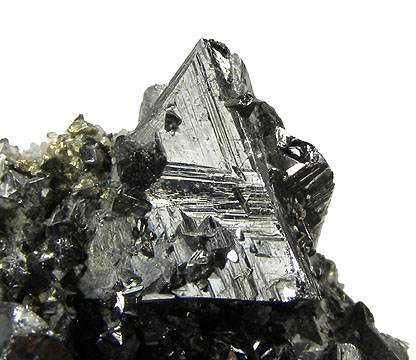
Tetrahedrite
Photo by Rob Lavinsky


This story sounds almost like it is untrue, but if you’ve ever worked for an old country contractor you know you can’t tell them anything.  The principal character in this tale was a one Peter Janni that was born in Italy in 1874 that eventually came to America to work on the railroad.  Eventually he fetched up in Northport, Washington where he proceeded to buy a limestone quarry just south of the town.  Janni sold limestone all over the state of Washington out of his quarry.

This quarry is located in the tetrahedrite zone in northern Stevens County.  The ore deposits are found in vugs and a structure called a chimney where narrow veins of galena bearing large percentages of silver are sometimes found.  In 1953 the quarry workers at Janni’s quarry found such a chimney that measured roughly 5 x 6 feet on the second level of the quarry.

The workers followed the chimney down and shipped almost forty tons of ore to the lead refinery owned by the CM&S Company in Trail, British Columbia.  Once they had reached down the chimney for fifteen feet Janni came over to where they were working and told the men to, “Cover the damn thing up.”  The men pleaded with Janni to let them continue following the chimney, but Janni refused telling them, “Maybe someday we will dig her up again.”

Nobody has any idea what got into Janni’s head that day, but according to some old timers still living in Northport this rich chimney is still in the quarry where it is it is buried under tons of limestone still on the second level.

Monday, March 14, 2011

Pure Gold and Electrum

The most common form of free gold that is found in placer deposits and some lode deposits is in the form of a naturally occurring alloy of gold and silver called electrum. In nature gold can also be alloyed with arsenic, bismuth, copper and platinum group metals (PGM). There were so many PGM's associated with Peruvian gold that many years later many of the antique coins from Peru were melted down for their platinum content.

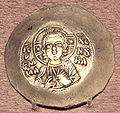
An Electrum Coin from Constantinople 

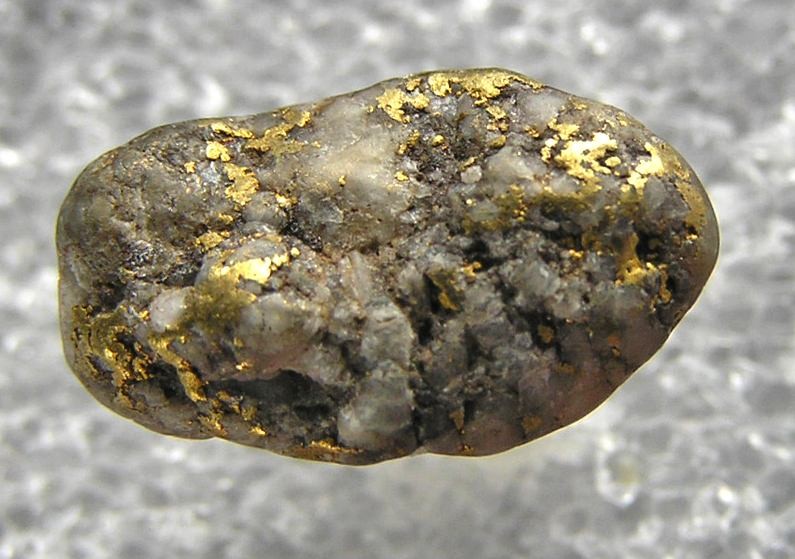
Naturally occurring electrum is the alloy of gold and silver is called electrum that can range from a bright golden yellow through various shades of gold where the color of gold becomes lighter and lighter until it finally becomes silver. In the jewelry trade this is called White Gold although most of it is man-made.

Electrum was the type of natural gold that was mined by the ancient Egyptians to the east of the Nile River from the desert between the river and the Red Sea. To the ancient Greeks it was known as gold or white gold that differentiated it from refined gold. The color of electrum can range anywhere from bright pale yellow to silver depending upon the amount of silver that is alloyed with the gold.

A nugget of electrum
Photo by Rob Lavinsky

A great deal of electrum is found in the ranges of Western Anatolia (Turkey) where the amount of gold can range from 70 to 90%. This type of electrum is in contrast to the electric that was used by the ancient Lydians that live in this area for coinage that ranged from 45 to 55% that is in approximately the same geographical area. This suggests that the coinage minted in Lydia were coins were invented was to increase the profits through artificially adding silver to gold so as to make more profit through the process of seignorage by issuing to the populace of Lydia a coin possessing a lower gold content that was found in the natural gold in the area.

The use of electrum goes all the way back to the third millennium BC during the days of the old Kingdom of Egypt or was often used as an exterior coating to the pyramidions that were atop the ancient Egyptian pyramids and obelisks.  They also used electrum for making ancient wine cups and in some places coins.

Friday, February 25, 2011

The World of Volcanogenic Massive Sulfides (VMS)

As a source of gold volcanogenic massive sulfides are not the primary source, but they do contain a substantial amount of gold as a byproduct. These deposits also hold significant amounts of copper, lead, zinc as well as gold and silver. Throughout history the VMS deposits are generally not the first choice of miners, as they are usually small and can be difficult to process. In today's world they have become a more significant source of metals than they were in the past because of advances in technology as well as the recent high metal prices that have caught the attention of prospectors.

This is Rouyn-Noranda the home of a VMS deposit. The Horne Smelter is in the background.

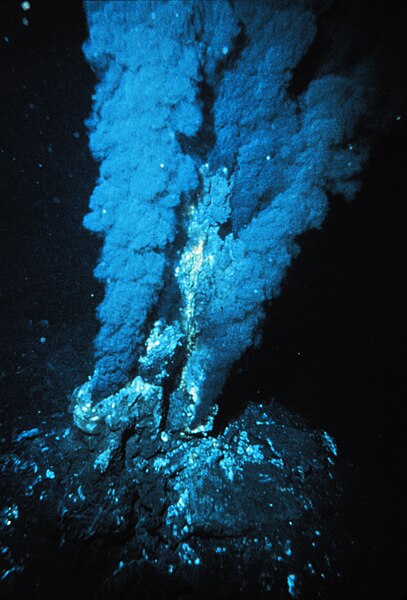
Deposits of VMS minerals can take in a variety of shapes occurring typically as lenses of polymetallic massive sulfide subform in patches on the seafloor near black smokers. Deposits of this nature can be found in extensional tectonic settings that include both spreading from the tectonic ridge, or can also be found in back arc basins such as the modern Sea of Japan. They range in age from some of the oldest rocks on Earth to the modern black smokers that are found in oceanic spreading centers.

Many deposits of this type that were once on the ocean floor have been incorporated in the continental crust by tectonic earth movements, so they are now on land. Even with the location of many of these deposits on dry land there are still many other exploration and mining companies that are interested in recovering minerals from the seafloor VMS deposits.

A black smoker where VMSs are formed in the Atlantic Ocean

Deposits of the VMS type are grouped according to the type of rock they are hosted in or on the basis of ore composition. This type of deposits can be classified in three different ways.

1. These are felsic volcanic hosted making up the most popular category that accounts for at least 50% of the deposits. Examples of this type of deposits can be found in the Abitibi region of Canada in Québec and Ontario.

2. These are mafic volcanic hosted accounting for about 30% of the deposits,

3. These are interbedded with a mixed bag of volcanic and sedimentary rocks that account for an additional 20% of VMS deposits.

The ore found in these deposits is broken into two groups: copper, zinc and zinc, lead and copper they also contain significant amounts of gold and silver.