Total Pageviews

Showing posts with label black smokers. Show all posts

Friday, May 13, 2011

Gold Deposits associated with Black Smokers


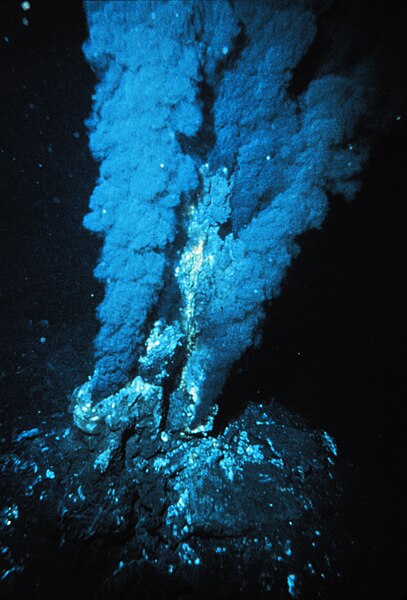
A black smoker and associated white smokers are found at spreading centers in the middle of the ocean.  What the smoke that is produced from one of them is in reality finely divided metal sulfides that are leached from the oceanic crust by seawater percolating through the ocean bottom to a depth of several hundred feet that is heated to a temperature that can exceed 300o C. As the mineral charged hot water is discharged to the open ocean it is suddenly cooled causing the dissolved minerals to precipitate out and form deposits of metals on the ocean floor.
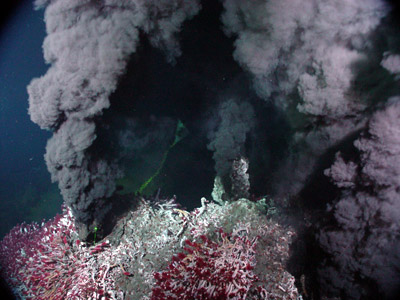
A black smoker at the sea bottom.  The black smoke is caused from finely divided  metal sulfides.


Black smokers are located on a tectonic spreading center where two plates are being forced apart by upwelling of basaltic magma. If the black smoker were on dry land it would be considered a hot spring, but because they are at the bottom of an oceanic trench in waters that exceed 12,000 feet they have earned the name Black Smokers because of the plumes of metal sulfides that emanate from them. There are some of these features that have white plumes of metal carbonates associated with them, and they are known as white smokers.
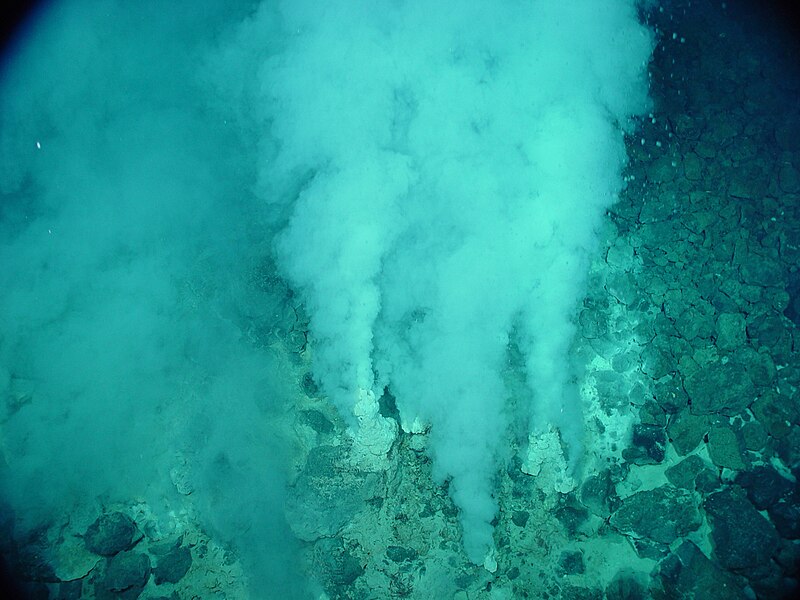
A white smoker producing carbon dioxide gas and metal carbonates.


Most of the metals that come from these hot springs are copper, lead and zinc, but there are also other metals such as gold and silver that are deposited on the seafloor, or are carried away in solution from the site of the black smoker. Aside from the primary metals that are deposited as sulfides at the site there are a number of other secondary metals that are also deposited such as indium, germanium and cadmium.  These models are also produced as byproducts and during the smelting process.

These products are known as Volcanogenic Massive Sulfides (VMS) and are represented in several large deposits in Archean aged rocks. Two notable examples these are found in the Abitibi region of Canada as the Kidd Creek mine to the east of Timmins Ontario, and the Horne mine near Rouyn-Noranda, Quebec. These are VMS deposits that are on 2.6 billion years old that were deposited when the overall temperature of the earth was much higher than it is now.

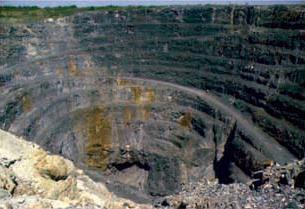
The open pit portion of the Kidd Mine in Timmins, Ontario.  It is thought by many that the Kidd Mine is an ancient  black smoker.


Although gold is founded on the VMS deposits as a byproduct more often it is mobilized during the process of subduction where it is deposited in separate quartz veins, or other gold traps that are removed from the main VMS deposits. Examples of this can be found in the green belt deposits throughout the world. Even though the mountains are now worn down to their roots in many places these deposits originated as black smokers in the depths of the sea prevail on dry land.

The deposits of black smokers have dotted the surface of the ocean bottom on both sides of the spreading center. As these deposits are moving away from the spreading center they become covered sometimes to great depths with sediments raining down from the surface of the ocean until they eventually are subducted beneath a continental or other oceanic plate where they are recycled to form other types of mineral deposits.

Geologists like to talk about the many different cycles that affect the Earth one of these might just as well be the mineral cycle that occurs as the Earth recycles the different mineral deposits forming new and different deposits of the same mineral.

Friday, February 25, 2011

The World of Volcanogenic Massive Sulfides (VMS)

As a source of gold volcanogenic massive sulfides are not the primary source, but they do contain a substantial amount of gold as a byproduct. These deposits also hold significant amounts of copper, lead, zinc as well as gold and silver. Throughout history the VMS deposits are generally not the first choice of miners, as they are usually small and can be difficult to process. In today's world they have become a more significant source of metals than they were in the past because of advances in technology as well as the recent high metal prices that have caught the attention of prospectors.

This is Rouyn-Noranda the home of a VMS deposit. The Horne Smelter is in the background.

Deposits of VMS minerals can take in a variety of shapes occurring typically as lenses of polymetallic massive sulfide subform in patches on the seafloor near black smokers. Deposits of this nature can be found in extensional tectonic settings that include both spreading from the tectonic ridge, or can also be found in back arc basins such as the modern Sea of Japan. They range in age from some of the oldest rocks on Earth to the modern black smokers that are found in oceanic spreading centers.

Many deposits of this type that were once on the ocean floor have been incorporated in the continental crust by tectonic earth movements, so they are now on land. Even with the location of many of these deposits on dry land there are still many other exploration and mining companies that are interested in recovering minerals from the seafloor VMS deposits.

A black smoker where VMSs are formed in the Atlantic Ocean

Deposits of the VMS type are grouped according to the type of rock they are hosted in or on the basis of ore composition. This type of deposits can be classified in three different ways.

1. These are felsic volcanic hosted making up the most popular category that accounts for at least 50% of the deposits. Examples of this type of deposits can be found in the Abitibi region of Canada in Québec and Ontario.

2. These are mafic volcanic hosted accounting for about 30% of the deposits,

3. These are interbedded with a mixed bag of volcanic and sedimentary rocks that account for an additional 20% of VMS deposits.

The ore found in these deposits is broken into two groups: copper, zinc and zinc, lead and copper they also contain significant amounts of gold and silver.

Thursday, February 24, 2011

Prospecting Ancient Tectonic Ridges

The ridge is at the center of a spreading zone where magma being erupted through the ridge causes spreading that is usually seafloor; one exception is Iceland where the ridge is exposed on dry land.  A ridge is also the home to “black smokers” that are the surface manifestation of leaching minerals from the oceanic crust.  It is fine metal sulfides that cause the smoke like effects when the hot water cools enough to cause these minerals to precipitate where they are deposited in chimney like structures around the black smoker.

The Kidd Creek Mine in Timmins, Ontario an example of a volcanic massive sulfide deposit.
NOAA

 When these sulfides are deposited they persist for billions of years creating mines that are termed “Volcanogenic Massive Sulfides” (VMS).  Some of the greatest metal sulfide deposits on earth are of this type.  There are many examples of deposits of this type around the world two of them are found in the Abitibi region of  Canada the Horne mine is Rouyn-Noranda, Quebec and the Kidd Creek mine in Timmins, Ontario.