Total Pageviews

Friday, May 13, 2011

Gold Deposits associated with Black Smokers


A black smoker and associated white smokers are found at spreading centers in the middle of the ocean.  What the smoke that is produced from one of them is in reality finely divided metal sulfides that are leached from the oceanic crust by seawater percolating through the ocean bottom to a depth of several hundred feet that is heated to a temperature that can exceed 300o C. As the mineral charged hot water is discharged to the open ocean it is suddenly cooled causing the dissolved minerals to precipitate out and form deposits of metals on the ocean floor.
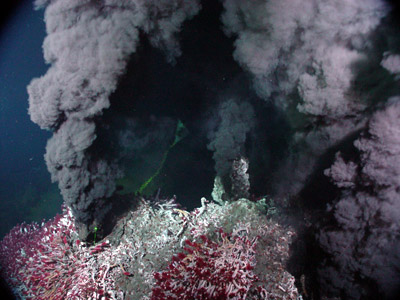
A black smoker at the sea bottom.  The black smoke is caused from finely divided  metal sulfides.


Black smokers are located on a tectonic spreading center where two plates are being forced apart by upwelling of basaltic magma. If the black smoker were on dry land it would be considered a hot spring, but because they are at the bottom of an oceanic trench in waters that exceed 12,000 feet they have earned the name Black Smokers because of the plumes of metal sulfides that emanate from them. There are some of these features that have white plumes of metal carbonates associated with them, and they are known as white smokers.
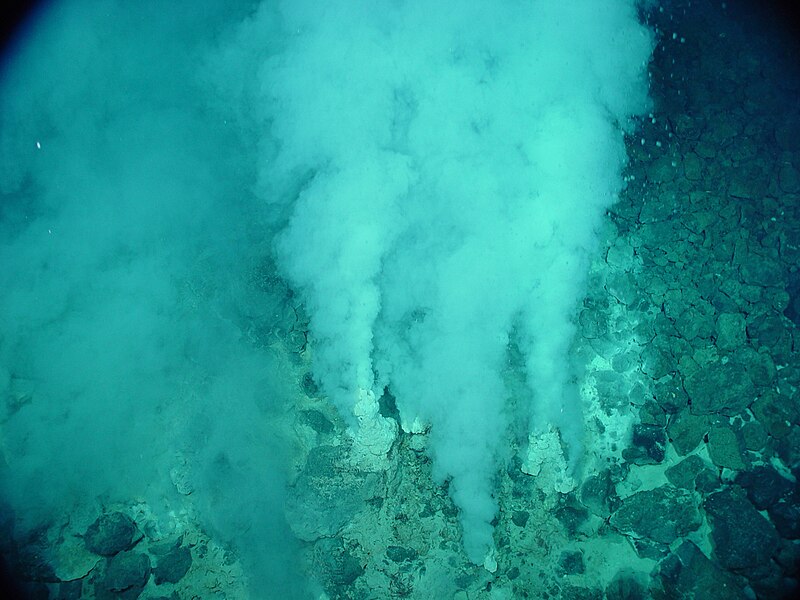
A white smoker producing carbon dioxide gas and metal carbonates.


Most of the metals that come from these hot springs are copper, lead and zinc, but there are also other metals such as gold and silver that are deposited on the seafloor, or are carried away in solution from the site of the black smoker. Aside from the primary metals that are deposited as sulfides at the site there are a number of other secondary metals that are also deposited such as indium, germanium and cadmium.  These models are also produced as byproducts and during the smelting process.

These products are known as Volcanogenic Massive Sulfides (VMS) and are represented in several large deposits in Archean aged rocks. Two notable examples these are found in the Abitibi region of Canada as the Kidd Creek mine to the east of Timmins Ontario, and the Horne mine near Rouyn-Noranda, Quebec. These are VMS deposits that are on 2.6 billion years old that were deposited when the overall temperature of the earth was much higher than it is now.

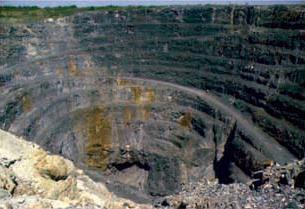
The open pit portion of the Kidd Mine in Timmins, Ontario.  It is thought by many that the Kidd Mine is an ancient  black smoker.


Although gold is founded on the VMS deposits as a byproduct more often it is mobilized during the process of subduction where it is deposited in separate quartz veins, or other gold traps that are removed from the main VMS deposits. Examples of this can be found in the green belt deposits throughout the world. Even though the mountains are now worn down to their roots in many places these deposits originated as black smokers in the depths of the sea prevail on dry land.

The deposits of black smokers have dotted the surface of the ocean bottom on both sides of the spreading center. As these deposits are moving away from the spreading center they become covered sometimes to great depths with sediments raining down from the surface of the ocean until they eventually are subducted beneath a continental or other oceanic plate where they are recycled to form other types of mineral deposits.

Geologists like to talk about the many different cycles that affect the Earth one of these might just as well be the mineral cycle that occurs as the Earth recycles the different mineral deposits forming new and different deposits of the same mineral.

Tuesday, May 10, 2011

Gold Occurrences in Nevada

The Goldstrike Mine in the Carlin Trend of Nevada   USGS


Placer gold has been found in 14 of the 17 counties in Nevada in the form of either commercially viable deposits, or deposits that are potentially viable. Most of these deposits are located in the northern and western part of the state. Many of these deposits were worked out by early prospectors, but there are many areas in the state were overlooked that can still afford a working wage if they are developed. It is especially important to hunt out areas where virgin gold can be found that were never mined in the past.

Much of Nevada is so arid that the early prospectors had several different methods of dry washing their gold bearing gravel. One of the biggest problems they had in processing placer gold was the presence of lots of caliche, a type of hardened sub-soil that attains the hardness of concrete. 

It is felt by many that the discovery of gold is an ongoing process with much of the gold still waiting to be discovered.  By drilling in the basin and range province of the United States exploration geologists are finding even richer deposits of gold then there are in the Carlin Trend.  It is claimed that prospecting in the state is exciting because there is so much undiscovered mineral wealth present, and it isn't all gold.

Placer Gold
Photo by Nienetwiler


Nevada is also the home of unique deposits of finely disseminated gold that was discovered in the 1960s by Newmont Mining Company who developed a method for extracting the gold. For the most part these cool deposits are found in an argillaceous limestone that has been subject to enter thermal alteration. This is the famous Carlin trend of cool deposits where the gold is so fine it can only be seen with electron microscope, and at times goals of the limestone was represented by a single ion.

Gold of this sort is mined using the heap leaching method of recovering the gold values. He teaching consists of piling up a heap of crushed stone about a quarter inch in diameter and treating it with a weak solution of an alkali salt of cyanide. The heap is piled up on a watertight floor that slightly slopes towards the center and all the pregnant liquor from the gold leaching process is directed to a sump where it is collected for treatment to recover the gold.

Although there are several different techniques used on the ore one of the most common is treating the pregnant liquor with powdered zinc. The gold in the liquor chemically replaces the sink it is collected as a black powder that is further refined into pure gold.

Nevada also produces many gemstones including precious opal and turquoise. The precious opal comes mainly from the Virgin Valley, and the author used to buy some really beautiful turquoise from the area around Crescent Valley.

Sunday, May 8, 2011

Gold Occurrences in California


There are 13,470 gold mines or prospects according to the California Geological Survey that are located in the state. These gold mines are found in all parts of the state but the greatest concentrations are found northeast of Sacramento in the foothills of the Sierra Nevadas. Another large concentration is found in the northwestern part of the state in the Trinity and Siskiyou Counties.  An even smaller, but dense concentration is found in Calaveras, Tuolumne and Mariposa Counties.  Gold has been found in most of the counties in the state but there are a few counties mainly in the Central Valley where gold was never been reported.

Mine buildings at the Bodie California gold mine.
Photo by Thomas Kriese
Although there were scattered reports of gold being found in California before 1848 it was the accidental discovery of gold at Sutter's Mill in Colema by John Marshall.  Marshall’s discovery touched off one of the greatest mass migrations in the history of mankind. It has been estimated that more than 200,000 people migrated to California between 1848 and 1852. California was admitted to the union in 1850 as the 31st state under the Compromise of 1850.

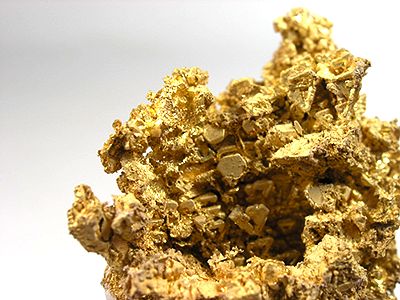
Crystallized gold from California.
Photo by Rob Lavinsky


The first mining that occurred in the beginning of the 1849 gold rush was from placer mines that were often operated by individual miners. With the discovery of the mother lode mining quickly moved underground, but it was no longer in the domain of the individual miners rather it was pooling of money required to operate lode gold mines. This new type of mining ushered in the day of large gold mining companies that made it virtually impossible for the individual miner to stay in the gold mining business. The industrialization of the gold mining business left plenty of opportunities for the individual to work as a miner in the large mines.

Although most of the placer gold was mined during the mid-19th century every spring freshet brings out a new batch of gold from the surrounding hills and mountains where it is concentrated in the rivers and streams. Although most of the gold mining in California today isn't hard rock mines a substantial portion of placer gold is still produced in the state. Much of this placer gold is produced by small-scale miners rather than the major corporations.

Hydraulicking a type of placer mining in California where high pressure water was directed against gold bearing gravel deposits.  This particular operation was at Dutch Flats, California.  Hydraulic gold mining was outlawed during the 19th century as one of the first environmental laws ever passed. 


Even though the areas that were extensively mined during the gold rush are still capable of yielding placer gold in quantities large enough to attract the small-scale miner, gold can be found in virtually all the rivers and streams in the state, as well as along the beaches of the Pacific Ocean.

Saturday, May 7, 2011

The Tools of the Trade by Raymond Kukkee, Prospector

Prospecting country in Northern Ontario this is a photo of Kakabeka Falls called the Niagara of Canada.  Ray lives in the town of  Kakabeka Falls, Ontario.
Photo by Hans Jurgen-Hubner


Raymond Kukkee has been a hard-rock prospector in Northern Ontario for over thirty years, and the following article is built on his experiences while prospecting. 

What you should take with you on a prospecting outing is always a good question. It's always better to have something and NOT need it, than to be 60 miles out on the trail wishing you did bring it along.
    
 Here's a list of what I usually take along on my day trips.  Remember I 'm going out in my truck and might be  dragging  a 4WD Quad along to save the feet too!

Even for a 2 hour walking trip, I take most of  the following tools and other helpful items,  but once out in the field  at times,  I may leave some  items  in the truck, depending on the outing:


•    A jeweler's loupe,  I use a 25x triplet
•    Topographic  and geology maps of area to be explored
•    Prospector's license*
•    Pad and pencils. Take extra pencils, they get lost easily. A compact  waterproof paper notebook is handy
•    A compass  (liquid-filled, good quality)  I use a Silva  or Brunton surveying type  c/w signaling mirror
•    A GPS unit capable of mapping,  projecting and tracking way points.    My present GPS is a Garmin GPSmap76CX, which is reliable and runs for a couple of days on 2 AA batteries.
•    Safety glasses for bashing rocks.  We only have ONE set of eyes so take care of them!
•     A compact first aid kit
•    A belt-carried hunting knife -6"   and / or a multi-tool type belt knife
•    A prospecting "pick" hammer. (In this area we have a special tool called a "Tweedie" tool named after Ron Tweedie, the inventor and maker.  It is a 36" short-handled   hammer with a 3" flat blade opposite that can be used both  for whacking rocks and grubbing, to remove moss/dirt for stripping.  (In prospecting that is convenient, it saves you bringing along a wide pick.)   At times it might be the only hammer you carry.
•    A sharp cold chisel  ½" x 12" long
•    A 4-lb short- steel- handled  "crack hammer"  unbreakable (Estwing) for serious sample removal.
•    Some paper to wrap special delicate specimens
•    Plastic sample bags 6-10  mil  8x14"  are good,  but  you can use recycled plastic bags of any type. I take along heavy recycled 1-liter plastic milk bags when available.*
•    A red or orange wax pencil for marking stakes or posts.
•    Fluorescent flagging tape to mark sample locations
•    A black marker to write ON the flagging tape
•    A short-handled ox-head axe--for cutting claim posts.   If cutting claim lines, I also  take along a
•    Swedish brush axe which is the bow design.
•    A folding shovel for the back pack, and a long-handled shovel for the truck.
•    A very compact emergency 3"x4"x 2"fishing outfit, a few hooks, line, sinkers, and a small lure.   Maybe a small collapsible fishing rod!
•    Wide-brimmed floppy hat that will cover the ears.
•    Full face mosquito net that fits over the floppy hat for extreme insect conditions.
•    Fly dope.   Various types, it must work on blackflies, mosquitoes, and deer flies.  But is generally USELESS for those tiny noseeum sandflies in hot weather
•    Extra socks to keep the feet dry.
•    Heavy boots that have high ankle protection. Waterproof boots are best
•    Rain gear--lightweight rubber but full body coverage including a hood--or the  Gortex type
•    Long-legged pants,  NOT shorts.
•    Long-sleeved shirt and jacket
•    Leather gloves, or good quality cotton gloves with leather facing
•    Eye-glasses.  I always take a spare pair!
•    Sunglasses
•    Sunscreen: 40SPF minimum.
•    A compact, folding dome tent.
•    In some areas, a snake bite kit is a good idea.
•    For SOME locations, belt-carried  Bear pepper spray is important.
•    Aspirin or Tylenol.
•    Medications if you need them.
•    Drinking WATER:  NEVER  allow yourself to become dehydrated.
•    Matches. Use safety matches, protected to keep dry, or bring along a Fire Starter (magnesium) bar.
•    Food:
•    Dry Trail mix for snacks.  
Oranges are good too, and keep well
•    Lunch!    The best part of prospecting out in the bush!  I almost always take cheese sandwiches going on day trips into remote areas.    Take food that will still be good for a week even if it's squashed, melted, or beaten up. Dehydrated type foods are good for long trips too.
•    **  NOTE:   NEVER take meat sandwiches or chicken with mayonnaise out into hot weather, they can be unsafe to eat after a few hours in summer heat!
•    Hot Coffee or Tea in a thermos for cold days.
•    A small single-burner propane stove can be handy!
 
    
I guess that’s about all you  can carry, but then there’s a spare key for the vehicle,  spare gasoline, a couple of quarts of oil, some tools, a Jack-all, a couple of spare tires, and walkie-talkies if you have them.


Don’t forget that 8-lb sledgehammer for serious work, a compact bow saw for firewood -- and your driver’s license.

I guess that’s about all you should need at this point.   I hope you’re having FUN!  If I think of anything else, I’ll let you know!     Stay safe!

Raymond  

* Needed in Canada!

Big Boys Toys for the Gold Patch

A sampling of some of the equipment that is produced by Goldlands at their plant in Bellingham Washington


As far as we know there is no formal definition for the Gold patch, so we will make one up right now. Our definition of the “Gold Patch” is that it is a large commercially viable deposit of placer gold from which the gold is recovered using specialized large-scale equipment.

Making a large-scale deposit of placer gold payoff is strictly a function of how much gold bearing gravel you can process in a day. You're not going to do it with neither a gold pan nor any other equipment that is used by the small-scale miner this takes some pretty good sized toys. One such company that makes this kind of gold recovery is Goldlands from Bellingham, Washington. The company makes a line of gold mining equipment specifically for the recovery of gold, platinum group metals and gemstones.

Goldlands manufactures a complete line of heavy industrial equipment suited for large scale operations for the recovery of gold and other heavy minerals.  They have some of the most innovative equipment in the field as they have been doing so since 1977.  Some of this equipment includes as quoted from their Webpage:;

“1.   The Gold SONIC CONCENTRATOR or "Live Sluice", a two tray, heavy duty high oscillation gravity concentrator for hardrock and alluvial precious metals extraction and concentration.  These process from 50 to 150 Tons per hour and can be placed in series for higher capacity operations.

Goldlands live sluice concentrator
 

2.   Portable 
HELICOID CONCENTRATORS called the Goldland "Blasters" which continuous feed and upgrade the metals and material.  These units include the MicroBlasters, GoldBlasters and NuggetBlasters, starting at the smallest test units of 1 Ton/Hour, up to high capacity of 150 Ton/hr units.

3.    
TROMMEL/SCRUBBERS:  These clay scrubbing units are portable a trailer mounted and process from 50 to 150 Tons/hour.  The gravels are washed thoroughly, releasing any gold baring material from gravel conglomerates.
Goldlands trommel unit


4.    Rotary 
MICRON GOLD CENTRIFUGES:   These centrifugal cylinders have a series of baffles within.  The units are rotated at a high but regulated speed which breaks the water tension and forces the micron, floating gold and precious metals to be captured and build up in the interior baffling.  The units are then purged at the end of shift and the concentrate extracted.

5.     
SCREENING SYSTEMS:  These high vibrating units have 4-6 decks and can be adapted to process either concentrate or bank run material. They are ideal for micron gold recovery.

6.     
MINING PROPERTIES AVAILABLE - Goldlands operates its own gold mines and has properties available for new customers who wish to learn to operate Goldland's mining equipment.   Learn and earn at the same time!”

Goldlands ships their equipment all over the world dismantled in shipboard containers.  There have even been reports of some of their equipment being used in Africa producing as much as $25,000 worth of gold per day.

Wednesday, May 4, 2011

What to do if you find a Lode Gold Deposit

A view of an undeveloped lode gold deposit.  The gold is in the white veins in the photo.
Photo by Eric Jones


The first thing you have too do after finding a potential deposit of lode gold is to be sure that it legally is yours either by ownership of the land, by a legal claim or by working out a deal with the rightful owner of the land.  The best type of deal is when you are the owner of the land where the deposit has been found.  In some jurisdictions where it is permitted is the mineral claim whereby you come into ownership of the mineral rights by expending a certain amount of money on the claim per year for several years until it finally becomes a patented claim that in effects gives you the ownership of the claim.  If it is on private property that does not belong to you, and you can’t file a claim then you will have to work out some kind of agreement with the lawful landowner.

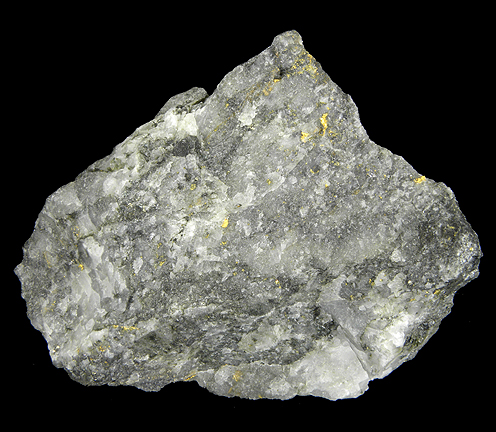
Most lode gold deposits are found in quartz veins that commonly called “Bull Quartz” by miners that are usually emplaced in a fault zone that might consist of one large vein or a whole series of quartz veins holding gold, or both.  It should be kept in mind that all showings of gold are not developed into gold mines in fact very few of them are.  During the 19th century this situation was called “Gamblers Ruin” that was the title of a book about mine appraisal.  The chances of developing your find into a working mine are about 1 in 300.

Gold in Quartz
Photo by Rob Lavinsky


If there is gold present you can find it in a brook adjacent to the suspected deposit.  This is done by panning in the brook a few feet on either side of the deposit, and another sample from the brook right at the point where the deposit is, or as close as you can get.  Another way for detecting gold deposits is by using a metal detector some of them can be set specifically for gold.  In some places you can rent a metal detector.  There are times when the gold in quartz is visible to the naked eye or with a magnifying glass.

An important step in developing a find into a mine is finding out if it actually contains gold and other valuable minerals this is done by taking a representative sample across the exposure by chiseling a line right across the exposure using a hammer and chisel.  This is hard work, but is necessary to get some kind of idea about what you have.  The rock chips are all saved and submitted to a licensed assayer for analysis.  This determines if you have discovered anything worth further exploratory work by determining how much gold is present per ton.  Remember gold showing as little as a few grams per ton is a payable deposit under the present price for gold.  You have a bonanza deposit when you measure the amount of gold present in troy ounces of gold per ton.

Another view of lode gold.
Photo by Rob Lavinsky


Once you have established that there is indeed gold present it is time to call for a diamond drilling program because there is nothing more convincing to bankers and other members of the financial world that is more convincing them a set of core samples.  The truth is you are pretty much on the hook for the first core sample that is taken at the point of discovery.  Further cores are taken by offsetting from the original discovery site by a predetermined distance in initial investigations this is usually 50 meters in each direction around the point of initial discovery.  It is not unusual for a drilling program to consist of several thousand meters of core drilling.

Core drilling also determines whether or not a find can be developed into a commercially viable mine, and there are any number of reasons why it isn’t.  One of the big finds we made during the 1960s was a deposit of copper that was drilled proving a resource worth $100,000,000 at the time.  It was never developed into a mine because It would have required the expenditure of $1,000,000,000 to get the ore out of the find.  In other words it wasn’t commercially viable, so no mine was developed.  The area was just too remote, and it still is.  We wound up calling this find the $100,000,000 nuisance.

Tuesday, May 3, 2011

Geosynclines and Gold Deposits

Geologic Provinces of the World.  USGS


A geosyncline is a long narrow trench that forms offshore from a continental margin that receives not only the sedimentation from the continental craton but other sources of sedimentation from deepsea sources.  Given enough time a geosyncline will develop into a subduction zone where the oceanic plate is subducted beneath the continental plate. In effect what this does is create a monstrous heat engine operating in the crust and mantle of the earth. In effect what a geosyncline is a giant heat engine several thousand kilometers long where oceanic crust is subducted beneath a continental plate. 

There are other geosynclines that can develop when two oceanic plats collide in this case it seems that the smaller plate is subducted beneath the larger plate.  The result however is almost the same as 20 to 30 kilometers away an arc of volcanic islands arises where many of the islands support a fine crop of andesitic volcanoes that erupts magma midway between basalt and rhyolite called andesite. Many of the volcanoes found in the Andes Mountains erupts this type of magma hence the word andesite the lava named after the Andes.

A late Cretaceous Subduction Zone on the west coast of the United States.  The geosyncline is the area depicted in white on the illustration.  Notice that some of this material is being subducted.  USGS


If this sounds like a geology lesson it is because this is all part of the Plate Tectonics theory that posits that there are about 20 tectonic plates of varying size that move across the face of the globe at speeds that measure in centimeters per year, or about as fast as a fingernail grows.  We live on and limit our mining to the crust of the earth that is roughly 10 kilometers thick.  Below the crust lies the mantle that proceeds down towards the center for a depth that is measured in hundreds of kilometers.  The mantle has about the consistency of tooth paste.  Below the mantle is the mesosphere that is more solid then the mantle due to far greater pressure.  The mesosphere is measured in thousands of kilometers.  At the bottom of the mesosphere is the core of the earth that is liquid descending ever downwards until you finally encounter the solid core of the earth.  Some geologists believe this is a single crystal of iron although there is really no way of proving this. 

Cross Section of the Earth   USGS


To introduce another concept is a measurement called the “Clarke” that is the average abundance of an element in the earth’s crust. The crustal abundance of gold averages 0.0000002 grams per ton from this number in order to achieve a commercial deposit, it is necessary to mobilize this gold where it is concentrated in some sort of trap where the gold makes a viable deposit; this is one of the many functions of a geosyncline.

As the material being subducted into the earth’s mantle it becomes superheated including the water that is riding on the plate that is being subducted into the lower crust and mantle.  This also includes any of the mineral deposits that dot the oceanic crust like polka-dots that are the from black smokers. It also includes the minerals that exist in solution in the salt brine that saturates the ocean floor.

Once all of this mixture reaches a sufficient depth the process of dewatering causes the water to boil, and at enough depth and pressure this water becomes supercritical, and also contains a witch's brew of chemicals that cause it to become highly corrosive and capable of dissolving just about anything that comes in contact with. The corrosive components of this water include chlorine, carbon dioxide and sulfur. Another function it serves is to lower the melting point of rock. By stripping the lighter elements from the rock it produces granite that works its way up through the crust of the earth in a manner that is very similar to what you observe in a “lava lamp.”

Gold is also mobilized by the same process and is carried through the surface of the earth where it is deposited as epithermal deposits in the roof rock over the granite intrusion, or in a contact metamorphic aura around the volcanic neck. This is the primary source of gold from which all other deposits of the metal are derived. It is also the primary source of practically all the other mineral deposits on earth.