Total Pageviews

Showing posts with label USGS. Show all posts

Monday, July 9, 2012

The Upside Down Mine


Sterling Hill Mine in Ogdensburg, New Jersey
Photo by Dmadeo


No, this isn't about a gold mine it's about a zinc mine specifically the one at Sterling Hill, New Jersey that for many years produced zinc and was one of the largest mines and the East Coast of the United States. The ore produced from this mine is noted worldwide for its many fluorescent minerals, but like all mines in eventually came to it in and was closed down although it still operates as a museum. At this mine and the ones in nearby Franklin, New Jersey form a canoe shaped orebody hosted in marble that is been the subject of much controversy over the years as to its origins.

During the 1960s Brian Skinner of Yale University was working for the USGS and with a colleague started speculating on how this ore body was emplaced. Under normal circumstances it is assumed that the ore came from deeper down in the bowels of the earth. However in this case under the marble was a layer of impervious rock that apparently did not allow the ore bearing hydrothermal fluids to rise up from below the marble.

Willemite, Franklinite and Rhodocrosite under Ultra-violet light from Sterling Hill
Photo by Rob Lavinsky


Skinner and his colleague were working in the mine one night when the question of the deposit’s origin came up.  The layer below the marble was impervious, but the marble itself wasn’t.  Many layers of sediments were deposited above the marble including some that were volcano-clastic in nature.  These rocks were also pervious allowing ground water to perk down from higher up that were capable of bearing ore bearing fluids.  They came to the conclusion that the ore bearing fluids came down from above and perked through the marble until they hit an impervious layer below the marble.  Here the ore bearing fluids stopped and gave up their load of dissolved minerals creating the deposit. However there is zinc minerals dispersed throughout the marble above the actual deposits.

This is all theoretical, but there are other examples of this same mechanism at work.  One glaring example can be found in the iron deposits found in northwestern Connecticut.  For almost two centuries the iron mines in Salisbury yielded some of the richest iron ore on earth that had its origin in the overlaying Walloomsac formation of schist interbedded   with marble.

The same specimen as above under normal light
Photo by Rob Lavinsky


The origin of this formation is volcano-clastics that came from an island arc that formed off the then east coast of North America that collided with the continent during the late Ordovician and caused the Taconic Orogeny.  This volcano-clastic material was the source of the iron that formed the famous Salisbury iron deposits, and supplied the magnesium that turned the limestone into dolomite.  The Walloomsac formation extends south from Lake Champlain to Manhattan where it underlies among other things the New York Stock Exchange.  Throughout its length at its base and in the underlying marble iron deposits are sprinkled like plums in a plum pudding.

It is theoretically possible that some gold deposits that are hosted by marble were deposited by the same mechanism i.e. leached from the overlying deposits.  A possible example of this mechanism in action are the gold deposits of the Carlin Trend in Nevada.  Another suspect is the San Pedro mine in San Luis Potasi, Mexico.  Both of these deposits are hosted in marble.  Keeping this mechanism in mind might lead to the discovery of other deposits of valuable metals.

Wednesday, February 23, 2011

Sand and Gravel

According to the USGS sand & gravel is one of the most accessible natural resources in the United States second only to crushed stone in value.  It has had an explosive growth rate since the beginning of the 20th century when relatively little was used.  Sand and gravel is mainly used in the construction industry in the form of construction sand & gravel mainly used in the production of concrete and in bituminous concrete (blacktop).


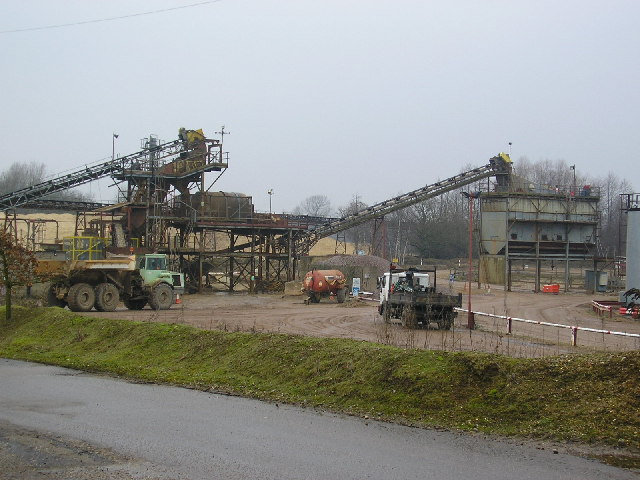
A sand & gravel pit
Photo by Roger W. Hayworth

Annual production of sand & gravel in the United States today it ranks as second in tonnage in the non-fuel minerals after crushed stone.  It is the only mineral commodity that is produced in all fifty states.  In general the United States is self sufficient in the amount of sand & gravel that is produced annually by producing enough to meet all its domestic needs, and is a small net exporter mainly to places where sand & gravel is used to a certain extent in the areas along the borders with Canada and Mexico.
Demand for sand & gravel is mainly controlled by the level of construction activity that controls its demand.  In the United States the production of sand and gravel has grown significantly since the end of WW II with production in 1950 at 320 metric tons increasing to  approximately 900 million metric tons by 2000.  The level of production has dropped since that time.


Sand that has been processed and stored
Photo by Claus Ablieter

Mining sand & gravel is mainly a clean operation in comparison to your local corner bakery although to many people it is unsightly.  This has led to a great misunderstanding on the part of the general public where the perception is that sand & gravel mining is harmful to the environment.  This has caused many sand & gravel deposits to be withdrawn from mining for demographic reasons that in many areas has caused shortages of sand & gravel to occur.
Sand & gravel is a product having a high in-place value that considering the present business conditions costs approximately 50 cents per ton mile.  The further it is necessary to transport the material the more it costs.  Sand & gravel that costs less then $2.00 to produce per ton is apt to cost more then $20.00 per ton delivered. 
A great deal of the problem that was the cause of a special investigation by the governors of the Northeast States was brought about by the mistaken perception that sand & gravel mining was environmentally hazardous; it isn’t.  This misplaced perception has done nothing more then increase the cost of virtually all construction projects throughout the United States.