Total Pageviews

Tuesday, May 24, 2011

Gold Mining Practices under the Roman Empire

Roman gold was of this sort
Photo by Alaska Mining


Minerals brought great wealth to the Roman Empire as they were used most often as payments for imports. The Romans were using a sluicing whereby broken rock was washed through channels containing prickly shrubs, which caught the gold. This extraction technology was being taught all over Europe in mining schools, yet the majority of the individuals working the mines were slaves who were subjected to atrocious working conditions and incurred a high mortality rate.

In 22BC, Publius Carisius, in charge of the Ulterior Army, succeeded in securing several gold mining areas, while he advanced northwards through the Pajares and Manzanal passes. By the middle of the first century AD, Rome’s gold supplies were being maintained in Spain and Dalmatia.

At the end of the First Dacian War in Autumn 106, Dacia was incorporated as a province with a garrison of two or three legions, and stationed at Apulum. Dacian gold mining was exploited at Sarmizegethusa, a colony founded there, and workmen were brought in from Dalmatia. The process of Roman gold mining allowed for Romanization to occur.

Roman Gold Mining in Britain

The only evidence of Roman gold mining in Britain is at the Dolaucothi Gold Mines situated near Pumsaint, Carmarthenshire, Wales. Washing the gravels from the river Cothi was the most elementary method of gold extraction by the Romans. These unique gold mines are set amid wooded hillsides overlooking the beautiful Cothi Valley. 2,000 years ago, the powerful Romans left behind a glimpse of gold-mining methods. The harsh mining environment continued in the 19th and 20th centuries, ending in 1938.

Dolaucothi Gold Mine in Wales that has been mined since the days of the Romans
Photo by David Smith


Types of Romans Gold Mining

The Romans used several different methods for mining gold and extraction, the first being hydraulic mining. This process was also used by the Spaniards. Gold would be stored in large tanks or vessels and when the water was released into a water source or river, the sediments would wash away, leaving veins in the earth and particles of gold. Pliny the Elder gives an account of hydraulic Roman gold mining, made possible by his observations in Spain.

The Romans also utilized deep mining techniques which allowed surveyors to track the veins with shafts and tunnels underground. The remains of Roman dewatering machines were found during the 1880s and the 1920s when the Rio Tinto mines in Spain were being mined by opencast methods (a large tank contains smaller reservoirs below it. It is likely that this complex was used for washing powdered ore to collect the gold dust). Rio Tinto was one of the principal Roman gold mining settlements, having produced more than 2,000,000 tons of silver ore in antiquity.

The Romans also used trip hammers to crush the ore. However, after the Roman occupation, the Carreg Pumsaint was discovered; a block of stone erected many years ago after the Romans had left the site. These types of crushing stones have been found at other ancient Roman mines in Europe, and the hollows in the block were formed by a trip hammer probably worked by a water wheel or a "water lever"

With the decline of the Roman Empire, mining activity was halted until its revival once again in the 11th century. Mining made its emergence in Harz, in what is now eastern Germany, and by the 15th century, amalgamation and retorting processes were widely used in gold extraction.

Author Bio

Lauren Axelrod is a fulltime archaeology student and owner of the website Ancient Digger at: http://www.ancientdigger.com

Archaeology. Her articles have been featured on Treehugger, India Times, Independent.uk, and USAToday. Ancient Digger is also featured on the Discovery News Blogroll under Archaeology.

1. The chemistry of gold extraction. John Marsden, Iain House

2. Roman Spain. By S. J. Keay

3. The Roman Empire. By Colin Michael Wells

4. Money and Government in the Roman Empire. By Richard Duncan-Jones

5. National Trust: Dolaucothi Gold Mines. Quote

6. Gold Nugget Photo

7. Dolaucothi Gold Mines Photo

Sunday, May 22, 2011

Aqua Regia takes a Back Seat to a new Organic Process for Dissolving Gold and other Precious Metals

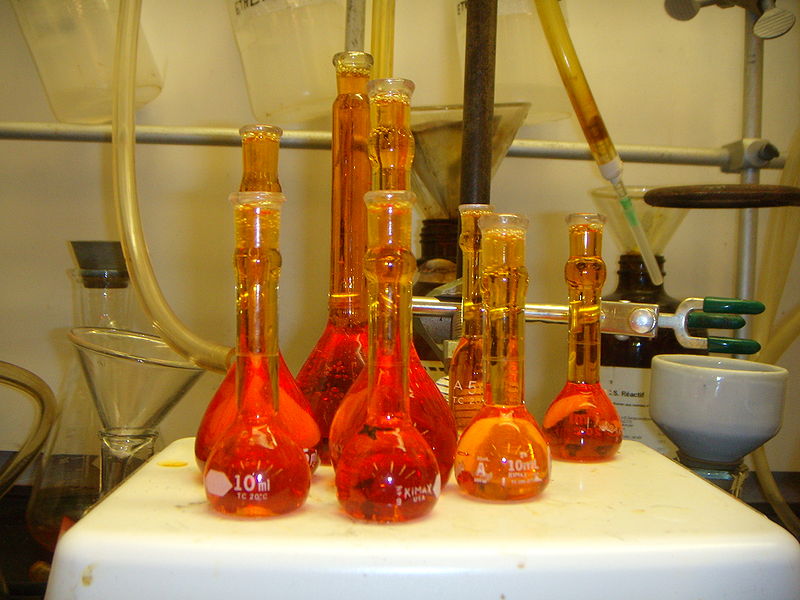
Solution of aqua regia in a laboratory
Photo by Thejohnier


Aqua Regia one of the few chemicals capable of dissolving gold and platinum group metals (PGMs) that was invented about 800 AD by the Arabic alchemist Gebar that was described in western literature in the 13 century by Paul of Taranto sometimes described as the “Pseudo Gebar.”  For centuries Aqua Regia reigned supreme until the development of organic solvents for gold were developed at the laboratory of Wei Lin and collogues at the Georgia Institute of Technology in the early 21st century. 

Aqua Regia is composed of one part of fuming nitric acid and three parts of hydrochloric acid that was used with a solution of tin chloride for the reaction forming the Purple of Cassius the only definitive test for gold until the invention of the Atomic Absorption Spectrometer in the 20th century.  Aqua Regia was also used in the gold refining process, but the same chemicals also dissolved PGMs making it difficult to remove PGMs from gold.  Lin’s new chemistry is capable of selectively removing the errant PGMs from gold by varying the constituents of the solution.

The new solution is based on the reaction of thionl chloride (SOCl2) and the organic solvent pyrazine.  Further experiments disclosed that by substituting other organic solvents such as N-N dimethylformamide (DMF), imidazole and pyrazine.  The gold can be recovered by calcining the resulting mixture.

Gold dust precipitated from aqua regia.
Photo by Greenhorn 1


A mixture of SOCl2 and DMS dissolves gold but doesn’t affect the PGMs making it possible to obtain 99.999 caret pure gold that is bullion grade.  By changing the recipe you can dissolve the PGMs without dissolving the gold.  This part of the process will make it easier to recover PGMs from catalytic converters then previous methods, and fuel cells in the future.

Even though the process can’t efficiently compete with conventional aqua regia at the present time Lin feels it will have uses beyond just dissolving gold and PGMs in the use of making nanostructures of the noble metals as well as recycling nano-coatings,  

Researches are ongoing with this technology, and it is expected that over the following years that advances in the technology will occur as well as new uses for the technology.  One of the major stumbling blocks that has to be overcome is the effects on the environment that is presented by this new technology.

Friday, May 20, 2011

Ferromanganese Nodules containing Gold

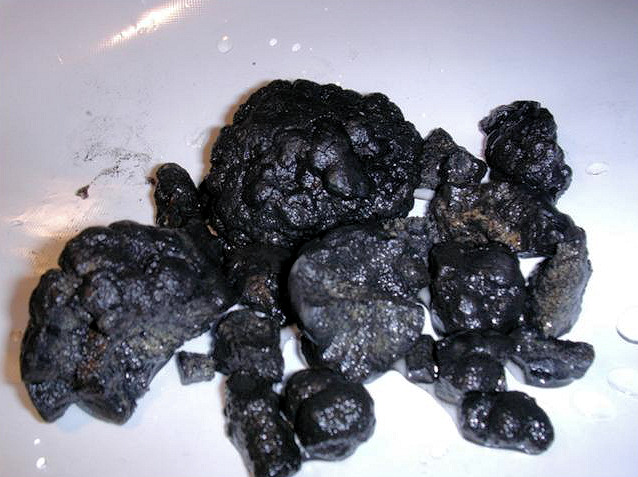
Ferromanganese nodules on the seafloor. USGS


Ferromanganese nodules are found more then a mile beneath the oceans where they are usually found in vast quantities on the abyssal plains. Most of these nodules are about the size of the potato although an occasional nodule may be found this the size of your kitchen table. At other times the modules have combined to make a pavement on the ocean floor. For the most part these nodules are composed of iron and manganese oxide, but they can also contain cobalt, copper, and other elements including gold and other precious metals. How these nodules form is actually poorly understood, but they are found in all the oceans of the world as well as its large lakes.

Because these modules are slow growing it takes about 1 million years to add a millimeter to their size, or about the thickness of the wire used in a small paperclip. When an ocean closes the nodules are swept down in the subduction zone to be recycled as new mineral deposits such as the deposits that are associated with all the earth’s suture zones. In the process of being recycled the various minerals are separated from each other forming different kinds of deposits including gold.

Ferromanganese nodules from the Pacific floor.
Photo by Marsin Zych


Altogether it is estimated that over millions of years these nodules have produced several billion tons of metal oxides. During the 1970s arose several nations that gave these nodules and a long hard look as a source of metals, but because they are submerged in the depth of 1 to 2 miles they quickly realized that the nodules were not an economic ore deposit.

The recent jump in commodity prices however has created a new interest in mining this resource. By using some technology borrowed from the undersea petroleum industry a company named “Nautilus Minerals Inc.” is the first company to explore the economic recovery of these resources; only their target is not modules is the deposits that are laid down by black smokers. There are other ventures that are now being undertaken in the Pacific Ocean that are also aimed to commercially mining these undersea resources.

It remains to be seen if any of these ventures are commercially viable, but time will tell!

How to use a gold pan

The usual size of the gold pan is about 14 inches that will hold about 20 pounds of gravel. Although you can take the gravel straight from the streambed it makes panning much easier if you use a classifier that removes all the stones larger than 3/8 of an inch from the gravel before you start panning. It is a good idea to examine these larger stones just to see if there are any gold nuggets present that might be thrown away with the oversized stone.

Gravel the largest piece in this picture in about 4 cm. This is typical of gold bearing gravel.
Photo by Stan Zurek


Gold is 19 times the density of water meaning that by shaking the gold pan combined with a circular motion when it is full of water will cause gold particles to settle through the gravel to the bottom of the pan. This is a process that you will want to repeat several times in the process of panning.

The gold pan is held at an angle so it's lower edge is submerged in water allowing the gravel to slowly pour over the rim and back into the stream. Periodically remove the pan from the stream and repeat the swirling motion to be sure you don't lose any of gold. Keep repeating this process until all that is left in your pan is an accumulation of black sand. It is in this black sand where gold accumulates. Always keep the edge of pan having the riffles submerged because the gold will be caught in the riffles rather than poring over the edge of the pan.

Gold panning showing how to hold a gold pan.  USDA


For the most part black sand is an accumulation of magnetite and hematite that our oxides of iron. Magnetite can be removed using a conventional magnet: hematite can be removed using a rare earth magnet. The magnetic separation of the iron oxides leaves behind a concentrate of the other heavy minerals that are found in stream gravel the most common of which are garnet and zircon as well as any other gold particles and other precious metals such as platinum. Gold and platinum often occur together!

Tuesday, May 17, 2011

Gold Occurrences in Utah

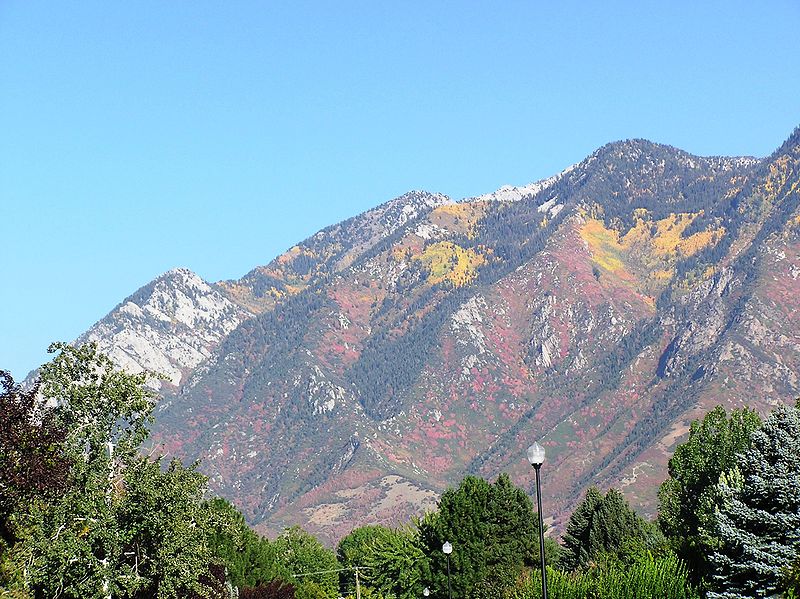
Mountains like this in Utah are where you can find gold.
Photo by Scott Catron


Most gold deposits found in Utah are in the mountains around Salt Lake City, and placer gold is found in the streams draining the Brigand district. Gold is also produced as a byproduct of the copper mining business at Bingham Canyon. Today most of the gold that has been mined in Utah was found during the Great Depression of the 1930s.  Please are gold is still found in the rivers and dry washes that are coming down the mountains in the area around Salt Lake City.

It has been recently discovered that there is gold present in skarn deposits in the Western part of the state that has a potential for gold. So far gold is been found in 146 of the skarn deposits in Utah that continues across the border into southwestern Montana. Skarn's are a variety of calc-silicate rock that occurs when limestone is intruded by igneous rocks. These rocks consist primarily of calcium bearing silicate such as diopside, wollastonite that are formed by the metamorphism impure limestone or dolomite. Typically the calc- silicate minerals have a greenish hue.

According to the Utah geological survey many of the skarn deposits are considered to be economic. Many of these skarn deposits also contain other or under rules such as sheelite one of the ores for tungsten. They also contain copper rowers such as chalcopyrite and the bornite.

Another source of gold in Utah is as a byproduct of the copper ores from Bingham Canyon, and Gold Hill. These copper deposits are found in porphyry that can also contain molybdenum and Gold.

Gold can sometimes be found as detrital gold in sedimentary rocks especially in the sedimentary rock conglomerate where it is found as fossilized placer deposits.  Conglomerate is nothing more complicated then a gravel deposit that has been turned to stone.  The largest gold producing area in the world, the Witwatersrand in South Africa is conglomerate.  This one area has in just over a century produced 40% of the gold that has ever been mined.  Gold is also produced from conglomerate in the Abitibi gold belt in Ontario and Quebec from conglomerate at Timmins Ontario.

Gold is often found associated with marble especially where it has come into contact with intrusive magma.  Often these deposits occurred during the Mesozoic era when dinosaurs roamed the Earth.

A crystal of bixbite on a matrix of rhyolite
Photo by Rob Lavinsky


Gold is not the only mineral those found in Utah that has great worth. The state gemstone of Utah is topaz that is found in topaz rich rhyolite as well as another mineral called “bixbite” that is reckoned to be more than 1000 times as valuable as gold.  According to the Utah geological survey bixbite is even more valuable than diamonds. If the stone was cut and polished it is worth far more than $2000 per carat.

Friday, May 13, 2011

Gold Mining Practices in Ancient Egypt.

The Ancient Egyptians were highly skilled in the mining of gold, made possible by the “alluvial spoil heaps and quarries which still bear witness to their activities”. Egyptian gold took two forms, dust or powder from alluvial workings and ring-shaped ingots cast from the smelted gold produced in the mines.


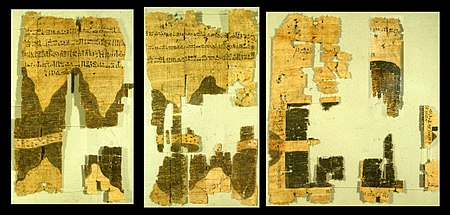
The Turin Papyrus Map is dated to 1100 BC is now at the Turin Museum. This map is rumored to be the oldest map in the world and it demonstrates the many gold bearing regions in the eastern desert of EgyptThe area shown is in the Wadi Hammamat between the towns of Quina and Qoseir. A network of roads intersects the mountainous regions and the inscriptions illustrate where gold was being mined in Egypt.

This is the right half of the above map.


In 60 B.C. Diodorus Siculus traveled in Egypt to inspect the gold mines of the Egyptians. His impressions and descriptions found in his Bibliotheca Historica drew largely upon the account given by Agatharchides of the working of gold. Agatharchides was a Greek philosopher and historian who wrote about the Red Sea in several books and the successors in Alexandria, where he worked at the court of PtolemyVI. Unfortunately, his work has been lost, yet Diodorus Siculus has keenly described laborers washing out gold from crushed quartz.


"At the extremity of Egypt and in the contiguous territory of both Arabia and Ethiopia
there lies a region which contains many large gold mines, where the gold is secured in great quantities with much suffering and at great expense. For the earth is naturally black and contains seams and veins of a marble which is unusually white and in brilliancy surpasses everything else which shines brightly by its nature, and here the overseers of the laborers in the mines recover the gold with the aid of a multitude of workers” [1].

Workers worked day and night and were confined to their particular work area in an event they tried to escape. The ground which was rich with gold was first burned and the remnants of the burn were crumbled by hand. The overseer or guard would point towards the ground or a rock. The workers with the greatest strength were assigned the quartz and they would pound it with massive force. No skills were necessary, just brute strength and agility. The workers would tunnel through the quartz, following the cleavage points and seams, never in a straight line.

Young men would wind their way through the hollowed tunnels and collect the rocks which would have been cast down piece by piece. They then transfer their load to the middle aged men who pound out the stones with iron pestles, making coarsely chopped pieces. Those pieces are then transferred to the women and older male workers whom cast them into mills and grind them into a fine powder.

The final stage includes pouring the powder on to a marble slap which has been worked into a board. The board is set at a gradual incline, so while a worker pours a continuous stream of waterover the board, the heaviest of the elements settles. Using a delicate sponging method, they pickup any small earthy particles, imperfect to be exact, and what’s left is gold dust. The gold dust is placed in earthen jars and mixed with “a lump of lead proportionate to the mass, lumps of salt and a little tin, and adding thereto, barley bran; thereupon they put on it a closefitting lid, and smearing it over carefully with mud they bake it in a kiln for five successive days and as many nights”. Once cooled, all that’s left in gold in pure form.

Notton noted that this working of the gold, as it is carried on at the farthermost borders of Egypt, is effected through all the extensive labors here described; for Nature herself, in my opinion, makes it clear that whereas the production of gold is laborious, the guarding of it is difficult, the zest for it is very great, and that its use is halfway between pleasure and pain [2].

1. Diodorus Siculus, Book III, Chapters 12 to 14; C. H. Oldfather translation, Loeb
Classical Library, 1935, 115-123
2. Notton,J. H. F.Ancient Egyptian Gold Refining: A REPRODUCTION OF EARLY
TECHNIQUES. Johnson Matthey & Co Limited, London.
3. Pictures are in the Public Domain

By Lauren Axelrod publisher of the Ancient Digger at: http://http://www.ancientdigger.com/ 

Nancy Twinkie goes Shopping for Prospector’s Supplies

It finally came to pass that Nancy Twinkie became so hooked on gold prospecting she decided that she should own her own prospecting gear.  So on one Saturday morning when it was raining off we went to a rock shop that carried the kind of gear she wanted.  It was quite a drive to the rock shop since the nearest one to where we lived in Connecticut was about forty-five miles away on the other side of the Connecticut River in East Hampton.  Although Connecticut isn’t exactly rock hounding country there are enough to support a few rock shops; this one is the largest in the state. 

While I was talking to the owner Nancy was poking around in the store for what she wanted, and they had enough of fixings to satisfy her wants.  The first thing she bought was a gold panning kit that included two pans one was 14 inches in diameter and the other was 10 inches.  The kit also had a 14 inch classifier along with a pair of tweezers, a small magnifying glass, and a snuffer bottle for snuffing up small flakes of gold from a goldpan.  There were even a couple of plastic vials to hold the gold.

Then she bought a folding shovel like the kind you use in the army to dig a foxhole.  Although many people would call this a folding shovel I learned the hard way that it is also known in certain quarters as a “hip spoon.”

Nancy went whole hog that day, and bought some other gear for rock hounding.  This collection included a 22 ounce Estwing rock pick, a four pound Estwing cracking hammer, a 1 inch chisel about a foot long, and a bull point of the same length. 

After collecting this gear we stopped at one of those Big Box stores and bought a pair of work boots and a zipper overnight case to carry all this gear in.  The goldpans didn’t fit, so she also bought a backpack.  That finished her collection, so with that we spent the rest of the day rock hounding. 

This is the part of Connecticut where there are several large pegmatite mines many of which have some really rare minerals, so we went to the Strickland Quarry for collecting.  (At the time Strickland was open for collecting, but has since morphed into a golf course, and is closed to collectors.)

After parking the truck we noticed there was a large boulder composed mostly of cleavelandite just on the edge of the parking area.  From the looks of that boulder it probably weighed more then two tons.  By examining the boulder I could see the blades of cleavelandite sticking out in all directions.  Knowing this was one of the signs that there might be pockets inside the boulder we decided to see what was inside and went to work on the boulder with my 8 pound sledge.   

It didn’t take long to find out that the sledge hammer wasn’t going to work so I went back to the truck for a single jack stone drill and a striking hammer.  This was some mining equipment I had inherited from my great grandfather along with some ¾ inch feather wedges. 
A single jack drill it pretty easy to use, and you can drill a hole with one in a hurry by hitting its upper end with a four pound hammer. Each time you strike the drill you have to rotate the drilling steel a quarter turn so that every time the cutting edge of the drill is cutting into a new part of the stone.  We had to make four holes into the rock that were about six inches deep to hold the feather wedges.  It probably took agout 15 minutes to drill the holes and set the feather wedges.  After the wedges were set and tapped into place the boulder was split in half in less then a half hour from when we started drilling. 

Feather wedges can still be bought at mason supply stores, but old fashioned stone drills are no longer sold.  However you can make your own from a star drill by grinding off two of the flutes, or by grinding a radius on the cutting edge of a cold chisel.

Once we were inside the boulder there were many interesting specimens as the pegmatite was an LCT type.  In some of the cavities we found nice specimens of columbite,  but the best specimen was a nice crystal of blue beryl.  Most of the specimen was badly flawed, but there were some areas that were faceting grade that would probably have made gems weighing more then 10 carets.  That stone is still in Nancy’s private collection!