Total Pageviews

Showing posts with label subduction. Show all posts

Thursday, March 22, 2012

Gold Occurrences in Peru


Coat of Arms of Peru
By Hunsun

Located high in the Andes of Peru, Newmont operates the largest gold mine in South America, the Yanacocha mine.  This mine has three active pits with the production exceeding 26 million ounces of gold.  The Yanacocha mine high in the Andes opened in 1993 with Newmont owns 56% of the mine with the balance held by Cia de Minas Buenaventura SA, this is Peru’s largest producer of precious metals.  This year, 2012, the mine is expected to produce 1.5 million ounces.

Another mine operated by Goldfields is the Cerro Corona mine a large open pit mine located in the highest part of the western Cordillera of the Andes in the northern part of Peru contains a copper-gold deposit estimated to contain about 8.7 million ounces of gold equivalent.  The concentrate produced by the flotation process leaves Peru from the port of Salaverry for smelters in Japan, Korea and Europe.  There are several other mining companies working deposits around Peru.

Placer mining was started by the Incas or other tribes long before the coming of the Spaniards, and continues until today.  The gold is found in virtually all the rivers flowing east or west of the Andes Mountains, but most of the operations are artisanal with a lot of small operators.  There is some illegal mining operations with an occasional town springing up in the middle of nowhere if there are especially rich diggings.

The mineralized area in Peru is limited to the Andes Mountains a narrow strip of land along the Pacific Coast a little over 100 km wide. It is within this area that is an active convergent margin hosting a diverse number of some of the world's richest gold, copper, zinc, lead and silver deposits. Many of these are world-class deposits that are currently being exploited. Much of this mineral wealth as a result of my impulses during key times within the past 70 million years with the geological setting a major deposit being related to structures that have been active since the early Paleozoic.

This narrow belt along the coast of South America is a good example of a metallogenic province that mainly is the result of a 240 million year old history of subduction related tectonics along the western margin of the Brazilian Shield that began in the early Triassic and continues to this day. This is than a continuous cycle of east directed subduction beneath the South American plate called the Andean cycle that is formed a linear volcanic and plutonic arc that has a landward back arc basin in eastern side of Peru.
During this period of 240 million years magmatism in the area was episodic that was regularly disrupted by shortening events causing the inversion of the back arc volcano sedimentary sequences along with the migration of the center of volcanism and intrusions.

The major ore systems in Peru are associated with arc-related igneous and volcanic rocks. It was this activity along the continental margin where the early episodes are dominated by copper -- gold minerals that are close to the subduction trench. The sequence of minerals progressed eastward to zinc -- lead then further eastward into tin -- tungsten. There is a regular sequence of mineralization as you get further way from the edge of the continent.

Friday, February 25, 2011

Prospecting on an Ancient Spreading Center

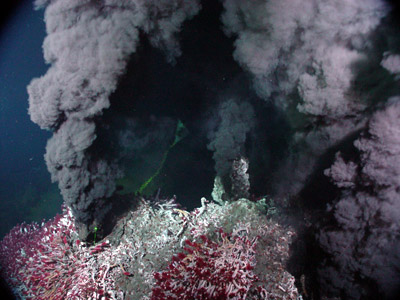
A tectonic ridge is associated with a spreading center where magma from the bowels of the Earth reaches the surface where it is the driving force for plate tectonics. The same feature is also the home of black and white smokers the source of many mineral deposits. For the most part tectonic ridges are found in the ocean deeps usually a depth of about 12,000 feet, but an exception is made for Iceland where the tectonic ridge is exposed on the surface of the land. Iceland is also one of the most volcanic areas on earth with the exception of the Ring of Fire that encircles the Pacific Ocean, but that is caused by just the opposite environment where tectonic plates are plunging beneath other plates in subduction zones.

Black smokers emitting clouds of metal sulfides.

The smokers are the result of ocean water penetrating deep into the oceanic crust that is composed of basalt, and leaching out the various metal ions and expelling the from the surface and clouds of metal sulfides. These sulfides are deposited in a particular sequence depending upon their solubility in water copper and iron are usually the first sulfides that are deposits and the other metals are deposited according to the  solubility of their sulfides.

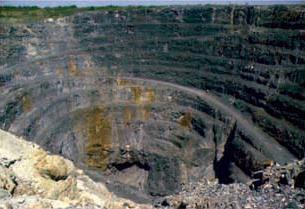
Kidd Creek Mine in Timmins, Ontario

Although deposits of this nature are formed in the depths of the ocean is theorized that because of plate movement these deposits can eventually be incorporated into continental plates. A good example of this type of deposits is the Kidd Creek Mine located in Timmins, Ontario or the Horne Mine in Rouyn-Noranda, Quebec.