Total Pageviews

Showing posts with label indicator mineral. Show all posts

Friday, February 25, 2011

Prospecting on an Ancient Spreading Center

A tectonic ridge is associated with a spreading center where magma from the bowels of the Earth reaches the surface where it is the driving force for plate tectonics. The same feature is also the home of black and white smokers the source of many mineral deposits. For the most part tectonic ridges are found in the ocean deeps usually a depth of about 12,000 feet, but an exception is made for Iceland where the tectonic ridge is exposed on the surface of the land. Iceland is also one of the most volcanic areas on earth with the exception of the Ring of Fire that encircles the Pacific Ocean, but that is caused by just the opposite environment where tectonic plates are plunging beneath other plates in subduction zones.
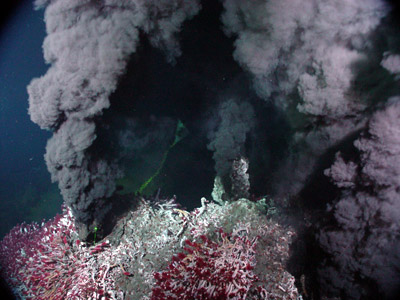
Black smokers emitting clouds of metal sulfides.

The smokers are the result of ocean water penetrating deep into the oceanic crust that is composed of basalt, and leaching out the various metal ions and expelling the from the surface and clouds of metal sulfides. These sulfides are deposited in a particular sequence depending upon their solubility in water copper and iron are usually the first sulfides that are deposits and the other metals are deposited according to the  solubility of their sulfides.
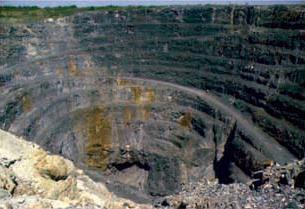
Kidd Creek Mine in Timmins, Ontario

Although deposits of this nature are formed in the depths of the ocean is theorized that because of plate movement these deposits can eventually be incorporated into continental plates. A good example of this type of deposits is the Kidd Creek Mine located in Timmins, Ontario or the Horne Mine in Rouyn-Noranda, Quebec.

Friday, November 26, 2010

Biotite as an Indicator Mineral for Gold

Introduction:

There are many minerals used for gold, but until recently I was unaware of the use of biotite as an indicator mineral for gold.  It seems however that under some circumstances that is exactly what role biotite plays.  In a minerologically diverse set of amphibolite schists coming from altered metavolcanics both amphibole and biotite in the gold bears veins.  It is felt by many geologists that any gold present has been leached out of the surrounding greenstone making it younger then the rock it is contained in, this is true of the Abitibi Gold Belt and other greenstone belts that are found throughout the Canadian Shield


Biotite is a common rock forming mineral found in abundance in both igneous and metamorphic rock. The mineral is a member of the cyclosilicate family of minerals characterized by perfect cleavage parallel to the C-axis that produces flakes or thin layers.  Its fracture is indistinct and uneven. 

  • Hardness = 2.5
  • Specific Gravity = 2.9 – 3.4+ a bit above average.
  • Streak = white
  • Associated minerals: quartz, feldspars, apatite, calcite, hornblende, garnets and schorl, (a black variety of  tourmaline.)
  • Other distinguishing features = its sheets can be bent and will flex back into shape, meaning its cleavage sheets are flexible.
  • Occurrences = worldwide in igneous and metamorphic rocks.
  • Color: = Black to brown shading into yellow with weathering.
  • Luster: Vitreous to Pearly.
  • Transparency = Transparent to translucent.
  • Crystal System = monoclinic; 2/m.
  • Crystal Habits = tabular to prismatic; many of its crystals are pinicoid termination forming books of mica like muscovite another member of the cyclosilicate family.  It is a lamellar to granular in appearance giving gneisses and schists their characteristic glitter.
  • Cleavage = Perfect in one direction.
  • Fracture = Not distinct and uneven due to its cleavage.

Gold Association:

Biotite is often found associated with lode gold deposits.  Because it contains iron it might be looked on where the biotite takes the place of granular magnetite where gold is often found.  It is well known that gold colors glass red so does it also affect biotite causing the presence of gold to increase the red hue found in some biotites.