
A black smoker and associated white smokers are found at spreading centers in the middle of the ocean. What the smoke that is produced from one of them is in reality finely divided metal sulfides that are leached from the oceanic crust by seawater percolating through the ocean bottom to a depth of several hundred feet that is heated to a temperature that can exceed 300o C. As the mineral charged hot water is discharged to the open ocean it is suddenly cooled causing the dissolved minerals to precipitate out and form deposits of metals on the ocean floor.
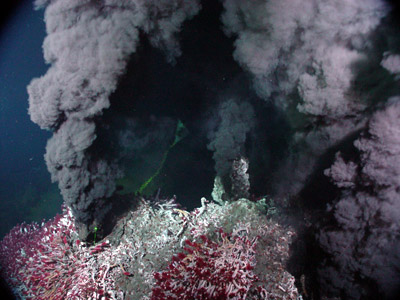 |
| A black smoker at the sea bottom. The black smoke is caused from finely divided metal sulfides. |
Black smokers are located on a tectonic spreading center where two plates are being forced apart by upwelling of basaltic magma. If the black smoker were on dry land it would be considered a hot spring, but because they are at the bottom of an oceanic trench in waters that exceed 12,000 feet they have earned the name Black Smokers because of the plumes of metal sulfides that emanate from them. There are some of these features that have white plumes of metal carbonates associated with them, and they are known as white smokers.
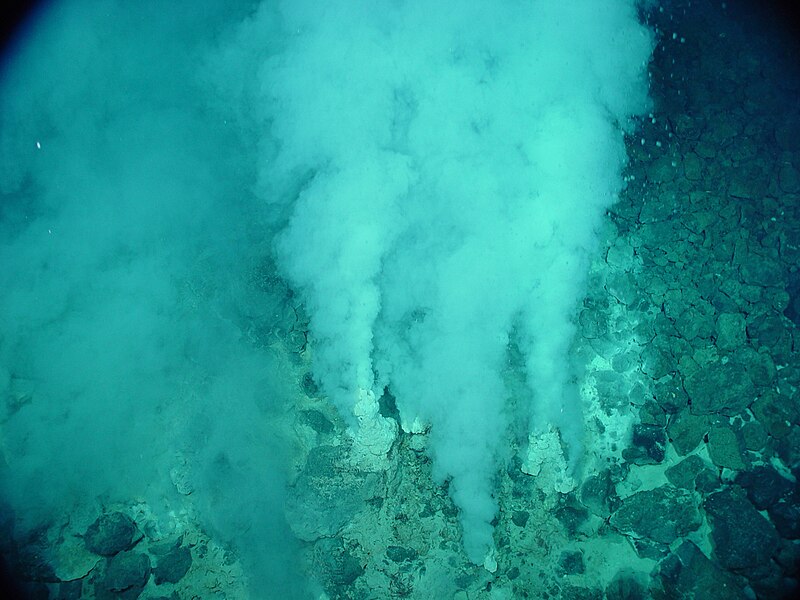 |
| A white smoker producing carbon dioxide gas and metal carbonates. |
Most of the metals that come from these hot springs are copper, lead and zinc, but there are also other metals such as gold and silver that are deposited on the seafloor, or are carried away in solution from the site of the black smoker. Aside from the primary metals that are deposited as sulfides at the site there are a number of other secondary metals that are also deposited such as indium, germanium and cadmium. These models are also produced as byproducts and during the smelting process.
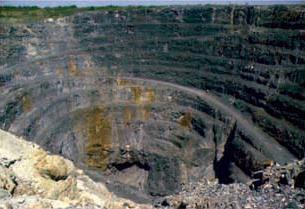
These products are known as Volcanogenic Massive Sulfides (VMS) and are represented in several large deposits in Archean aged rocks. Two notable examples these are found in the Abitibi region of Canada Timmins Ontario Rouyn-Noranda , Quebec
|
| The open pit portion of the Kidd Mine in Timmins, Ontario. It is thought by many that the Kidd Mine is an ancient black smoker. |
Although gold is founded on the VMS deposits as a byproduct more often it is mobilized during the process of subduction where it is deposited in separate quartz veins, or other gold traps that are removed from the main VMS deposits. Examples of this can be found in the green belt deposits throughout the world. Even though the mountains are now worn down to their roots in many places these deposits originated as black smokers in the depths of the sea prevail on dry land.
The deposits of black smokers have dotted the surface of the ocean bottom on both sides of the spreading center. As these deposits are moving away from the spreading center they become covered sometimes to great depths with sediments raining down from the surface of the ocean until they eventually are subducted beneath a continental or other oceanic plate where they are recycled to form other types of mineral deposits.
Geologists like to talk about the many different cycles that affect the Earth one of these might just as well be the mineral cycle that occurs as the Earth recycles the different mineral deposits forming new and different deposits of the same mineral.

