Total Pageviews

Showing posts with label sluice box. Show all posts

Tuesday, June 14, 2011

Nancy Twinkie Buys a Highbanker

A Jobe highbanker similar to the one Nancy bought.


After she had gone with me on several gold panning trips it became apparent to Nancy
she needed some way to speed up the gold recovery. We already owned a sluicebox,
but Nancy wanted to have something different. It should be pointed out that the Internet
didn’t exist for us common folk in the early 1980s, so Nancy took up reading some back
issues of the Northern Miner that I had, a Canadian publication about the mining scene
that is still published in Toronto.

There was an advertisement for a highbanker in the Northern Miner, so Nancy sent
away for some information about this piece of gear. In essence, a highbanker is nothing
more then a sluice box that stands on stilts, and is on steroids because of the addition of a
grizzly on its business end. Some highbankers also include a pump to supply water to its
sluice. Nancy sent away for the whole works pump and all.

A couple of week’s later Nancy called me to come over to her house as quick as I could
she needed some help. I went right over, and the first inkling I had something was up
was when I saw a trailer truck parked in front of her house. Nancy was there talking
to the truck driver about several large cartons that had to be unloaded containing the
highbanker along with all its attachments including the pump and 200 feet of plastic hose
that was three inches in diameter. It took both the truck driver and me to manhandle
these cartons from the truck, and get then into Nancy’s house.

Then the unpacking began, and the first thing that became apparent was a sign at the
top of the carton advising us that some assembly was required. Now that was a sign I
had seen before much to my regret because in past experiences this had always required
several trips to my local friendly hardware store for missing nuts, bolts and washers. To
my surprise the maker of the highbanker had included all the bells and whistles, so no
trips to the hardware store.

Once the highbanker was set up it proved to be a formidable beast standing on four
metal legs just high enough so you could shovel stream gravel into its grizzly with the
oversized stones falling off the back end. Once the hoses and pump were attached water
went into a manifold below the rear of the grizzly that was distributed in a stream the
width of the highbanker.

Once we had put Nancy’s highbanker together we sat down to read the directions about
how to use the beast. After reading those directions we had to wait for the following
weekend to give it a try.

Friday, April 22, 2011

Gold, Uranium and Carbon in Detrital Deposits

One of the common associations with gold in detrital deposits is the association of gold with uranium and carbon. This holds true in the Witwatersrand and all the other gold deposits of a detrital nature.  For many years the origin of the carbon was hotly debated with the most recent evidence holding that it is from primitive life forms that lived in the distant past in the Archean


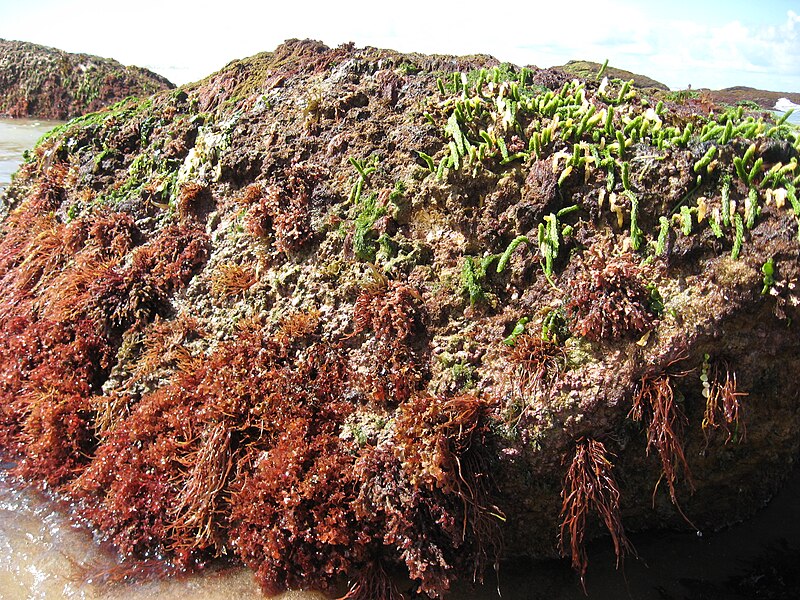
Algae exposed at the intertidal zone similar to the ancient algae that trapped gold.  Even today this kind of mat could be a good place to search for gold.
Photo by Leonardo de Jorge


It has been posited that these algae formed great mats similar to stromatolites that acted as a trap for the gold particles and uranium minerals in the same manner that modern mats of algae work to snare gold particles in a modern environment.  It is common practice to use an artificial mat of the same nature in a sluice box to entrap gold.

Although the deposits can be several thousand feet deep now, but at the time of depositation they were relatively shallow at the bottom of running water that was only a few tens of meters deep subsequent Earth processes have buried them to their present depth. 


An angular uncomformity with a basel layer of conglomerate that would be a good place to look for gold.   The best place is right at the uncomfority.
Photo by Lamprus


At the time many of these gold bearing deposits were at the bottom of a braided stream channel that by being deposited in this manner explains the stringers of gold found in such a deposit.  These stringers of gold are common in detrital gold deposits.  Sometimes there is a layer of carbon that is as thin as a pencil line that is so rich in gold and other minerals that they are mineable. In many detrital deposits the slim lines occur at a regular frequency to the extent that the entire deposit is mined so that I can undergo further ore dressing to free the gold so it can undergo even further treatment usually by being leached with a solution of cyanide.

Even today if you encounter a mat of algae in the bottom of the stream or river is a good place to search for gold that has been caught in the mat by the action of running water.

Thursday, March 17, 2011

Recovering Gold with a Sluice Box

One of the oldest methods of recovering gold from stream gravel is the sluice box that has been around for thousands of years. All a sluice box is literally a box that is open on both ends and does not have a top. Other than the gold pan the sluice box and its variations are still used today for the recovery of gold in both small-scale and large-scale placer mining.

Removing gold from a sluice box

All sluice boxes are lined with riffles designed for the recovery of gold that usually take two parts. On the bottom of the sleuth box is covered with some sort of fabric usually indoor/outdoor carpeting, or another effect of gold trap is the backside of a strip of conveyor belt. The riffles in a sluice box represent obstructions in a flowing stream of water that mimic naturally occurring obstructions found in a streambed.

Sluice boxes come in all sizes ranging from a 3 foot aluminum version that is portable enough to be handcarried to the stream where you are going to work. The other extreme is found at work in many commercial gold mining projects all over the world. Most of these sluice boxes are built from wood where they are going to be used, and it is unusual for one of these large sluice boxes to be several hundred feet long and more than 10 feet across with sides are least 4 feet high.

Gold miners using a variation of a sluice box in Nome, Alaska

During the late 1960s I happened to witness how one of these large sized commercial sluice boxes was cleaned of gold from a season's worth of operation. This sluice box was in the Yukon Territory of Canada, and had been in operation for the entire season, and was closed down when the weather started getting cold. As a rough idea of how large this thing was it appeared to be about 125 feet long, 12 feet wide and had sideboards that extended up to 6 feet. The gravel was fed into the upper end of the sluice box by a front end loader that was probably dropping several cubic yards of gravel at a time into upper end of the sluice box.

Water to operate the sluice box came from a dam about 1/2 mile up the river and probably 20 feet higher than the sluice box. This water was channeled down into the sluice box with enough force so it was able to wash away the gravel as it was being added. The riffles at the bottom of this sluice box or cast-iron grates from storm drains. It looked like a miner had half the grates from the storm sewers in Toronto in the bottom of the sluice box.

Miners operating a sluice box during the California Goldrush

There was another front end loader working at the tail end of the sluice box to remove the gravel that had worked its way down through the length of the box, and poured out of the lower end.

When the operation shutdown in the fall they started removing these grates from the top end of the sluice box, and work their way down. There was enough gold caught under the grates at the upper end that are just about made your eyes pop out. The miners were removing it from the sluice box with shovels and pouring the gold into plastic buckets.

Friday, March 11, 2011

How to use Mercury to recover Gold

The use of mercury to recover gold probably dates back to the Romans this was written about in De re Metallica by Georgius Agricola during the 16th century. In this book the recovery of gold using mercury was also described. Gold and Mercury will combine into a substance called an amalgam, and once again the gold can be separated from the mercury by the application of heat by heating the amalgam in a retort that recovers the mercury by distilling its vapor back into metallic mercury. This is a process that has been known for centuries. Using mercury in a sluice box required cleaning the riffles every few hours making it necessary to close down the sluicing operation while this was done.

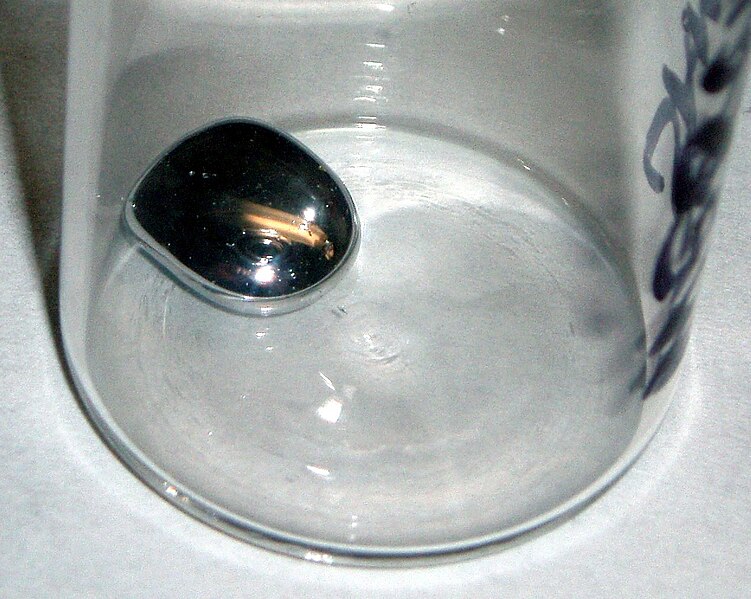
A drop of mercury in a beaker.

During the gold rush days of the 19th century large amounts of mercury were used in sluice boxes where large quantities of mercury were placed behind the ruffles in the box to catch gold particles in the black sand. In some of the larger sluice boxes the miners would use several 76 pound flasks of mercury as a gold trap. It was also very damaging to the environment causing pollution that linger. on to this day.

Although it is still used in some places the use of mercury is now frowned upon because of its damaging effects on the environment. In some jurisdictions its use is highly restricted, so that it can only be used under tight controls to prevent it from causing contamination.

Hydraulic mining in California.  The sluice box is at the lower left that used mercury in the gold recovery process.

The use of mercury for gold recovery is highly controlled in most countries although it is used by some artisanal miners in Third World Countries.  In the United States it is regulated under the terms of the Resource Recovery and Recycling Act (RCRA).  In Canada its use is prohibited within 109 yards of a stream or river to prevent pollution of the water. The recovery of gold by mercury is a highly technical procedure that should not be attempted by any amateur prospectors or miners.

Tuesday, December 14, 2010

The Sluice Box

A sluice box is a step beyond the gold pan in placer mining gold. They are quite simple in construction and are extremely effective. Although you can buy some pretty fancy looking sluice boxes from dealers there is a certain pleasure in building your own; especially one that works as well as a store-bought one.

The author built one by using up an 8” x 8' an inch thick piece of lumber with a few extras like a crossbar that was added about a foot from the upper and on the back of the sluice box that stuck out about a foot on either side for carrying. A strip of indoor/outdoor carpet that covered the bottom of the sluice box with some half-inch by 1 inch cleats they were nailed on top of the carpet.  A piece cut from an old conveyor belt works even better.   The handles made it really easy to carry.  The sluice was only 4 feet long so you could put it into a car trunk.

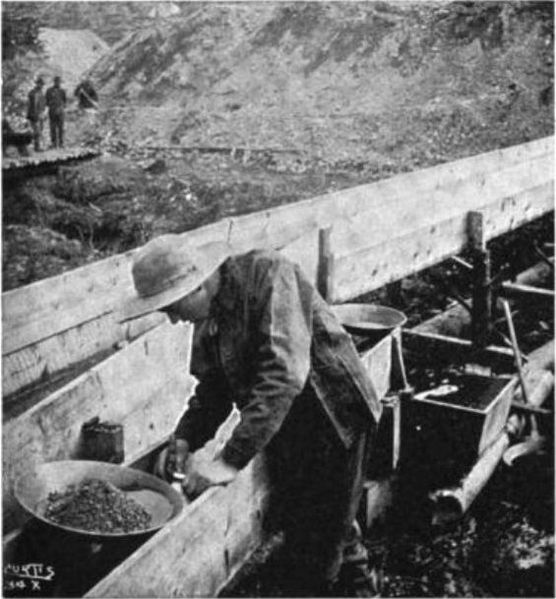
Taking gold out of a sluice box before 1902

In use the sluice box was set up in the bed of the stream with a couple of good-sized rocks placed at the ends of the handle to hold it down. It was placed in the stream so that its lower end was facing downstream and it was slightly tilted so that the upper end was about two inches higher than the lower end.

The stream gravels were shoveled into the upper end after being run through a classifier to remove the larger stones.  With a hose that was placed into the stream a ways above the sluice box water was played into the upper end of the sluice box, water from the hose washed the gravel down through the box.

The carpet was to catch any gold in the gravel that washed its way down through the box.  The cleats that were nailed down over the carpet held it in place and also acted as another means for catching that heavy gold and other heavies found in the stream gravel including diamonds and other gemstones.
You can work all day using this device and at the end of the day when you take it out of the stream you clean up the concentrate that is been trapped by the carpet and cleats. If you want you can pan the concentrate in a gold pan to recover the gold. You can also put the concentrate into a large wide mouth bottle and take it home where you can pan it out in your leisure.
A sluice box can be built as big as you like. They author once saw a sluice box at a commercial gold mining site that was 100 feet long about 6 feet wide and 4 feet high. The operator of the sluice box loaded the upper end with a front end loader and had a stream damned up at a higher level and carried the water down in a fire hose. He used the covers off catch basins to trap the gold that was removed at the end of the season. It looked like he had half the catch basins in Toronto at the bottom of his sluice box.

It was quite a sight at the end of the season when they removed the grids from the bottom of the sluice box. There was so much gold under the grids they had to shovel out with shovels. The tax man was there from the Yukon Territory to be sure they got their fair share of the tax money. I think everyone knows they are who witnessed the removal of the gold practically had their eyes popping out of their heads, it was some sight.