Total Pageviews

Showing posts with label box. Show all posts

Thursday, March 17, 2011

Recovering Gold with a Sluice Box

One of the oldest methods of recovering gold from stream gravel is the sluice box that has been around for thousands of years. All a sluice box is literally a box that is open on both ends and does not have a top. Other than the gold pan the sluice box and its variations are still used today for the recovery of gold in both small-scale and large-scale placer mining.
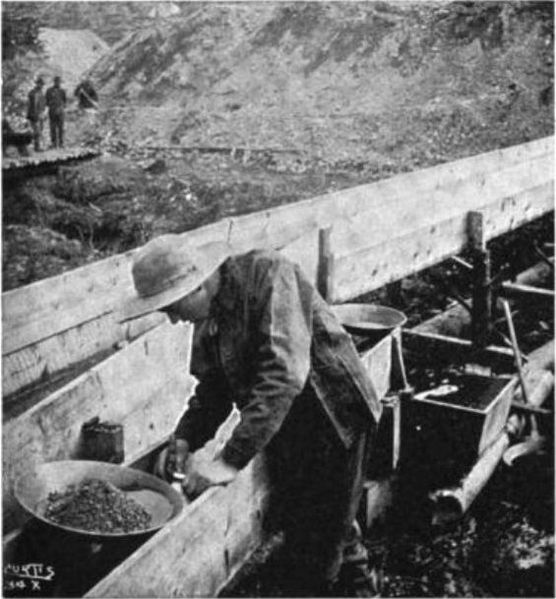
Removing gold from a sluice box

All sluice boxes are lined with riffles designed for the recovery of gold that usually take two parts. On the bottom of the sleuth box is covered with some sort of fabric usually indoor/outdoor carpeting, or another effect of gold trap is the backside of a strip of conveyor belt. The riffles in a sluice box represent obstructions in a flowing stream of water that mimic naturally occurring obstructions found in a streambed.

Sluice boxes come in all sizes ranging from a 3 foot aluminum version that is portable enough to be handcarried to the stream where you are going to work. The other extreme is found at work in many commercial gold mining projects all over the world. Most of these sluice boxes are built from wood where they are going to be used, and it is unusual for one of these large sluice boxes to be several hundred feet long and more than 10 feet across with sides are least 4 feet high.

Gold miners using a variation of a sluice box in Nome, Alaska

During the late 1960s I happened to witness how one of these large sized commercial sluice boxes was cleaned of gold from a season's worth of operation. This sluice box was in the Yukon Territory of Canada, and had been in operation for the entire season, and was closed down when the weather started getting cold. As a rough idea of how large this thing was it appeared to be about 125 feet long, 12 feet wide and had sideboards that extended up to 6 feet. The gravel was fed into the upper end of the sluice box by a front end loader that was probably dropping several cubic yards of gravel at a time into upper end of the sluice box.

Water to operate the sluice box came from a dam about 1/2 mile up the river and probably 20 feet higher than the sluice box. This water was channeled down into the sluice box with enough force so it was able to wash away the gravel as it was being added. The riffles at the bottom of this sluice box or cast-iron grates from storm drains. It looked like a miner had half the grates from the storm sewers in Toronto in the bottom of the sluice box.

Miners operating a sluice box during the California Goldrush

There was another front end loader working at the tail end of the sluice box to remove the gravel that had worked its way down through the length of the box, and poured out of the lower end.

When the operation shutdown in the fall they started removing these grates from the top end of the sluice box, and work their way down. There was enough gold caught under the grates at the upper end that are just about made your eyes pop out. The miners were removing it from the sluice box with shovels and pouring the gold into plastic buckets.

Tuesday, December 14, 2010

The Sluice Box

A sluice box is a step beyond the gold pan in placer mining gold. They are quite simple in construction and are extremely effective. Although you can buy some pretty fancy looking sluice boxes from dealers there is a certain pleasure in building your own; especially one that works as well as a store-bought one.

The author built one by using up an 8” x 8' an inch thick piece of lumber with a few extras like a crossbar that was added about a foot from the upper and on the back of the sluice box that stuck out about a foot on either side for carrying. A strip of indoor/outdoor carpet that covered the bottom of the sluice box with some half-inch by 1 inch cleats they were nailed on top of the carpet.  A piece cut from an old conveyor belt works even better.   The handles made it really easy to carry.  The sluice was only 4 feet long so you could put it into a car trunk.

Taking gold out of a sluice box before 1902

In use the sluice box was set up in the bed of the stream with a couple of good-sized rocks placed at the ends of the handle to hold it down. It was placed in the stream so that its lower end was facing downstream and it was slightly tilted so that the upper end was about two inches higher than the lower end.

The stream gravels were shoveled into the upper end after being run through a classifier to remove the larger stones.  With a hose that was placed into the stream a ways above the sluice box water was played into the upper end of the sluice box, water from the hose washed the gravel down through the box.

The carpet was to catch any gold in the gravel that washed its way down through the box.  The cleats that were nailed down over the carpet held it in place and also acted as another means for catching that heavy gold and other heavies found in the stream gravel including diamonds and other gemstones.
You can work all day using this device and at the end of the day when you take it out of the stream you clean up the concentrate that is been trapped by the carpet and cleats. If you want you can pan the concentrate in a gold pan to recover the gold. You can also put the concentrate into a large wide mouth bottle and take it home where you can pan it out in your leisure.
A sluice box can be built as big as you like. They author once saw a sluice box at a commercial gold mining site that was 100 feet long about 6 feet wide and 4 feet high. The operator of the sluice box loaded the upper end with a front end loader and had a stream damned up at a higher level and carried the water down in a fire hose. He used the covers off catch basins to trap the gold that was removed at the end of the season. It looked like he had half the catch basins in Toronto at the bottom of his sluice box.

It was quite a sight at the end of the season when they removed the grids from the bottom of the sluice box. There was so much gold under the grids they had to shovel out with shovels. The tax man was there from the Yukon Territory to be sure they got their fair share of the tax money. I think everyone knows they are who witnessed the removal of the gold practically had their eyes popping out of their heads, it was some sight.