Total Pageviews

Showing posts with label gold panning. Show all posts

Wednesday, March 2, 2011

Gold Occurrences in Maryland


You can probably find gold under the capitol dome!
YHistorically there have been several active gold mines in Central Maryland that have produced both lode and placer gold; this also includes the District of Columbia  There is a gold belt that runs across the middle of the state where today there are no active gold mines presently, but there are plenty of people panning for gold.  This panning activity takes place in several rivers and creeks including the Potomac River as it flows through Washington as far south as Georgetown.

Georgetown is located across the Potomac River from Washington, DC so we have to assume that gold is in our nation’s capitol. Just think of that the Capitol United States is built on a foundation of gold. That is probably a novel idea since most of the gold diggers in Washington seem to be in the Capitol itself.

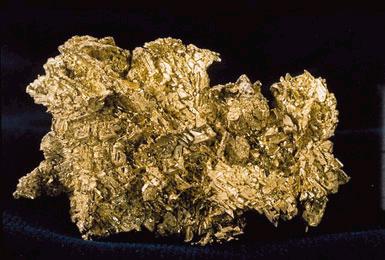
Crystalline gold.   USGS

Before it was closed during WW II there was an active lode4 gold mine located at the Great Falls of the Potomac in Maryland. All gold mining activity was banned by the government nationwide as it was felt the manpower to operate a mine would be better used in the war effort.  It was originally planned to reopen the mine after the war was over, but it never did.

There is ongoing placer mining and prospecting in the center of the state reportedly with a great deal of success.  This placer mining takes place on the rivers and creeks found in the area.  This gold mining belt extends across the state ending in Baltimore; can’t you imagine panning for gold on the banks of the Susquehanna River right in one of the Baltimore’s city parks!

The gold in Maryland was originally discovered by an Irish Union soldier while on KP duty, during the Civil War, that was washing frying pans on the banks of the Potomac River.  One of the ways to clean an army frying pan is to use sand as a cleaner.  The soldier probably had filled the frying pan with sand and gravel from the river that he sloshed around to clean the pan and found gold in the bottom of the pan.  It has been reported he was a member of a regiment from California.  If that was the case he was already familiar with the process of how to pan for gold, and was probably goofing off on his KP duty.

One of the precursors of gold is the presence of greenstone in the gold bearing belt thought by geologists familiar with gold deposits to be the source rock from which it is percolated by the action of hot groundwater.  The first chromite produced in the United States came from these same greenstone belts. The hot gold bearing groundwater that has percolated through the greenstone removing its gold content also carries many other dissolved minerals.  One of the principle minerals is silica that is deposited from the water at about the same temperature as gold.  Gold in quartz ore is often found together in veins making it one the most common forms of lode gold.


References:
Kuff, Karen, Cold in Maryland, 1987, http://www.mgs.md.gov/esic/brochures/gold.html
Prospecting for Gold near Washington, DC, http://www.infiltec.com/gold/

Monday, January 3, 2011

Nancy Twinkie Strikes it Rich

Nancy Twinkie Strikes it Rich:

After near freezing to death in the bottom of the Satan’s Kingdom gorge looking for gold on the coldest day of the winter with Nancy Twinkie I came home and put my gold panning gear away until warm weather.  I honestly thought I had seen the last of Nancy and the whole collection of the camera crew from NBC.  I was wrong! 

For those that didn’t read the first of this series Nancy Twinkie and the Frozen Pan of Gold, Nancy Twinkie is a cute little blond TV Newscaster.

Several months passed the snow melted away, the birds returned and the next thing I knew summer had arrived.  Now in mid-summer the world of news practically comes to a standstill because not much is happening.  With this happy thought I was sitting at my desk one morning when the phone rang – it was Nancy Twinkie who wanted to do another story about gold panning now that the weather had improved.  So, we set up an appointment for two days later in the same place under the Satan’s Kingdom Bridge.

Satan’s Kingdom is a gorge on the Farmington River in New Hartford, Connecticut where the stagecoach robbers used to wait to waylay the Hartford stage when the days of the Wild West were back East.

We all met at the coffee shop, from there we drove over to the river where the whole collection of TV people debarked from their cars, so help me this time it looked like a convoy.  This time the crew looked more like the 8th Army then a camera crew.  There must have been at least thirty of them; it looked like the whole studio came this time except the janitor.

During the summer the Satan’s Kingdom Gorge becomes the haunt of a pack of nature lovers and tree huggers who go floating down through the gorge riding on old inner tubes; this lot is called tubers, and there must have been a couple of hundred of them milling around or floating down the river.  It became immediately obvious there were more people in Satan’s Kingdom then there needed too be.

We poked through the masses to our place under the bridge next to the river where I filled one of my gold pans with about twenty pounds of river sand and gravel.  As I started to work the pan down to see if there was any gold Nancy Twinkie asked me how hard it was to pan for gold, so I told her after I finished this pan full I’d teach her how to pan for gold.  I worked the pan down to just a swirl of black sand, and sure enough there were a few small colors of gold showing at the end of the swirl.  Nancy became real interested then.  Little did I realize she was beginning to suffer from a case of gold fever!

If you have never had gold fever it is one of the more serious illnesses you can catch.  Your breathing becomes labored, your eyes pop out, nothing will cure your sickness except finding more gold. Not even black flies!

I taught Nancy Twinkie how to use a gold pan, and where to look for gold.  By the time we had finished there was a whole crowd that gathered around us watching.  We had spent several hours panning for gold, and I’ll be huckleberried if Nancy didn’t find more gold then I did.  By that time she was thoroughly hooked on gold panning, so as we left I gave her one of my new plastic gold pans, and wished her luck.

Since I wasn’t married, I casually asked her if she would like to join me for a day of panning in the Berkshires the following Saturday.  She accepted, and I was in trouble, just how much I didn’t know until later!

Monday, December 27, 2010

Equipment Needed for Gold Panning

How to use a gold pan is something that is easily learned, but requires some practice.  The gold pan as we know it was invented by some Yankee tin-knocker during the California gold rush of 1849. Prior to that just about any water-tight container was used; one of the most common was a shallow wooden box.  The author has even used a plastic food container as a gold pan in a pinch.

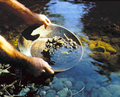
A gold pan in use.
As illustrated by the assortment of gold pans and gold pan sets illustrated in the Amazon search box at the bottom of this Blog it is possible to purchase many different varieties and configurations of gold pans. We personally prefer using a whole set consisting of a 14 inch classifier that is used to remove anything larger than 3/8 of an inch. What passes through the classifier goes into a 14 inch green plastic pan. This larger pan is used to work down the bulk of the gold bearing gravel. What is left in the pan is to concentrate consisting of mostly black sand and other stream heavies including gold. Although you can work down through the sand to its gold content it is more efficient to save the sand for later.   

A gold panning kit also includes a couple of other handy items; one of them is a small squeezable plastic bottle equipped with a plastic tube that is used to suck up small pieces of gold and gold dust in your pan. The other handy thing is a couple of small plastic vials that are used to keep the gold in you collect. Gold is placed into the vials from the suction bottle simply by squeezing it causing the gold to be expelled.


The other equipment that is required on a successful gold panning expedition is not directly related to gold panning, but they are things that you actually need. You will need a jeweler's loup with a 10 X. magnification, a long handled shovel and if the water is cold a pair of waterproof gloves. Since you are apt to be wandering around in the bit of a stream or other place with standing water it is a good idea to have a pair of rubber boots.

This is the basic equipment required for a successful gold panning expedition!