Total Pageviews

Showing posts with label gold pan. Show all posts

Wednesday, June 13, 2012

Kitchen Utensils used for finding Gold


Many of these things can be used in the search for gold, but not all.
Photo by Jeppestown


About the last thing in the world you would expect to use in the hunt for placer gold are ordinary kitchen utensils. Just think about that some of the most useful tools in the hunt for Gold are nothing more complicated than a spoon, knife and fork along with several other common things that can be bought at a kitchen supply store.

One of the most useful things you can have as nothing more than a simple plastic colander. This is used to separate large stones that would normally go into your gold pan before they ever get there. The colander is used by placing it over a gold pan and filling it with stream gravel then pouring water over it causing the smaller particles to come out through the bottom into the Gold pan. You can then throw away the larger stones, but examine them first to be sure they do not contain a gold nugget.

Another useful kitchen gadget is a wide mesh sieve you can actually set up in the gold pan below the colander this serves to separate even more of gold bearing sand from the larger particles. The material that is caught by the strainer is retained for future panning to recover any larger particles of gold.

Although a gold pan or even better a set of gold pans are nice to have but they are not really necessary because the author has actually used plastic food containers to pan for gold. No we ever set a gold pan had to be round!

The spoon, knife and fork are used to dig around in places that are too small to use a regular shovel. This is especially true of places like crevices in rocks. In the same vein one of the most useful tools for the recovery of gold is a large serving spoon that is also used in small places that are also too large for shovel.
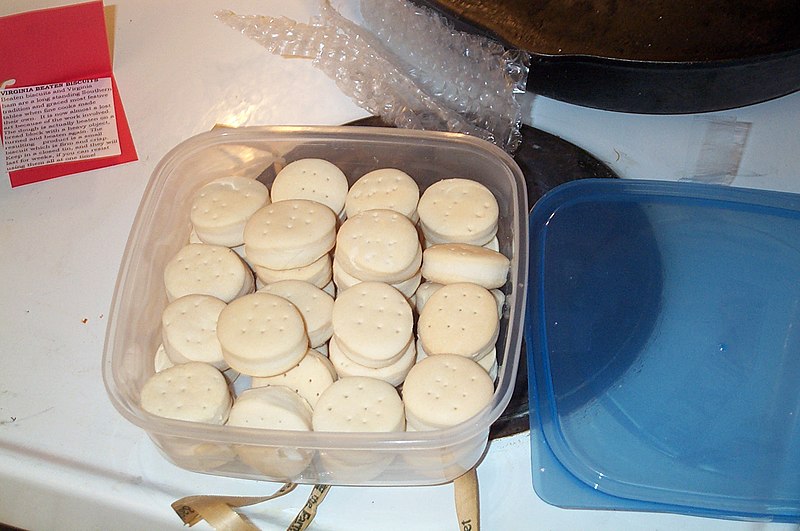
One of these plastic food containers can be used as a gold pan.
Photo by Stuart Spivack


Most of the gold panning kits that are now on the market include a snuffer bottle that is used to suck up small pieces of gold that are too small to be picked up by the fingers. You can use a turkey baster to do the same thing although it is a little large and cumbersome but actually works better is an ordinary eyedropper. Some kitchen supply stores supplying these things made from plastic as large as 5 ml, or 1 ounce.

Your homemade gold panning kits should also include a 10 X. magnifying glass and a pair of sharp pointed tweezers. This collection along with a conventional gold panning kit should serve in just about any situation that you find yourself in your hunt for placer gold. Who knows you may even find some other devices in your kitchen supply store that you may also find useful.

References:

This article is coming from personal experiences by the author over many years of panning placer gold.

If you would like to learn more about gold please click here!

How to Build a Gold Rocker Box:


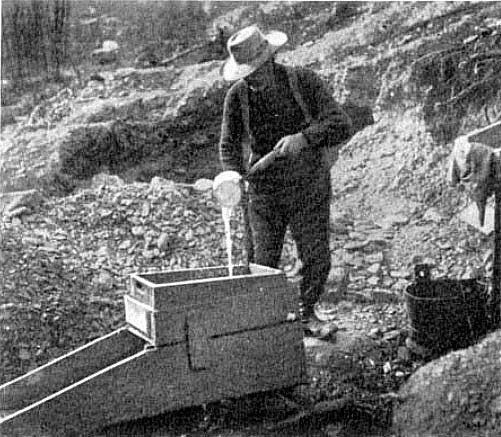
A gold rocker box in use


A gold rocker box is a device that efficiently recovers gold from river sand and gravel that is capable of processing more gold per hour then a gold pan.  Its invention was during the Georgia Gold Rush that predated the California Gold Rush by several years.  During the days of the Forty-Niners the rocker box was considered more important then the gold pan.  It was also important during the Klondike Goldrush because the miners were able to use the rocker box on higher stream banks because it used far less water then the conventional gold pan.

The Gold Rocker Box was a slightly more complex way of producing gold that could easily be built in the field by the average miner from rough sawn lumber.  It also had the advantage of being usable by one man.  It was built in two parts; the upper part was a box that acted as a grizzly separating the larger stones from the lower part where the smaller sand and gravel went to be processed. 

In essence the lower part was a sluice box from four to five feet long, and about a foot wide.  This part of the box was equipped with a set of cleats along the bottom of the sluice to catch the gold particles, and let the lighter load of gravel run out the lower end of the sluice box as waste.

The upper part of the gold rocker was a shallow wooden box with a one half inch screen that acted as a grizzly to remove the larger stones from the gravel that was passed through it on the way to the sluice box.  The miner discarded the larger stones, but first examined them to be sure he was not throwing out any gold nuggets.

A piece of canvas that went from the back of the upper box that was attached to the lower box assured that the gravel was properly dispersed into the sluice box.  This device has survived the test of time as the big dredges often used a rocker box to finish off the concentrate of gold and other stream heavies.

To build a rocker you start by building the upper box first this is about eighteen inches by twelve inches in size, and about four inches deep.  Then a lower sluice box is constructed that is from four to five feet long, a foot wide, and about four inches deep.  The upper box is attached to the lower box with four one x twos that are about a foot long.  A piece of canvas is attached to the rear of the upper box, and is angled down to the lower box and attached at the point where the upper box ends.  The lower box is equipped with a series of wooden cleats that catch the gold from the gravel that is being passed through. 

There is also some kind of a one x two attached to both of the boxes so that the miner is able to rock the device back in forth sideways while he is pouring water in through the upper box.  The whole device is elevated from the ground with a set of legs about four inches high that are attached to the sides of the lower box.  These legs are joined together by a wooden frame that is attached to the bottom of the legs.

In use the upper box is filled with gravel by the miner, then he pours water by the dipper full washing the gravel down into the lower box.  As he adds the water he rocks the whole device back and forth so the gravel falling through the grizzly is spread evenly in the lower box, and is thoroughly washed.  The gold, if any, collects behind
 the wooden cleats in the bottom of the lower box to be removed after a large quantity of gravel has passed through the device.  The larger stones that stay on top of the grizzly in the upper box are discarded, but examined first so you don’t throw away any gold nuggets.

The rocker box finds many uses in prospecting as it is able to separate any heavier material from lighter.  It is used for the panning of platinum group metals as well as the heavier gemstones like diamonds and sapphires.

References:


Friday, October 7, 2011

What’s that in the bottom of your gold pan?

Iron oxide that has been removed from gold concentrate with a magnet.
Photo by Peter Kuiper

Gold isn’t the only thing that ends up in your gold pan, although with a density of 19.1 it is one of the minerals that might be staring up at you.  Platinum or platinum group metals (PGM) having a density almost matching gold is another.  The rest of the odds and sods found with the rest of the black sands can range from a to z with zircon the last.  They can be divided into several different classes with iron oxides being one of the most abundant,

Iron Oxides:

Magnetite:  This is mixed with hematite on about a 50-50 ratio.  Magnetite can be removed with a common magnet.  This mineral is opaque black and is a member of the spinel group of minerals.

Hematite:  This is the second most abundant mineral found in the bottom of a gold pan. Unlike magnetite is can’t be removed with an ordinary magnet, but is attracted to a rare earth magnet.  Both magnets are used in the process or removing iron oxides from gold concentrate.

Iron bearing sulfides:

Pyrite: this is also called “fool’s gold” because it resembles gold but can be recognized by its rotten egg smell when tested with acid. Pyrite is brittle whereas gold is malleable.

Chalcopyrite:  The same tests apply as to pyrite except chalcopyrite is somewhat redder then pyrite.

Arsenopyrite: this occurs as silver colored cubic crystals that look like pyrite.  The simplest test is made by striking one of the crystals with a hammer when it emots a garlic smell.

Corundum:

This is aluminum oxide with a hardness of 9 on the Moh’s Scale that includes rubies and sapphires.

Diamond:

This is the hardest mineral of all with a hardness of 10 on the Moh’s Scale.  It occurs as a bypyramidal crystal.   

Uranium/Thorium:

There are several minerals present in stream heavies that contain these elements the most common are pitchblende, uranite, columbite/tantalite and allenite.

Tungsten:

The two common minerals of this element are wolframite and scheelite/  Both of these minerals fluoresce under ultraviolet light in a bluish/white glow.

PGMs:

Platinum group metals occur with gold on about a 5 to 1 ratio with more gold.  They look like steel and like gold are quite malleable.  They also leave a silver streak on a touchstone and are not affected by any acid except aqua regia a mixture made from 1 part of nitric acid and three parts of hydrochloric acid.

A zircon crystal
Photo by Rob Lavinsky

Zircons

These are the ore of zirconium that has many uses in modern technology.

Many of these minerals themselves are ores for their various elements.  In many places they are actually mined from beach sands for their metal content in places like Australia of the Southeast United States using specialized equipment mainly the spiral classifier.

Generally, any mineral with a hardness of 7 on the Moh’s Scale and denser then 3 will wind up in the bottom of your gold pan.  We did not include complete descriptions of these minerals because there are more then adequate descriptions available at www.mindat.org. :

Friday, May 20, 2011

How to use a gold pan

The usual size of the gold pan is about 14 inches that will hold about 20 pounds of gravel. Although you can take the gravel straight from the streambed it makes panning much easier if you use a classifier that removes all the stones larger than 3/8 of an inch from the gravel before you start panning. It is a good idea to examine these larger stones just to see if there are any gold nuggets present that might be thrown away with the oversized stone.

Gravel the largest piece in this picture in about 4 cm. This is typical of gold bearing gravel.
Photo by Stan Zurek


Gold is 19 times the density of water meaning that by shaking the gold pan combined with a circular motion when it is full of water will cause gold particles to settle through the gravel to the bottom of the pan. This is a process that you will want to repeat several times in the process of panning.

The gold pan is held at an angle so it's lower edge is submerged in water allowing the gravel to slowly pour over the rim and back into the stream. Periodically remove the pan from the stream and repeat the swirling motion to be sure you don't lose any of gold. Keep repeating this process until all that is left in your pan is an accumulation of black sand. It is in this black sand where gold accumulates. Always keep the edge of pan having the riffles submerged because the gold will be caught in the riffles rather than poring over the edge of the pan.

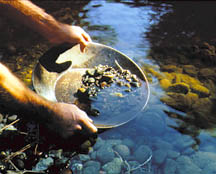
Gold panning showing how to hold a gold pan.  USDA


For the most part black sand is an accumulation of magnetite and hematite that our oxides of iron. Magnetite can be removed using a conventional magnet: hematite can be removed using a rare earth magnet. The magnetic separation of the iron oxides leaves behind a concentrate of the other heavy minerals that are found in stream gravel the most common of which are garnet and zircon as well as any other gold particles and other precious metals such as platinum. Gold and platinum often occur together!

Monday, December 27, 2010

Equipment Needed for Gold Panning

How to use a gold pan is something that is easily learned, but requires some practice.  The gold pan as we know it was invented by some Yankee tin-knocker during the California gold rush of 1849. Prior to that just about any water-tight container was used; one of the most common was a shallow wooden box.  The author has even used a plastic food container as a gold pan in a pinch.

A gold pan in use.
As illustrated by the assortment of gold pans and gold pan sets illustrated in the Amazon search box at the bottom of this Blog it is possible to purchase many different varieties and configurations of gold pans. We personally prefer using a whole set consisting of a 14 inch classifier that is used to remove anything larger than 3/8 of an inch. What passes through the classifier goes into a 14 inch green plastic pan. This larger pan is used to work down the bulk of the gold bearing gravel. What is left in the pan is to concentrate consisting of mostly black sand and other stream heavies including gold. Although you can work down through the sand to its gold content it is more efficient to save the sand for later.   

A gold panning kit also includes a couple of other handy items; one of them is a small squeezable plastic bottle equipped with a plastic tube that is used to suck up small pieces of gold and gold dust in your pan. The other handy thing is a couple of small plastic vials that are used to keep the gold in you collect. Gold is placed into the vials from the suction bottle simply by squeezing it causing the gold to be expelled.


The other equipment that is required on a successful gold panning expedition is not directly related to gold panning, but they are things that you actually need. You will need a jeweler's loup with a 10 X. magnification, a long handled shovel and if the water is cold a pair of waterproof gloves. Since you are apt to be wandering around in the bit of a stream or other place with standing water it is a good idea to have a pair of rubber boots.

This is the basic equipment required for a successful gold panning expedition!


Monday, November 29, 2010

How Gold was recovered in the past

Gold was the first metal discovered by man as it is found in nature as a pure metal that is commonly found in the beds of streams as gold nuggets.  The earliest gold miners before the dawn of history limited their production to whatever gold nuggets they were able to find.

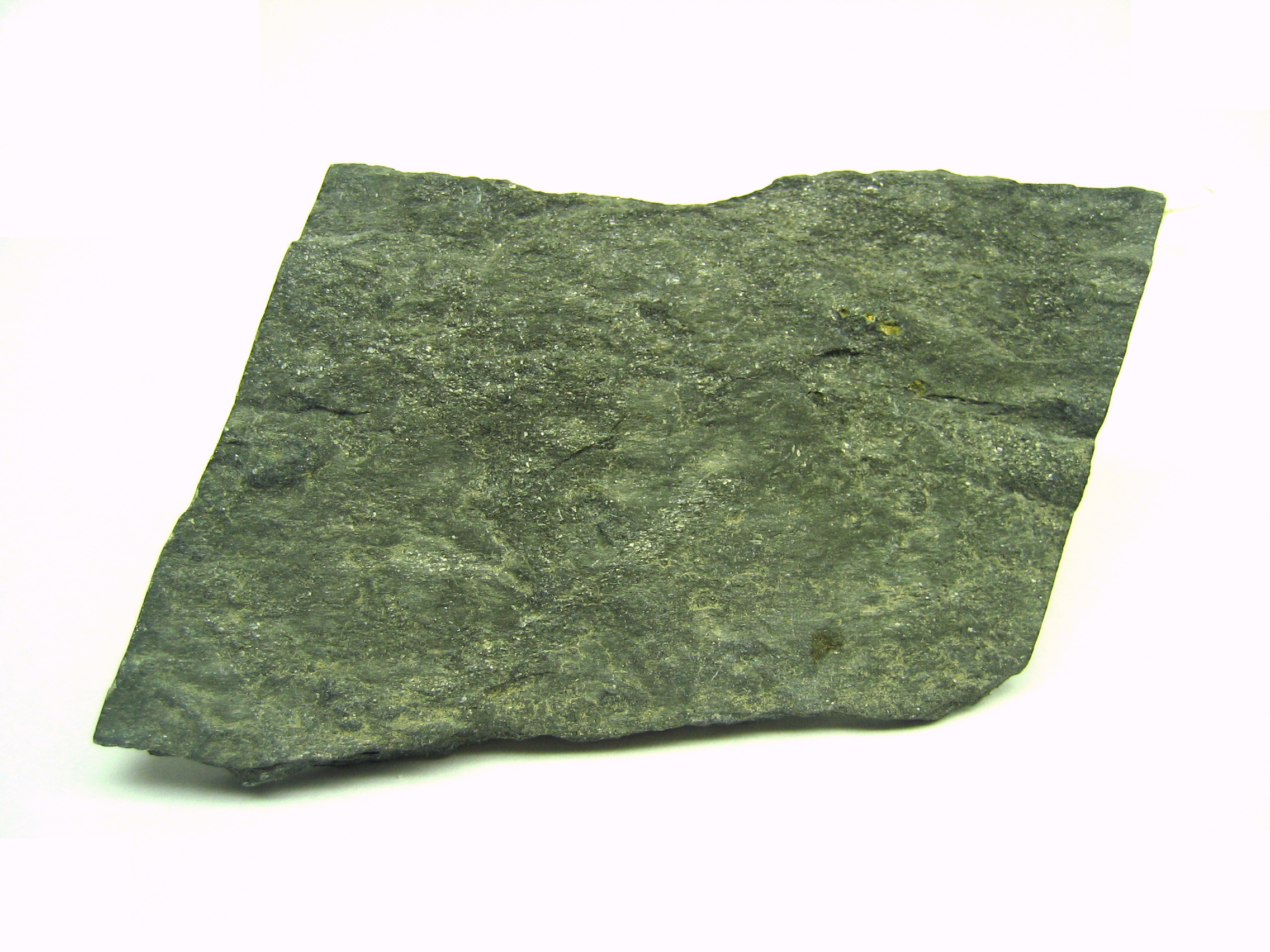
A flat stone like those used in early gold recovery
It didn't take the early miners long to discover that there was much finer gold particles in the sands of the streams as well as nuggets.  It didn't take nearly miners very long to discover they could recover this gold hidden in the sand that because of its weight would remain behind while the lighter sand particles could be washed away by running water.

A goldpan used during the California Goldrush

Man being the ingenious creature he is used a flat stone set at a slight angle to wash the sands leaving the particles of gold behind as the water took the lighter particles of sand.  Gold is 19 times heavier then water while most of the sand had a density of about three times of water.  This was an early demonstration of what is now called gravity separation, a method still in use.

Jason seizing the Golden Fleece
We are all familiar with the Greek Myth of “Jason and the Golden Fleece.  The dwellers living around the Black Sea used to put sheepskins in the bed of streams coming down from the mountains to catch any gold washed down from those same mountains.  This ancient mining method is still made use of in the bottoms of high-bankers and sluice boxes to catch gold particles.  However today they use indoor/outdoor carpet or old conveyor belts to entrap the gold.

In many countries they made use of a shallow wooden box to separate gold from sand, a practice still in use in some countries.  This was their form of a gold pan, and even today the use of square gold pans has made a big comeback.  They are touted to be the latest thing in gold recovery, but in reality they have been in use for centuries. 

The modern goldpan is a recent discovery that was first used by the 49ers during the California Goldrush.  The original goldpans were something knocked together by some nameless tinsmith that were used by the miners to pan for gold along the gold-bearing streams.