Total Pageviews

Showing posts with label gold belt. Show all posts

Thursday, December 29, 2011

Gold Occurrences in Panama

The Coat of Arms of Panama shows plenty of evidence about the gold mining history of the  country.

The Isthmus of Panama is what joins North America to South America, and is the home of the Panama Canal joining the Atlantic and Pacific Oceans.  Not surprisingly Panama also contains extensive gold deposits that have only recently been exploited.  Although gold was known in the earliest days it wasn’t until the early 1990s that several groups of miners who were mainly Canadians got several concessions from the Panamanian government to exploit the mineral resources of the Republic of Panama.  At the time because of lack of infrastructure there was no sense in mining Panama’s mineral wealth.  This all changed when terrorists destroyed the World Trade Center in New York City on 9/11/2001 by ramming the buildings with airplanes.  This started the price of gold spiraling upwards from a price that was pegged at $300/oz in March 2001 to more then $1,500 today.  Gold isn’t the only source of mineral wealth in the country that may prove to be the largest copper deposits found anywhere on the planet.  By 2004 the money started pouring in to Panama for exploration of mineral resources, and it is still pouring into the country.

The Isthmus of Panama was formed about three million years ago when huge amounts of sediments from both North and South America filled in the gaps between the islands of an island arc forming a solid strip of land that finally joined the two continents together.  Many scientists feel this was one of the most important events that has occurred in the past 60 million years.  Because it filled the gap between the Americas it completely changed the pattern of oceanic circulation that gave us the world’s present climates by forcing warm water northwards thereby heating the whole northern hemisphere.  It also created a landbridge that allowed the plants and animals from the Americas to mingle.

Panama and the Panama Canal,  The high mountains to the south of the canal are the home of much of the gold in the country, but gold is found throughout the country wherever there are volcanic mountains   NASA


The islands were for the most part volcanic like the modern Lesser Antilles of the Caribbean Sea.  These volcanoes are represented today by the string of volcanoes in  Panama.  It is these volcanoes inland from the subduction zone just off the west coast of Panama where the Cocos Plate is being subducted beneath Panama that keeps these remnants of volcanic islands still active today it also provides the heat engine that allowed the many mineral deposits to form.

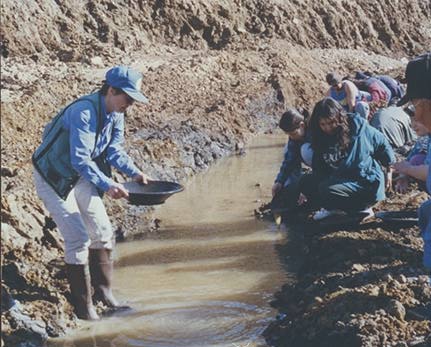
Gold panning lessons.   Public Domain


There are extensive deposits of placer gold in Panama with one of them in the southern part of the country more then 100 miles long along the banks of a river.  Because of its tropical nature the placer deposits in the country have been little exploited although some artisanal native miners have been working these deposits for years.

Wednesday, August 24, 2011

Gold Occurrences in Ontario


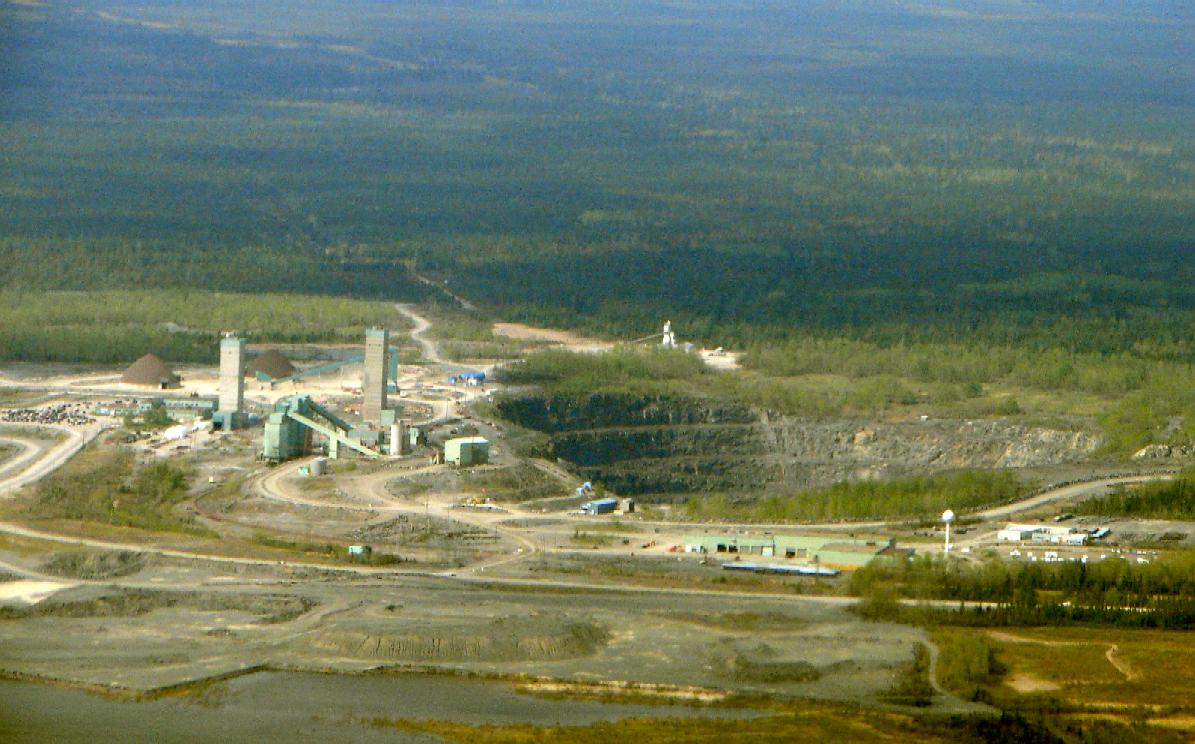
Kidd Creek Mine in Timmins Ontario   P199


The City of Timmins lies about 600 miles north of New York City it is common knowledge to most Americans that the Gold Rush happened in California in 1849, but a far larger gold rush occurred in Porcupine Ontario fifty years later.  Porcupine was later incorporated into the Township of Timmins, but Porcupine still exists complete with a Tim Horton’s shop.  One of the mines, the Dome Mine is still producing gold over a century later from a vast open-pit mine.  The other mines are now closed, but in West Timmins they have recently discovered one of the largest gold deposits of the past century.  It appears they haven’t written the last chapter in the book about Timmins Gold.

Most of the gold found in Ontario is found in the so-called Greenstone Belts the largest of which is the Abitibi reaching all the way from Wawa on Lake Superior into Quebec past Val D’or.  From this one Greenstone Belt there are more then 160,000,000 ounces of gold that have been mined since its discovery in 1909.  This is only one of several Greenstone Belts in the province that has produced gold. 

Gold bearing belts are found in several other localities in Northern Ontario with other notable occurrences at Cochrane, Red Lake, Hemlo, Marathon and so many other places that prospecting for gold in Ontario is practically the same thing as carrying coals to Newcastle. Many of the VMS mines in Ontario produce gold as a byproduct.  One example of this kind of deposit is found in the Kidd Creek Mine to the east of Timmins that was the site of a famous discovery in 1963.  Most of the gold that has been found in Ontario is from hard-rock deposits.

Somebody has said that there has never been a single nugget of placer gold that has been found in the province.  According to an open file report by the Ontario Geological Survey there appears to be a considerable amount of float gold present in the glacial drift of Ontario.  It is probable that placer deposits have not had enough time to develop since the glacier melted.  At any rate the report covers about two hundred pages listing all kinds of places where placer gold and indicator minerals for kimberlites have been found in Ontario.  You can access this document online by going here.

According to the author’s prospecting friends in Ontario all the prospecting done in the province is in hard rock. With the amount of gold that has been discovered that really makes sense. It could be possible that what has worked in the past will work in the future. The possibility of placer mining has not happened because of the scarcity of alluvial gold. Although the Abitibi region of Ontario holds many lode mines, placer deposits are practically non-existent. The glaciers of the past million years took the gold laden soil south and deposited it in states across the American mid-west. These are from New York to Illinois.
Most of the gold of Ontario is found associated with the greenstone belts of the Abitibi and Superior Provinces that span the whole province from Manitoba to Quebec. It is thought that the gold was mobilized from the greenstones that are metamorphosed basalts by hot water. It was deposited in quartz veins that are often found near fault systems.
Another place that gold is found in Ontario is in beds of ancient conglomerate. An example of this type is a large piece of conglomerate on display on the lawn of the library in Timmins. This is probably an ancient placer deposit that has been fossilized. The stones in this piece show little or no sign of having been metamorphosed. It is an example of an Archean sedimentary rock.
Some of the other regions of Ontario that have produced gold is the area around Wawa and Marathon. The Western part of the province is also promising country to prospect. Prospecting in Ontario is not just limited to looking for gold. There is at least one active diamond mine in the James Bay Lowlands, as well as diamond bearing kimberlites found in several places in the province.
Diamonds are often found in the same rivers and streams that carry gold in their sand and gravel deposits. The largest diamond that was ever found in North America was found in a placer deposit.
There are plenty of other minerals that can be found in Ontario as well. These minerals might not be as glamorous as searching for gold, but in many ways they are more important in the modern world. Among them are copper, lead, zinc, nickel, iron, lithium, beryllium, niobium, tantalum and the rare earth elements. The platinum group metals are often found associated with copper, cobalt and nickel.
If there is anyplace where people have looked in Ontario for mineral wealth they have found it. The province maintains a very active geological survey that holds vast amounts of knowledge concerning the mineral wealth of Ontario.

Wednesday, August 17, 2011

Gold Occurrences in Quebec


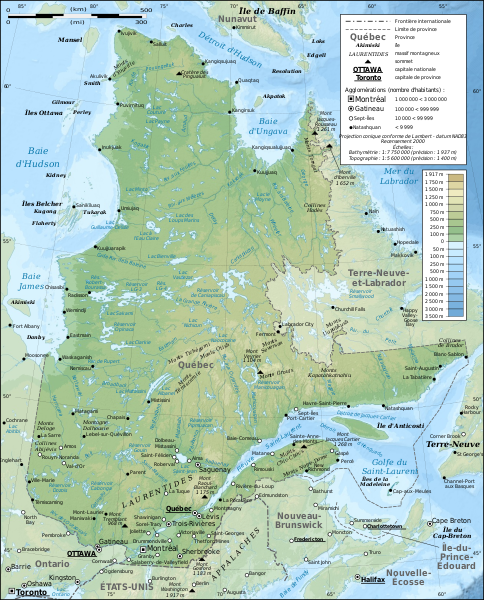
Topographic Map of Quebec   NASA


There are many gold deposits in Quebec many of which are being explored or developed into active gold mines at this moment.  The province is also the eastern terminus of the Abitibi Gold Belt that begins in Wawa Ontario and supposedly ends at Val D’or Quebec.  This is the second largest gold belt on earth only the Witwatersrand of South Africa is larger.  Since it was first discovered in the early 1900s the Abitibi has produced more then 160 million troy ounces of gold, more then there is in Fort Knox.

There are several different parts of the province that contain gold either as native gold or associated with other metals of which copper is one.  This is the case in the copper/gold mines around Chibougmau.  There is a goldmine located about 60 km west of Chibougmau on Rt 113 in the Chapais Mining Camp. Further north these is mining exploration work being undertaken on the Taigus Road that goes from Radisson east to within a little more then 100 km from the Labrador border.  There is also further exploration work being done in the far north of Quebec in the Ungava Bay Territory.  

The Matagami Camp is another hotspot of activity for both gold mining and exploration with several mining and exploration examining the surrounding area for gold and other base metals.  Exploration has reached the level where a surface mine is being opened near the town of Malartic between Val D’or and Rouyn-Noranda.  This site is located in the Abitibi Gold Belt.  A new find of Volcanogenic Massive Sulfides has been reported near Rouyn-Noranda. 

A great deal of exploration and mining activity is found north of the St. Lawrence River especially in Archean aged rocks, but most of the placer activity is found south of the river especially in the rivers and streams that drain the Height of the Land on the Maine Border.  Gold is found in the area centered on Sherbrooke and Thetford Mines as well as along the Chaudiere River.  This is an interesting area because it also displays the same kind of chaotic geology as the rest of the area that is on the seaward side of the Brampton/Baie Verte fault where continental terrane and oceanic terrane collided during the Taconic Orogeny forming the Iapetus Suture Zone.  This entire area in the Eastern Townships warrants further exploration for lode gold.  

Tuesday, March 8, 2011

Gold Occurrences in Georgia

Gold-mining begin in Georgia during the 1830s or so much gold was found the United States government actually opened a branch meant in Dahlonego that remained in operation until the outbreak of the Civil War in 1861. The gold belt in Georgia extends across the state from South Carolina to Alabama and is part of the Southern gold-pyrite belt that is found in the Piedmont and the Blue Ridge Mountains of the Southern states. Small amounts of gold are also found in the beach sends along the coast of Georgia, and in the outer islands.

This is the Glory Hole at the Consolidated Mine in Dahlonego, Georgia
Photo by Kudzovine

One of the places that is included in this gold belt is Atlanta where is conceivably possible for a resonance to find gold in their backyards. Placer gold is also found in the vicinity of Fort Benning where it is a wonder some sergeant hasn't had the bright idea of having his men panning for gold in the area.

Throughout the gold belt in Georgia to minors have produced both placer and lode gold where the placer gold was found along the creeks and rivers of the state and lode gold is to be found in the hard crystalline rocks.

The placer gold is found in the creeks and rivers of the state with most of the gold being found close to bedrock. Another place where it is possible to find placer gold is in a particular type of deposits called a saprolite that is formed by the deep weathering of crystalline rocks turning them into a mixture of clay and quartz grains. It is from deposits of this sort that we get the name, “Sweet red Georgia clay.” During the period of active mining in Georgia the saprolites deposits produced a considerable quantity of gold. In many places the bedrock was turned saprolites to a depth of more than 100 feet.

Although most lode gold is found in quartz veins where the gold is precipitated out of solution in the formation of a deposit. This is the primary way in which lode gold is found, but there are also lode deposits that are associated with pyrite in this case the gold is either dissolved into the pyrite as an impurity, or forms as thin films between the crystal faces. In the same way gold was also found as impurities with over massive sulfide deposits where they are being mined for other metals gold was often a byproduct.

The stone of the Southern gold belt ranges from Slate to gneiss with the quartz veins, we following the grain of the rock although the few cases it will deviate from the grain by a few degrees cutting across the layers of strata. In many cases gold found fault zones where gold and quartz are often found in veins in the fracture zones.

Friday, March 4, 2011

Gold Occurrences in North Carolina

Gold was discovered in North Carolina in 1799 by an 11-year-old farm boy named Conrad Reed who was fishing in the creek that ran across this father's property. He was fishing in the creek when something that was yellow and shiny caught his eye, so he took it from the creek  and brought it home where for several years it was used as a door stop. It was actually a gold nugget that weighed 17 pounds, but nobody in his family was able to identify what the mystery stone was. From that time on gold is an important part of North Carolina's history.

Reed was one of the many Hessian soldiers that deserted from the British Army during the Revolutionary war and took up farming in North Carolina. Although he was unable to identify what the mystery stone was, but by being a practical man when he was offered $3.50 by a local jeweler he accepted the offer. It wasn't until later that he found out with the mystary stone really was that led to a suite where Reed was eventually awarded $1000.

Panning for gold in North Carolina

The first gold mine in the state was established in 1803 that would make North Carolina the only state producing gold until 1828. It remained nation until the discovery of gold in California in 1848. The gold rush of 1849 into North Carolina's reign as the leading gold producing state of the nation although gold is still produced in the state mainly by weekend miners and prospectors.

Although there are placer gold deposits to be found in North Carolina most of the early mines were in hard rock where some of them extended as far as 400 feet into the earth. One of these mines located at Gold Hill eventually reached a depth of 800 feet in 1857.

North Carolina is located in the gold pyrite belt of the Southern Appalachian's that reaches from Maryland to Alabama. In North Carolina it includes the Piedmont and the Blue Ridge Mountains. The last significant amount of gold that was produced in North Carolina was as a byproduct from copper mining in the Blue Ridge Mountains.

Amalgamation tables at the Reed Gold Mine in North Carolina 

Gold is still being produced in North Carolina by small-scale miners and weekend prospectors that even though they don't get much gold for their efforts they are at least rewarded with a few colors of gold at the bottom of their gold pans.


Wednesday, March 2, 2011

Gold Occurrences in Maryland


You can probably find gold under the capitol dome!
YHistorically there have been several active gold mines in Central Maryland that have produced both lode and placer gold; this also includes the District of Columbia  There is a gold belt that runs across the middle of the state where today there are no active gold mines presently, but there are plenty of people panning for gold.  This panning activity takes place in several rivers and creeks including the Potomac River as it flows through Washington as far south as Georgetown.

Georgetown is located across the Potomac River from Washington, DC so we have to assume that gold is in our nation’s capitol. Just think of that the Capitol United States is built on a foundation of gold. That is probably a novel idea since most of the gold diggers in Washington seem to be in the Capitol itself.

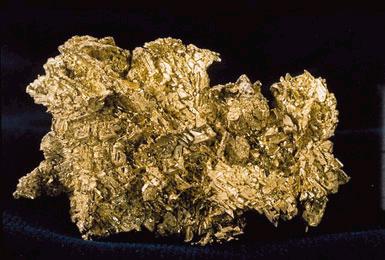
Crystalline gold.   USGS

Before it was closed during WW II there was an active lode4 gold mine located at the Great Falls of the Potomac in Maryland. All gold mining activity was banned by the government nationwide as it was felt the manpower to operate a mine would be better used in the war effort.  It was originally planned to reopen the mine after the war was over, but it never did.

There is ongoing placer mining and prospecting in the center of the state reportedly with a great deal of success.  This placer mining takes place on the rivers and creeks found in the area.  This gold mining belt extends across the state ending in Baltimore; can’t you imagine panning for gold on the banks of the Susquehanna River right in one of the Baltimore’s city parks!

The gold in Maryland was originally discovered by an Irish Union soldier while on KP duty, during the Civil War, that was washing frying pans on the banks of the Potomac River.  One of the ways to clean an army frying pan is to use sand as a cleaner.  The soldier probably had filled the frying pan with sand and gravel from the river that he sloshed around to clean the pan and found gold in the bottom of the pan.  It has been reported he was a member of a regiment from California.  If that was the case he was already familiar with the process of how to pan for gold, and was probably goofing off on his KP duty.

One of the precursors of gold is the presence of greenstone in the gold bearing belt thought by geologists familiar with gold deposits to be the source rock from which it is percolated by the action of hot groundwater.  The first chromite produced in the United States came from these same greenstone belts. The hot gold bearing groundwater that has percolated through the greenstone removing its gold content also carries many other dissolved minerals.  One of the principle minerals is silica that is deposited from the water at about the same temperature as gold.  Gold in quartz ore is often found together in veins making it one the most common forms of lode gold.


References:
Kuff, Karen, Cold in Maryland, 1987, http://www.mgs.md.gov/esic/brochures/gold.html
Prospecting for Gold near Washington, DC, http://www.infiltec.com/gold/

Friday, February 25, 2011

The World of Volcanogenic Massive Sulfides (VMS)

As a source of gold volcanogenic massive sulfides are not the primary source, but they do contain a substantial amount of gold as a byproduct. These deposits also hold significant amounts of copper, lead, zinc as well as gold and silver. Throughout history the VMS deposits are generally not the first choice of miners, as they are usually small and can be difficult to process. In today's world they have become a more significant source of metals than they were in the past because of advances in technology as well as the recent high metal prices that have caught the attention of prospectors.

This is Rouyn-Noranda the home of a VMS deposit. The Horne Smelter is in the background.

Deposits of VMS minerals can take in a variety of shapes occurring typically as lenses of polymetallic massive sulfide subform in patches on the seafloor near black smokers. Deposits of this nature can be found in extensional tectonic settings that include both spreading from the tectonic ridge, or can also be found in back arc basins such as the modern Sea of Japan. They range in age from some of the oldest rocks on Earth to the modern black smokers that are found in oceanic spreading centers.

Many deposits of this type that were once on the ocean floor have been incorporated in the continental crust by tectonic earth movements, so they are now on land. Even with the location of many of these deposits on dry land there are still many other exploration and mining companies that are interested in recovering minerals from the seafloor VMS deposits.

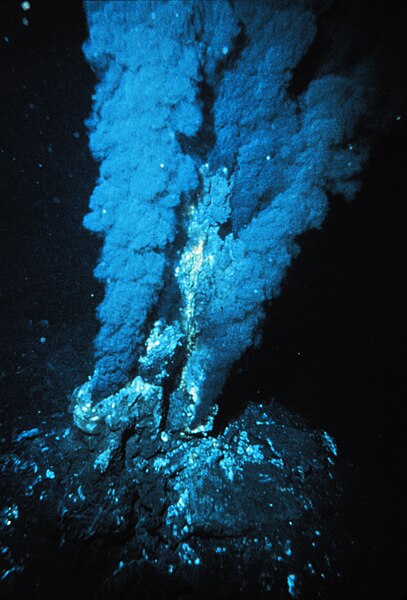
A black smoker where VMSs are formed in the Atlantic Ocean

Deposits of the VMS type are grouped according to the type of rock they are hosted in or on the basis of ore composition. This type of deposits can be classified in three different ways.

1. These are felsic volcanic hosted making up the most popular category that accounts for at least 50% of the deposits. Examples of this type of deposits can be found in the Abitibi region of Canada in Québec and Ontario.

2. These are mafic volcanic hosted accounting for about 30% of the deposits,

3. These are interbedded with a mixed bag of volcanic and sedimentary rocks that account for an additional 20% of VMS deposits.

The ore found in these deposits is broken into two groups: copper, zinc and zinc, lead and copper they also contain significant amounts of gold and silver.

Tuesday, February 8, 2011

Gold occurrences in Finland

The adit of a mine in Finland


One of the last places in the world you would expect gold is Finland, but it does have a very diverse geological history that has led to the creation of many different types of gold deposits of a variety of ages and different styles of mineralization. In the past any gold produced in Finland occurred as a byproduct from the mining of various Volcanogenic Massive Sulfides (VMS). It is only within the past decade that this situation has changed because of the closure of some of the baseball to mines, and the beginning of production from some of the recently discovered gold only deposits.

The gold deposits occurred during several distinct episodes of the crustal evolution of Finland. Gold deposits began in Finland during the Archean word forms and greenstone belts with low-grade copper, cobalt and nickel massive sulfides were formed. The same geologic setting created low grade ranging from 0.1 to1.0 ppm of gold but it is in very large deposits. Another type of gold deposit is found in the Tampere schist belt in southern Finland that is host to the Kutemajarvi gold deposits that in the period ranging from 1994 to 2003 produced 13 tons of gold from 1.4 million tons of ore. This mine was reopened in June 2007 by Dragon Mining that now operates under the name of “Orivesi Mine.”

The gold deposits in Finland are mainly associated with the Baltic Shield, but in the northern part of the country they are found in the greenstone belts of central Lapland where there are very few deposits having atypical mineralization.  Many of these deposits contain a significant enrichment of copper, cobalt, nickel and in some deposits uranium.  The areas having the largest potential for gold are to be found in the Paleoproterozoic greenstone belt located in eastern Finland and Lapland.  In the western Central Lapland greenstone belt there is the possibility of finding iron oxide, copper and gold deposits.  These systems are found in the western part of the Central Lapland greenstone belt.

In Central Lapland the greenstone belt is found in the northern part of the Fennoscandian Shield.  The mineral deposits found in this area are mainly sulfides and sulfoansenides in nature that also have gold values.  In this they resemble BHP Billiton’s deposits at Olympic Dam Mine located in Australia.


Wednesday, January 19, 2011

Gold Occurrences in Alaska

Gold is found throughout Alaska, and the resources are as vast as the land itself. One of the prominent features found in Alaska is the Tintina Gold Province (TGP) an arching curve that extends all the way from northern British Columbia, the southwestern part of the Yukon Territory and crosses the entire state of Alaska where it finally vanishes into the sea northwest of Anchorage. This gold belt has produced several gold rushes over the years probably the most famous is the Klondike Gold Rush that occurred in the late 1890s.

A gold dredge working on the TGP
Photo by Chris Lot

The TGP covers roughly 150,000 km² that is bounded on the north by the Kaltag Tintina fault and on the south by the Farewell-Denali fault. Geologically it could be considered a suture zone where one tectonic plate collided with another one. Throughout most of this vast area you can only find a few roads one of which is the famous Alcan Highway that goes to Fairbanks. The apex of the TGP arc is just about centered on Fairbanks, Alaska. Altogether the TGP is one of largest gold provinces in the world at 1200 km long and about 200 km wide.

The Tintina Gold Belt superimposed on a Landsat image.   USGS

The regional climate that is associated with the TGP is generally subarctic that includes several different physiographic regions and ecoregions like that Yukon-Tanana upland, the Yukon River low lands and the Kuskokwin Mountains.

Geologically Alaska is made up of several different terranes with the Tintina gold belt being only one of many. Although the TGP is the largest one in Alaska gold can be found throughout the state. Most of the Gold that has been recovered in the TGP to date has been placer gold, but new methods of mining and metallurgy have allowed some previously known deposits to be brought online.

Virtually all of the known gold deposits in the state have already been staked, but it is still possible in the state of Alaska to buy or lease a claim. There is a lot of information about doing this on the Internet. We put into our web browser, “Mining claims for sale in Alaska” and had more than 9,600,000 hits.


In addition to the gold deposits found in the TGP that also contains many other deposits of Volcanogenic Massive Sulfide (VGM) minerals. Some of the other metals that are produced in the TGP include copper, lead, zinc and tungsten.