Total Pageviews

Showing posts with label Canadian. Show all posts

Tuesday, March 20, 2012

Gold Occurrences in Ecuador


Coat of Arms of Wcuador

Ecuador is nestled between Colombia and Peru, but has seen nowhere the amount of exploration the other two countries have, a statement that is especially true of Peru.  According to some of the giants of the gold mining industry like Barrick and Newmont Ecuador is the prime place for exploration.  This is where the gold discoveries are going to be made, not in Peru where they are already mining gold.  Even though Colombia and Peru contain some really big deposits of gold Ecuador just hasn’t seen the level of exploration that has gone on in these other countries.

A great deal of gold has been found over the ages in south-eastern Ecuador including the gold used by the Incas from Pizzaro in the early 1500s.  This was enough gold to fill a room, but the Spaniards still executed the last of the Inca emperors.  The gold found here is epithermal in nature with drilling results by Aurelian Resources indicating a multi-million ounce deposit at their Fruta Del Norte project.

Today there are several exploration companies that are uncovering the enormous potential of this little explored region of South America.  Many of these exploration companies are working within a few kilometers from where Aurelian has its Fruta Del Norte property.  Many of these companies are exploring deposits that could potentially yield many ounces of gold.

Chimborazo one of the many volcanoes found in Ecuador that have epithermal gold deposits associated with them.
Photo by David Torres Costales


The majority of these companies are from Canada that are talking among themselves about arranging joint ventures.  The country of Ecuador is clearly open for business with all indications they have a government that is open for business and are prepared to act in a responsible manner.

Most of the Canadian and other companies are concentrating on the potential of developing lode gold deposits although there is plenty of room for placer deposits along the rivers and streams of Ecuador.  A great many of the deposits in this district are along tributaries of the Amazon River.

The potential for finding gemstones in this part of the world is also high it is just across the border in Colombia where some of the largest emerald mines in the world are located.  Years ago your author while exploring another of the tributaries of the Amazon discovered several sandbars that were littered with gem grade topaz that also contained placer gold.

Wednesday, February 15, 2012

Nancy Twinkie goes Big Time

A DeHaviland Beaver like the ones we had except ours were on floats not skis.
Photo by Dave Bezaire & Susi Havens


Every summer after black fly season was over Kenny, Hans and I used to go prospecting in Northern Canada in the Arctic Archipelago.  By that time I had married Nancy Twinkie.  It turned out to be an excellent choice and Nancy had developed into a good prospector and part time gold miner.  When she got wind of us going up north again she let out a howl that almost took the roof off the house.  She wanted to go too!   She also made it quite clear there was no reason why she shouldn’t.  Besides she could even get in a TV Special about prospecting in the far north.  Well, you know how a woman is when they get their head made up?

Kenny, Hans and I had a powwow about this development where at first the other two didn’t want to hear anything about Nancy’s plans.  She only howled louder, I never realized how much noise such a little snippet of a girl could make when she didn’t get her way.  I soon found out, so we decided Nancy could go with us as the camp cook, besides that we were sick of our own cooking.  It left too much to be desired.

With that we started the long trek by car to Winnipeg where we left our planes during the off season.  When we weren’t using them we leased them to the charter service in Winnipeg so they kept earning us money when we weren’t using them.  We had a pair of DeHaviland Beavers, a big single engine plane with a pair of pontoons bigger then canoes.  They also came with Pratt & Whitney radial engines that if they weren’t dripping oil we wouldn’t use them.

While we were getting the planes ready and buying what prospectors supplies we needed, Nancy went shopping for food.  She bought the usual, but even some things to eat we would never even thought of.  One of the items she bought was a big bag of marshmallows; can you just imagine taking a bag of marshmallows on a prospecting expedition?  I thought I’d never live that one down!

We took off on the long trip north to Victoria making our first landing on the lake at Thicket Portage.  It felt pretty good to have Nancy along she flew with me; Kenny and Hans were in the other plane.  After getting gas we continued to fly north to Churchill were we laid over for the night.  Rather then spending money it was our habit to sleep right in the plane.  The next morning we took off and continued north to our next gas stop at Baker Lake.  From Baker Lake we continued on north to our final destination at Cambridge Bay where we finally set down on the bay.

Cambridge Bay is on Victoria Island at 69o north.  The Arctic was abloom with flowers, and although the black fly season was over there were swarms of mosquitoes that took their place.  This surprised Nancy because she hadn’t counted on mosquitoes, and can they make your life miserable.

This story is going to take several episodes so be sure you see the next one: Nancy Twinkie meets the Inuit

Thursday, November 17, 2011

Gold Occurrences in Nunavut

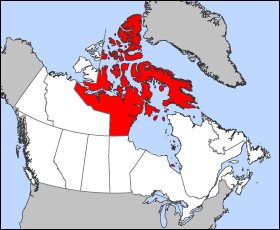
Nunavut is shown in red.


Eastern Nunavut is dominated by the mountains of the Arctic Cordillera a range of volcanic mountains that extends southwards from Ellsmere Island to the Torngat Mountains of northern Labrador and Quebec.  At 8,583 feet (2.616 meters) Barbeau Peak is considered to be the highest point on the east coast of North America.  Many of these mountains are of volcanic origin, and some of them still display cones.  It is the inhospitable nature of the Canadian Archipelago combined with the volcanic nature of these mountains that we must assume there is plenty of gold that hasn’t been discovered yet.

In essence the Arctic Cordillera are reworked rocks of the Canadian Shield and in many respects are similar to the Appalachians although the orogeny that formed them is much younger.  The area is fairly heavily intruded with volcanics that are associated with the orogeny.  To the west of these mountains Nunavut is composed of older rocks belonging to the Canadian Shield.  There are a series of greenstone belts that are found throughout the Canadian Shield including those found in Nunavut.  It is in these rocks that much of the gold in Canada has been found.


The Meadowbank Gold Mine under construction.
Photo by Agrico-Eagle Mining


Nunavut’s first gold mine opened in 2010 operated by Agnico-Eagle it is the first gold mine in the Territory and the first gold mine to become operational here.  The mine is called the Meadowlake Mine that opened in June 2010.  Exploration for other mines is proceeding.  There have been plenty of problems this mine has faced ranging from difficulty in off-loading freighters, leaky dikes, getting permits and delays in completing an airport capable of handling jets.  With these problems it has been estimated that production at this mine is apt to be more then CN$350 per ounce.

At one time in 1999 there were two operational mines in Nunavut both of these mines produced lead-zinc.  One of these mines had the title of being the most northerly mine in the world.  This was the Polaris Mine on Little Churchill Island.  The Nanisivik near the village of the same name produced silver along with the production of lead-zinc.  Both mines are now closed.

There is an active exploration industry and several other mines are in the process of being opened.  Prospecting in Nunavut is expensive but there are grants made available from the territory of $8,000 if you are a serious prospector. The territory also conducts classes for the local population in a program that travels from community to another conducting night and field classes for the people living there. These classes have been conducted for several years, and it was a local prospector who took the classes that found a deposit of gemstones in 2001 that he sold to a mining company.
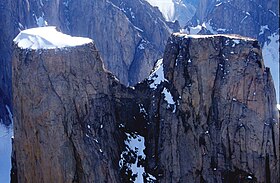
Mt Aasgard in Nunavut is one example of the terrain you will encounter.  It is located on Baffin Island


Unlike other parts of Canada, Nunavut has not been well mapped so there is plenty of opportunity for prospectors to find valuable mineral deposits. One of the things that you have to be careful of is that it takes about 100 prospects before you can develop a single mine. 

Tuesday, November 8, 2011

Gold Occurrences in Alberta

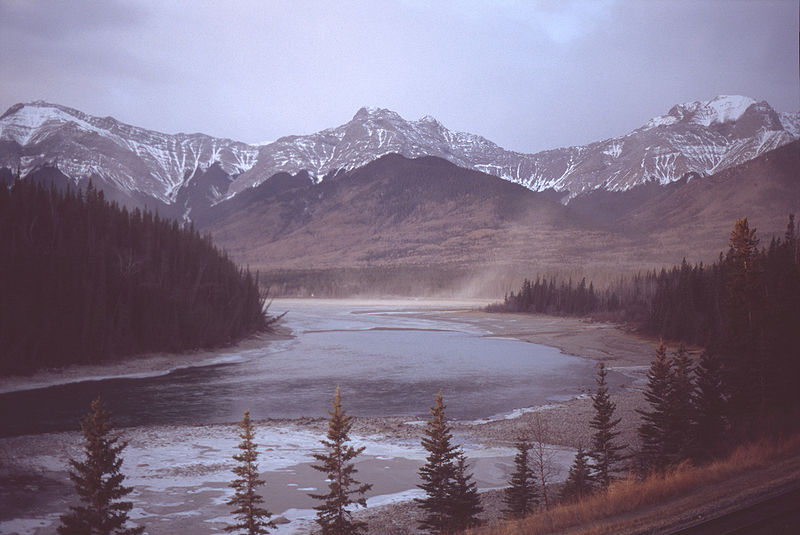
Gold country in Alberta


Although there are over 200 reported instances of lode gold occurring in Alberta there are several places where it might be found.  In the very northeast corner of Alberta is a small fragment of the Canadian Shield that might contain the right geology for the occurrence of gold.  North of the 55 degree line is a mass of Paleozoic and Mesozoic sediments that have been intruded with volcanics, and are highly faulted and sheared from earth movements.  These sediments are quite apt to contain gold.  Another place where gold is apt to be found is in the tailings of the Athabasca Oil Sands.

The area underlain by the Precambrian rocks in northeastern Alberta has more then 200 known occurrences of gold.  Some of these deposits produce the potential into being developed into significant mines.  These deposits are mainly in sulfide hosted deposits with the gold being associated with other metals.  Many of these deposits are found in hydrothermal veins associated with iron mineralization.  Many of these deposits especially those found in the Athbasca basin were emplaced within the past 1.5 billion years.  Many of these deposits are in Phanarozoic deposits especially those whose host rock is in black organic rich shale.  Many of these deposits are to be found in the Alberta portion of the Rocky Mountains.  There are many places where by sampling the soil it is possible to find anomalously high concentrations of gold.  These anomalies indicate the possible presence of viable gold deposits lurking underground.

The Athabasca Tar Sands a possible source of placer gold.


Placer deposits in the province are found in rocks ranging from the Cretaceous to modern.  A good place to look is in conglomerate, or in stream gravel.  Deposits of fine placer gold are found along the Saskatchewan River as it flows through Edmonton.  On warm lunch hours one can see executives with their pants rolled up panning for gold.

This kind of gold is usually found in fine particles that are known as flour gold.  The color of this gold ranging from the pale yellow to a coppery red depending upon what other metals are alloyed with the gold.  The yellowish specks of gold are alloyed with silver forming a compound called electrum. The reddish colored gold is alloyed with copper. Sometimes the gold that is discovered and placer deposits is coated with iron or manganese oxides that have to be removed with acid. Gold itself is not affected by any acid except act the region a mixture of nitric and hydrochloric acids. Fools gold differs from real gold because it is brittle and crushes easily.

There are several different river systems in the province that do contain placer gold among them are the North Saskatchewan, Red Deer, McLeod, Athabasca, and the peace River systems.

Tuesday, August 30, 2011

The National Instrument 43-101 (the NI 43-101 or the NI


This is a mineral resource scheme that is used in Canada for the public disclosure of information about mineral properties in Canada or by extension all over the world if securities in the companies promoting such properties are sold to the Canadian Public.  In practice the NI 43-101 is a strict guideline about how companies whose stock is traded in Canada can disclose both scientific and technical information about mineral projects on bourses under the supervision of the Canadian Securities Administrators.  The list includes the Toronto Stock Exchange (TSX) or the TSX Venture Exchange (TSX-V).  Many of these companies are listed on other stock exchanges outside Canada, such as the Johannesburg Stock Exchange, Australian Securities, the London Stock Exchange and all the exchanges headquartered in New York City.

There are many different types of reports that are covered including press releases, reports, the reporting of resources and reserves, presentations, oral comments and websites.  Included in the classes of minerals covered are metalliferous deposits, precious metals, coal, bulk minerals, dimension stone, precious stones and mineral sands (placer deposits).  For TSX listing purposes the NI 43-101 Technical Report would have to be accompanied by a report that is prepared in accordance with NI 43-101 specifications.

The NI 43-101 grew out of one of the biggest mining scams in history, the Bre-X (Busang) scandal to protect investors from mineral project disclosures that weren’t substantiated.  The Bre-X scandal occurred when it was claimed there were over 200,000,000 ounces of gold in the deposit or 8% of the total world’s supply.  It was all smoke and mirrors and a huge fraud.  Its chief geologist committed suicide by jumping from a helicopter over the mine-site.  The whole thing was a massive fraud with no gold.  The core samples had been salted with gold, and after analysis in an independent lab many of them proved to be scrapings from jewelry.  The investors lost their shirts!

Bluntly, the purpose of the NI 43-101 is to protect investors from misleading, erroneous or fraudulent information or claims relating to mineral properties is not published or promoted to investors on stock exchanges that are overseen by the Canadian Securities Authority.  This includes stock issued by foreign corporations selling securities in Canada.  

The NI 43-101 stipulates and codifies the form and content of a compliant report (i.e.; a report that complies with the Reporting Standard).
Prescribed disclosure within the National Instrument relates to;
§                    All disclosure of scientific or technical data, including disclosure of a mineral resource or mineral reserve, concerning a mineral project on a property material to the issuer must be based upon information prepared by or under the supervision of a qualified person

§                    What the National Instrument is to be used for, such as which types of mineral properties must be covered by a compliant report
§                    Prescribes the terminology to be used to describe various features, both geologically and financially, within the report
§                    Stipulates the type of information to be discussed and the technical data which must be portrayed, for various levels of reporting
§                    Prescribes a list of approved Competent Persons, and the definition of Groups and Associations which may qualify to certify such a person as "Qualified"
§                    Prescribes that a Qualified Person vouches for the accuracy and completeness of the contained information and the manner in which it is presented
§                    Provides guidance on reporting Historical mineral resource estimates
Proscribed disclosure within the National Instrument precludes a company from reporting;
§                    quantity, grade, or metal or mineral content of a deposit that has not been categorized as an inferred mineral resource, an indicated mineral resource, a measured mineral resource, a probable mineral reserve or a proven mineral reserve
§                    results of an economic analysis that includes inferred mineral resources
§                                allows for the potential grade, quantity and metal or mineral content of an exploration property, provided that a qualifying statement is made as to this being conceptual in nature
§                    the term preliminary feasibility study, pre-feasibility study or feasibility study when referring to a study unless the study satisfies the criteria set out in the National Instrument