Total Pageviews

Showing posts with label volcanoes. Show all posts

Tuesday, June 12, 2012

How the Geological Theory of Uniformitarianism affects Everyone's Future


James Hutton the founder of the Theory of Uniformitarianism 


It was during the mid-17th century that the Archbishop JamesUssher of Ireland and a notable biblical scholar used the Bible to determine the age of the earth based on the generations described in the Bible. From carefully counting the number of generations described in the Bible Ussher it determined that the earth had been created during the year of 4004 BCE. This may not indicate the actual age of the earth although it does tell how many generations are described in the Bible.

A little more than a century later the Scottish geologist James Hutton who is called the father of geology came to the conclusion the earth was much older then it was believed to be by Archbishop Ussher. Working out of the University of Edinburgh Hutton laid down one of the basic tenets of geology when he suggested that the processes occurring today for the same processes that had acted in the past, and would be the same processes working in the future. This is a polite way of saying, “Nothing ever changed and nothing ever will.”

It was in 1785 that Hutton wrote, “we find no vestige of a beginning, no prospect of an end.” James Hutton, 1785.  100 based his theory on was the slow, natural processes that he is observed in the landscape of Scotland. One of the first things he realized was that if a stream was flowing for enough time it would create a valley. He also observed that ice could a erode rock, that sediment could accumulate in such a way as to form new landscapes. I'm also realized that the effects of great disasters on the face of the earth such as earthquakes, asteroids, volcanoes and floods are nothing more than a part of the regular cycle of earth processes.

The entire theory is postulated by Hutton known as the Theory of Uniformitarianism is based on the slow, natural processes that occur on the face of the earth cussing him to speculate that millions of years would've been required to form the surface of the earth into its present state. This theory was used to give rise to a new science that was closely related to geology that is called, “geomorphology.” This is the study of landforms and how they were created.

Hutton himself is not a very good writer that is considered by many to be unfortunate, but his paper of 1785 suggested an entirely new theory of geomorphology that is the study of landforms and their development. Another sentry was to pass before another geologist Sir Charles Lyell. Whose money and metal book the principles of geology that was published in 1830 popularized the concept laid down by Hutton in his earlier work on uniformitarianism.

Today the age of the earth is estimated to be about 4.50 5 billion years old with a planet having had enough time for the slow, continuous processes of geology to mold and shape our as we now know.  In the same vein we know that sudden disasters have also had some very profound impacts on our landscapes.

In 1994, the US National Research Concil will stated:

“It is not known whether the relocation of materials on the surface of the Earth is dominated by the slower but continuous fluxes operating all the time or by the spectacular large fluxes that operate during short-lived cataclysmic events. (Davis, 18).”

Today it is recognized that the water that falls on those writing during a storm slowly erodes the soil, wind is capable of moving the sands of the desert's, floods can change the course of a river while the theory of uniformitarianism unlocks the keys of our distant past and predicts the future and is the controlling factor for everything that occurs today.

For further reading about this subject consult:

Davis, Mike. Ecology of Fear: Los Angeles and the Imagination of Disaster.
Lyell, Charles. Principles of Geology.
Tinkler, Keith J. A Short History of Geomorphology. Barnes & Noble Books, 1985.

Monday, November 28, 2011

Gold Occurrences in Guatemala


Coat of Arms


Guatemala is the northern most country in Central America adjoining Mexico on its southern border.  Gold mining has been practiced in Guatemala since before the days of the Spaniards by the Maya Indians, and is still being practiced today.. the country is mounted on the north by Mexico, on the northeast by Belize and on the South by Honduras. The Caribbean Sea lies to the east, and the Pacific Ocean to the West.

Some of the core rocks of Guatemala were laid down around 370 million years ago that have since been overlaid by tertiary volcanism many of these mountains contain iron, copper, lead, zinc and traces pf gold and silver that are still being mined today.  The Tertiary period when dinosaurs roamed the Earth was when this massive layer of volcanic rocks were laid down with their accompanying mineral deposits.  The eruptions did not stop during the Tertiary there are volcanoes still erupting today in Guatemala. 

Volcan Flores one of the many volcanoes of Guatemala
Photo by Rick Wunderman (Smithsonian Museum)


As recently as 23,000 years a very large eruption occurred for me a call barrel that is now occupied by Lake Atitlan in the Guatemalan highlands.  One recent eruption of Mt. Santa Maria in 1902 was one of the most violent eruptions of the 20th Century.  As recently en eruption of the volcano Pacaya in September 2010 caused 1,800 people to flee their homes as the volcano spewed ash, lava and rocks over the surrounding countryside.  The eruption was also blamed for at least three deaths.

It is a well known fact that gold is often found in the vicinity of former volcanic eruption's in deposit great amounts of gold by the action of hot water. Even today there are many hot springs to be found in Guatemala in it which could still be bearing gold laden waters. An especially good place to look for gold is around ancient volcanoes especially those that have created calderas. Gold is not usually found in the center of a caldera but rather at its edges. Many times these gold deposit a company magnetic highs that are found at the outer edges of a caldera eruption.

A great deal of Guatemala is covered by tropical rain forest combined with the rugged terrain and it's prospecting in the country very difficult although not impossible. This condition prevails through all of Central America. In Guatemala there are both placer and lode deposits of gold.  Gold can be found in most of the rivers and streams flowing down from the highlands of the country. Because of ground cover finding lode gold is more difficult although not impossible if you use modern geophysical instruments.

Gold is often accompanied by deposit so magnetite that is sensitive to a flux gate magnetometer. There are other advanced methods of exploring for gold including one very accurate means that involves taking soil samples, and subjecting the samples to analysis by an atomic absorption spectrometer.

It is possible that the area encompassed by Central America could well prove to be one of the most mineral rich areas in the world. 

Saturday, March 5, 2011

Epithermal Gold Deposits

Epithermal gold deposits are typically found in a near surface environment where the gold and other metals are deposited usually within 1.5 km from the surface. This type of deposit is always associated with volcanism either of the surface of the earth or in spreading centers at the bottom of the sea where their physical manifestation is hot springs, or are found associated with black smokers. They are commonly found in the vicinity of volcanoes either presently active or extinct where they form a halo around the point of eruption.

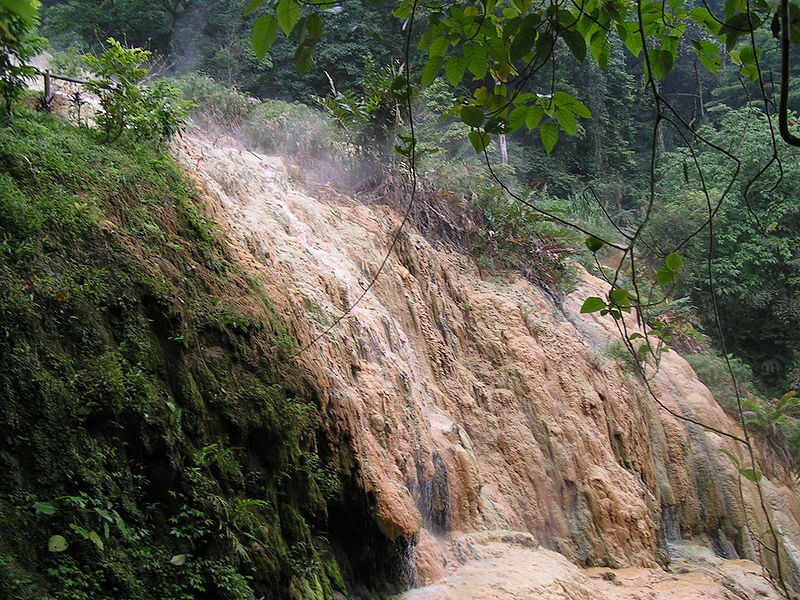
This is the type of mineral deposits that can be laid down by a hot spring.

An area where a epithermal deposits are common and is in the caldera of Yellowstone National Park where various mineral deposits are being deposited to this day due to the action of geysers, hot Springs and other geothermal events. This can be observed in the deposits of sinter that builds up around the geysers and hot springs. Yellowstone park itself is in a giant caldera that was caused by an eruption that occurred about 640,000 years ago. The hot spring activity that is associated with the park is caused from a magma chamber that is relatively close to the surface.

A prospector I know is working in volcanic terrain where the last eruption was 3 million years ago where the erosion rate is ~1 mm/year indicating that about 3 km of rock has eroded from the site since it had its last eruption.  In this terrain that is located within an ancient caldera enough of the surface rock has eroded away so that most if not all the epithermal deposits that were present, but around the periphery of the caldera one is more apt to discover epithermal deposits of gold and other metals then inside the caldera itself.

This is gold deposited on barite a common association in epithermal deposits.
Photo by Rob Lavinsky

This does not mean that gold deposits can’t be present in such an environment it just means that they are not likely to be epithermal deposits.  Although epithermal deposits are precluded by the depth of erosion it does not preclude other types of other hydrothermal deposits. Since epithermal deposits occur within a low-temperature environment that occurs less than 1.5 km below the surface it stands to reason that if there are still hot springs in this caldera it is still possible to have epithermal deposits occurring as secondary deposits superimposed on other deposits of hydrothermal origin.

Epithermal deposits occur in three different phases depending upon how much sulfur is present in the epithermal water. Deposits of this nature are classified as high sulfidation, intermediate sulfidation and low sulfidation each of these types of deposits are identified by their alteration mineral assemblages, occurrence, texture and in some cases are even identified by the associated element. Pyrite is the most common of these minerals, but you can also find mercury, antimony, arsenic and tellurium. Included in this suite it is also possible to find the base metals copper, lead and zinc as well as gold and silver. Gold and silver may be alloyed together as the alloy electrum.