Total Pageviews

Showing posts with label radiometric. Show all posts

Tuesday, November 22, 2011

Gold Occurrences in Greenland


Greenland suffers from a split personality because geologically it is part of North America, but politically it is part of Europe; to be specific Denmark. Greenland geologically is part of the Canadian Shield although in many places it has been reworked. In the southwest corner is found some of the oldest rock on earth is taking the form of gneiss that has been intruded by a younger magma that provided the radiometric date. It is this younger magma from which a date of about 4 billion years ago has been derived. The gneiss itself is much older.

Like the rest of the Canadian Shield, Greenland is blessed with greenstone belts that are always associated with gold.  The east coast of Greenland lies just to the west of the IapetusSuture Zone making it similar to western Connecticut and Eastern New YorkNorthern Ireland, Scotland and the Scandinavian Peninsula split off the eastern coast of Greenland during the period when the Atlantic Ocean was opening making a strip along the east coast similar to the eastern United States.  Some of the rocks in Scotland are identical to the Catskill Mountains in New York composed of what is called the Old Red Sandstone in Scotland.

A geological team at work in Greenland
Photo by Erik


Although much of Greenland hasn’t been explored as it is covered with up to two miles of ice enough has been explored so there are some active gold mines found on the Island.  The island could become the next mining frontier an idea that drew over 150 people to a meeting about the potential for mineral exploration in Greenland in TorontoGreenland itself is one indication about how the soaring prices for metals attracts miners to the out-of-the-way places that under usual conditions are normally overlooked.  Greenland is an extension of the Canadian Shield that contains many potential mineral deposits.  Just one deposit of cryolite sparked the whole aluminum industry during the late 19th Century.

Greenland underwent two episodes of the breakup of a continent as recently as the Eocene about 40 million years ago and displays both extensional terrain and extensive volcanism just the place to look for gold.  Right across the middle of the island there are extensive flows of lava that cover the surface of the land beneath the ice.  One of these breakups formed the Davis Channel between Greenland and Canada the other involved the formation of the Atlantic Ocean that gave birth to Ireland, Scotland and Scandinavia.  The ancient suture zone was just off the coast of present day Greenland.

Gold isn’t the only precious commodity found on Greenland; True North Gems has also found extensive deposits of rubies in southwestern Greenland.  There are also many other things then gold that are being mined on the island right now.  Exploration is ongoing for other commodities.  One of these is diamonds, although none have been discovered yet geologically there is no reason why they haven’t, and plenty of reasons why they should.

Although Greenland is off the beaten path it isn’t so far away that it can’t be in what is called in international trade a part of the Hudson – Rhine Axis of Trade.

Tuesday, November 15, 2011

Gold Occurrences in the Northwest Territory of Canada

The NWT of Canada


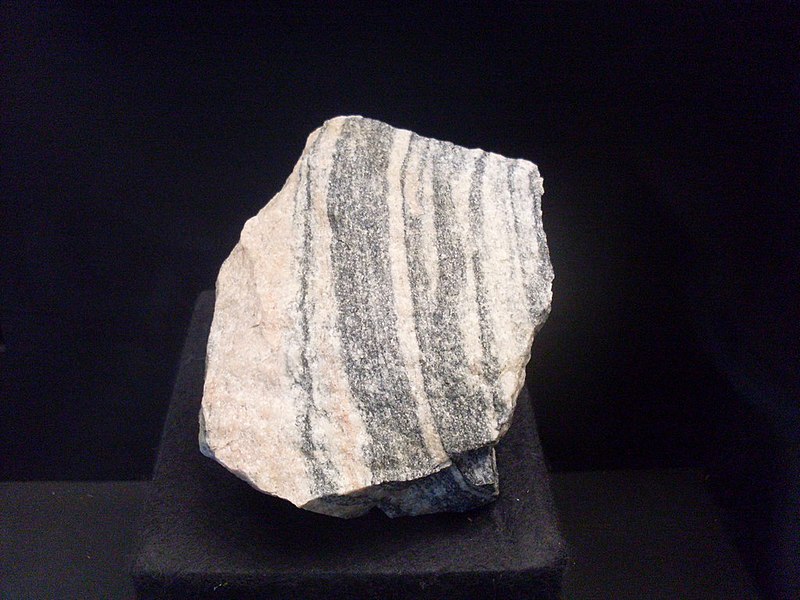
Some of the oldest rocks on Earth are the Acasta Gneiss found in the Northwest Territory of Canada.  The rock itself is metamorphosed sedimentary rock that is far older then its radiometric date of 3.8 billion years.  A zircon found in this rock has been dated as 4.03 billion years old.  These rocks of the Acasta formation are by far the oldest rocks discovered in North America, and were originally laid down in the Hadean era.

A fragment of the Acasta Gneiss on display in the Natural History Museum in Vienna.
Photo by Pedro Alexandrade


Unlike the Yukon that lies to the west of the NWT that has no exposed rock of the Canadian Shield most of the territory is composed of rocks of the shield.  These rocks display plenty of greenstone belts notably the Yellowknife Greenstone Belt near Great Slave Lake.

Gold was discovered in the territory in 1898, but active mining did not commence until the mid 1930s in the area around Yellowknife. The opportunities for additional exploration and prospecting in the territory abound. There are other valuable mineral deposits that are being worked in the territory including uranium and the recent discoveries of diamonds have resulted from the opening of diamond mines.

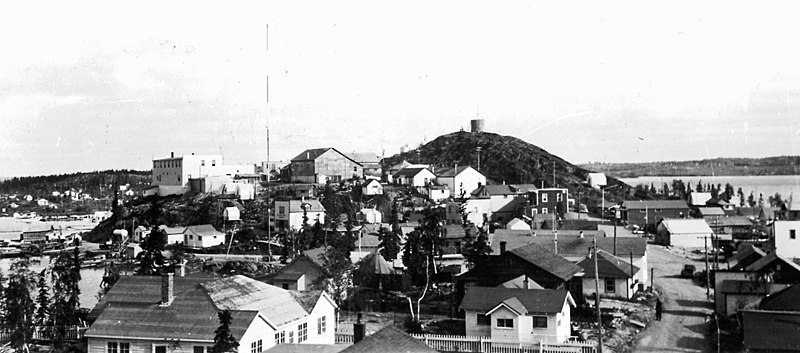
Yellowknife, NWT in the mid 20th century.
Photo by YK Times


A vast amount of information is available through the Northwest Territory’s Geoscience Office in Yellowknife. Another source of information is the Prospectors and Developers Association of Canada (PDAC) in Toronto, Ontario. The Northern Miner in Toronto is a weekly newspaper covering the mining industry worldwide including the Northwest Territory.

Prospecting for Gold the Northwest Territories of Canada along with many other valuable minerals including copper, diamonds and uranium is a viable occupation. Parts of the territory along the Arctic coast and on the islands in the Arctic Ocean contain gas and oil. A few years ago a geologist inadvertently published the locations of test wells on Ellsmere Island and received a proper wigging for his efforts. The territory depends on mining for most of its economy. Today however the emphasis is on diamonds rather then gold.

A significant gold discovery has recently been announced at the REN gold site. The gold was discovered in a seven kilometer long iron formation. Gold is often associated with iron especially with the ore granular magnetite. Some of the grab samples of ore collected have as much as 198 g/t of gold. In follow-up drilling more gold was found in the host rocks adjacent to the gold rich body of iron ore.  The area around Yellowknife is dominated by the Yellowknife Greenstone Belt that has been the scene of several past and present gold mines.

Over the years there have been a number of gold mines found in the area around Yellowknife the territory’s capitol. This city was originally settled as a gold camp and became the capitol later. The diamond mining industry is now centered Yellowknife although the actual mines are located to the Northeast of the city around the Lac de Gras area.