Total Pageviews

Showing posts with label New York State. Show all posts

Friday, May 18, 2012

Lost Mines at Austerlitz. New York


Bash Bish Falls just south of Austerlitz


There are reports of a lost mine or two in Austerlitz, New York in Columbia County located in the high peaks of the Taconics.  According to reports the mine wasn’t profitable because there were only a few streaks of yellow gold to be found in the massive quartz.  Geologically this makes sense because the author has seen a lot of this quartz as float in the streams of Columbia County in the past.  There are also outcrops of the same quartz veins to be found throughout the county especially on the New York Thruway, the Berkshire Spur (I-90) and Rt. 22 in several places especially in Petersburg, New York.

According to the story Oscar Beckwith who had been born in the area around 1810 who had traveled extensively in the American West returned home at the age of 67.  Soon, Beckwith found traces of gold on his property he sought financial backing from a resident of the county named Simon Vandercook by making him a partner.  This new partnership didn’t work out to well and they soon took to quarrelling until in 1882 Beckwith solved the problem by murdering Vandercook.  This was a particularly grisly murder that also included cannibalism in Beckwith’s attempts to hide the murder.  He ate Vandercook’s liver after frying it in a frying pan.  He then cut the body up and prepared it for pickling in a barrel of salt brine, and the charred remains of Vandercook’s skull were found inside the kitchen stove..

He then disappeared for six years following the murder thus escaping justice, but he was eventually found and brought to justice.  Beckwith soon confessed to his crime where he described bludgeoning and stabbing Vandercook then started eating him to hide the evidence, after his trial Beckwith was sentenced to death by hanging in the courtyard of the county jail in Hudson because his crime had been so gruesome. 

While he was being held for hanging he told his jailers about finding a second vein of gold that was vastly richer then the first that he discovered just before murdering Vandercook.  Although they tried his jailers could never get him to reveal where the second vein of gold was.  Beckwith was hanged between heaven and earth on a cold, bleak morning in March 1888.  Shortly after he was hanged the famous Blizzard of 1888 struck that completely obliterated any traces of his old cabin along with any traces of his gold find.

Did Beckwith and Vandercook find another mine?  It was this discovery that may have prompted him to murder Vandercook driven by greed.  It was this murder that lends some truth to the story that they had found a new vein of gold that Beckwith wanted all by himself.


Sunday, January 23, 2011

Gold Occurrences in New York State

Although gold is known to occur in New York State a law dating back to the birth of the United States in 1776 dictates that any gold found in the state will remain the property of the State of New York. The effect of this law that is still on the books has acted as a damper on any efforts to find gold. Even if you were to find gold in your own backyard if you read the fine print on your deed you will find that gold does not belong to you but to the state. Efforts are now being made to change that law to date it is still in effect. Not only gold is affected by this law, but so is silver. Plainly the law says all gold and silver deposits found in New York will remain the property of the state. This law has been amended several times over the years allowing the finder of a gold deposit a period of several years to work his claim.

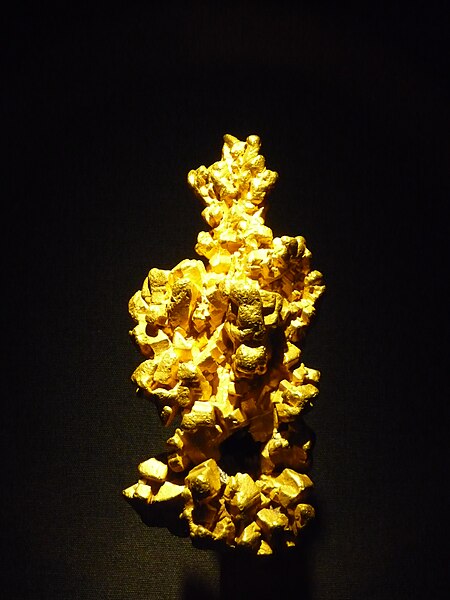
This is what gold looks like in the form of the Latrobe Nugget on display in the London Natural History Museum.
Photo by Gump Stump

Looking at a geological map of New York State it is easy to see that there are several environments in the state that are likely to contain both lode and placer gold. Probably the most likely place where you can find lode gold is in the Adirondacks, and the second most likely place is in the Hudson Highlands, and strangely enough right in New York City. These are areas in New York State where the bedrock is made up of crystalline rocks that may, or may not be the host for gold.

There is a lineation associated with the west bank of the Hudson River called Logan's line that marks the westernmost part of the Taconic orogeny. Anywhere to the east of this line it may be possible to find gold especially in the quartz veins found in the Slate belt of eastern New York along the border with New England.

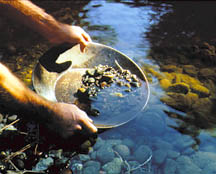
This is how you pan for gold.  USGS

Two of the counties gathering attention are Columbia and Saratoga counties. Although the particulars of these deposits are not clear from examining the geology found in those counties it is apparent they are probably lode deposits.

Another potential source for gold is found in the conglomerate of both the Schwangunks and Catskills where it was weathered out of high mountain ranges that light to the east. The rocks that are found in the Schwangunks were deposited in the Queenstown Delta, and the conglomerates that are found in the Catskills were eroded from another later mountain range that light even further east. These ancient conglomerates could be the host of fossilized placer deposits similar to the Witwatersrand Reef in South Africa, the world's largest deposits of gold.

It may look like Manhattan, but there is likely to be gold under its streets.
Wikimedia Commons

There is likely to be gold found in placer deposits across the length and width of New York that were brought down by the action of continental glaciers in at least three glaciations in the past 1 million years. Immediately to the north of New York State lies the Abitibi Gold Belt of Québec and Ontario. This extends for over 500 miles from Wawa, Ontario to Val ‘Dor, Québec. The scouring action of the glacier removed any gold that was loose in the soil of these provinces and took it south to be deposited across the width of New York State.

Just to the north of the Pennsylvania State line is the terminal moraine of the last glacier. This is an area that would be no doubt be good for prospecting in the many streams and rivers that cut through the glacial deposits. The action of running water would tend to concentrate any gold that was deposited in this area by the melting of the glaciers.

The plunge pool under Niagara Falls probably contains gold if you can find a way to get it!
Wikimedia Commons

The other big terminal moraine in the state is Long Island, there is the possibility that a small amount of gold was brought down from New England by the glaciers forming deposits in the sand and gravel.

Although you may not get rich hunting for gold in New York State at least there is enough that may be found to at least see what it looks like. Maybe someday the state assembly will change the law about the possession of gold to where the average New Yorker will be able to keep any gold that he finds.