Total Pageviews

Showing posts with label Canadian Shield. Show all posts

Thursday, November 17, 2011

Gold Occurrences in Nunavut

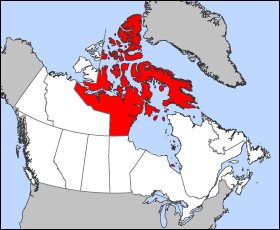
Nunavut is shown in red.


Eastern Nunavut is dominated by the mountains of the Arctic Cordillera a range of volcanic mountains that extends southwards from Ellsmere Island to the Torngat Mountains of northern Labrador and Quebec.  At 8,583 feet (2.616 meters) Barbeau Peak is considered to be the highest point on the east coast of North America.  Many of these mountains are of volcanic origin, and some of them still display cones.  It is the inhospitable nature of the Canadian Archipelago combined with the volcanic nature of these mountains that we must assume there is plenty of gold that hasn’t been discovered yet.

In essence the Arctic Cordillera are reworked rocks of the Canadian Shield and in many respects are similar to the Appalachians although the orogeny that formed them is much younger.  The area is fairly heavily intruded with volcanics that are associated with the orogeny.  To the west of these mountains Nunavut is composed of older rocks belonging to the Canadian Shield.  There are a series of greenstone belts that are found throughout the Canadian Shield including those found in Nunavut.  It is in these rocks that much of the gold in Canada has been found.


The Meadowbank Gold Mine under construction.
Photo by Agrico-Eagle Mining


Nunavut’s first gold mine opened in 2010 operated by Agnico-Eagle it is the first gold mine in the Territory and the first gold mine to become operational here.  The mine is called the Meadowlake Mine that opened in June 2010.  Exploration for other mines is proceeding.  There have been plenty of problems this mine has faced ranging from difficulty in off-loading freighters, leaky dikes, getting permits and delays in completing an airport capable of handling jets.  With these problems it has been estimated that production at this mine is apt to be more then CN$350 per ounce.

At one time in 1999 there were two operational mines in Nunavut both of these mines produced lead-zinc.  One of these mines had the title of being the most northerly mine in the world.  This was the Polaris Mine on Little Churchill Island.  The Nanisivik near the village of the same name produced silver along with the production of lead-zinc.  Both mines are now closed.

There is an active exploration industry and several other mines are in the process of being opened.  Prospecting in Nunavut is expensive but there are grants made available from the territory of $8,000 if you are a serious prospector. The territory also conducts classes for the local population in a program that travels from community to another conducting night and field classes for the people living there. These classes have been conducted for several years, and it was a local prospector who took the classes that found a deposit of gemstones in 2001 that he sold to a mining company.
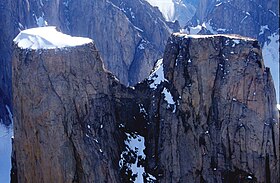
Mt Aasgard in Nunavut is one example of the terrain you will encounter.  It is located on Baffin Island


Unlike other parts of Canada, Nunavut has not been well mapped so there is plenty of opportunity for prospectors to find valuable mineral deposits. One of the things that you have to be careful of is that it takes about 100 prospects before you can develop a single mine. 

Thursday, August 4, 2011

Gold Occurrences in Newfoundland

Gold from the Nugget Pond Mine in Betts Cove on the Baie Verte Peninsula of Newfoundland.
Photo by Rob Lavinsky


Gold was originally discovered in Newfoundland in the 1870s when there was a flurry of gold mining and prospecting in the Canadian Maritime provinces and Newfoundland.  This activity died down after a few mines were opened and closed again.  My great grandfather was one of those caught up in this early gold rush, but at least he mined enough gold for my great grandmother’s wedding ring.  It was this same gold rush that led to his leaving Canada for the United States as it was discovered he was poaching gold from Crown Lands; he decamped from Canada rather suddenly.

Most of the gold occurrences in Newfoundland are found in the central part of the island, and at latest count there were over 200 mines or prospects.  This is significant because the Baie Verte fault that marks a suture zone where gold is deposited.  The Baie Verte fault cuts across the island from north to south as the dividing line between continental rocks to the west and oceanic rocks to the east already has active gold mines along the strike of the fault.  This fault has been interpreted as a subduction zone that is dipping toward the west. The fault is one of the major faults that were in the super-continent of Pangaea. It extends from Staten Island, New York northwards with several name changes to Newfoundland.  It is also found in Europe from Ireland across Scotland finally cropping out in western Norway.

Gold is only one of the metals associated with this fault where others include copper and other heavy metals.  There have been several important mines found in the area controlled by the fault including the asbestos mines around Thetford Mines, Quebec and numerous gold occurrences.  

Mings Bight was where the first gold was discovered in the 1870s that were followed ca. 1903 by some short-lived mines.  By 1935 there were only 26 recorded instances of gold being found in Newfoundland.  It wasn’t until 1976 when significant gold mineralization was found near Cape Ray on the south coast.  In 1984 another deposit was found at Hope Brook.

A surge in prospecting followed the Hope Brook discovery that lasted until 1990.  The prospecting was focused on some dismembered ultramafic belts that were analogies of the mother lode deposits of California.   Then the search broadened until it included most of central Newfoundland.  The low price of gold during the 1990s virtually stopped exploration until it started to pick-up in 2002 and remains very active.

The island of Newfoundland has produced more then 64 tonnes of gold with previously discovered, and new deposits being explored promising a rich future for gold prospecting in Newfoundland. Gold exploration waned as the gold price fell in the late 1990s but began to accelerate in 2002-03 in conjunction with the strong rebound in the price. As of late 2004,with the price continuing to rise, exploration is very active.
Previously discovered deposits and prospects are all being re-investigated and several promising new grassroots discoveries have been made.

The Province has produced over 64 tonnes of gold, about half of which has been derived as a by-product of base-metal mining.

Friday, July 29, 2011

Gold Occurrences in Labrador

The Torngat Mountains of northern Labrador
Photo by Gierdzep


Politically Newfoundland and Labrador are one province of Canada their geological histories are so different that we have decided to treat them as separate entities.  Throughout most of geological time Labrador has been part of the Canadian Shield with some of its far north disturbed by a fairly recent orogeny that raised the Torngat Mountains.  The Torngats are in Quebec, Labrador and a small pert is in Nunavut.  Geologically they are considered the Artic Cordillera with the highest mountain being Mt. Caubvick at 1,652 m (5,420 ft.)  Geographically Labrador contains some of the wildest land on the East Coast of North America to the point it even lacks a trans-Labrador highway.  It is also little explored even though it is known to contain gold.

Labrador in cells contains very few known gold deposits that are more a function of the lack of exploration rather than the fact that gold isn't there. You will find most of the gold in Labrador Inuit southwest corner where it butts up against Quebec.  This is where they build a railroad From Sept Isles Quebec to Labrador city to transport iron from the mines there and Shefferville Quebec. Gold is often associated with iron mines.

There are many geochemical anomalies of gold phoned him the Archean Nain Province where it is associated with strong iron carbonate alteration of the Florence Lake greenstone belt and in quartz base metal veins at the Aucoin showing.  The superior province also contains several areas that show minor gold mineralization where the northern occurrences are associated with metamorphosed iron deposits in the southern ones with pyrite-pyrrhotote-arsenopyrite veining in mafic and metasedimentary gneisses. Gold is also found in the eastern Makkovik province where it occurs as small being hosted the positives in quartz. These are found in felsic volcanic rocks at Poiniadluk Point.  In the southeastern Churchill Province gold is found that the VBE-2 prospect where it is located in the Tasuyak metasedimentary gneiss that contained up to 5.5 grams per tone located in sulfide-graphite rich layers.

Gold is often found associated with greenstone belts that extend across the Archean all the way from Wawa Ontario to past Chibougamau Quebec.  This is such wild country that it has never been thoroughly explored for gold and it is likely that the Abitibi Greenstone Belt extends eastwards into Labrador.

During the mid-1800s my great-grandfather prospected for gold in Labrador where he found enough to make my great-grandmother's wedding ring. Some prospecting was done as early as 1870.

Thursday, March 24, 2011

Gold Occurrences in Wisconsin

There is gold to be found in Wisconsin in the forms of placer deposits in just about any county in the state that were brought here by the many glaciers that have come down from the gold bearing regions of Canada. It should be remembered by prospectors that Wisconsin is divided geologically into two different parts that are nearly equal in size. In the southern part of Wisconsin the basement rocks are buried under a deep deposit of sedimentary rocks that in some places can be miles deep. The northern part of the state is a continuation of the Canadian Shield.

Bedrock map of the Lake Superior region.

Gold found in the northern part of Wisconsin comes from both small lode deposits as well as widespread placer deposits. The placer gold is found in just about any stream or river in the state as well as the beaches along the southern shores of Lake Superior. The deposits lode gold all discovered in several places up to this point none of them found were economically viable. There are several mines in the northern part of the state that are producing both iron and other base metals. Geologically there is no reason why gold should not be associated with these deposits. Just across the border in Michigan there is working gold mining that is produced gold for many years. Of interest are the copper mines that are found in the northern part of the state where the operators of these mines were well aware of the presence of gold, but for economic reasons they just didn't raise the issue.

Throughout the whole state of Wisconsin there are glacial deposits of placer gold brought down from Canada that by being reworked by running water for placer deposits. These deposits are found in the rivers and streams wherever there is a sudden change of velocity in the running water, or on beaches of the many lakes in the state where the gold is concentrated by wave action. Gold of this nature is usually found in fine grains and what is termed flour gold that forces the prospector to become very skillful in the use of the gold pan recover this gold.

Glacial Deposits
Photo by Richard Webb

The gold isn't the only thing the glaciers brought down from Canada; they also brought down several gemstones including diamond, ruby, sapphire and zircon. Weight for weight the stones are actually worth more than gold with the exception of zircon. Deposits of these gemstones are often found in placer gold deposits because there are also concentrated by the action of flowing water. Like gold the glaciers scattered these gemstones across the whole state.

A glacier.
Photo by Kristan Hutchison

Anyone in Wisconsin is allowed to do what is termed recreational gold panning without having to have a license as long as the stream banks and bottoms are not harmed or large amounts of silt and other waste products is not released into the waters of the State. Any gold you find belongs to the person that holds the mineral rights on the property where you found it. You must get permission from the property owner before you do any panning by reaching some sort of agreement with the holder of any mineral rights before you start gold recovery. 

Sunday, March 13, 2011

Gold Occurrences in Ohio

Gold does occur in Ohio in the glacial drift that covers the state where it has been brought down from Canada by two separate episodes glaciation the Wisconsinan and the Illinoian in the past 300,000 years. There is no lode gold in Ohio because the crystalline bedrock of the state is buried beneath thousands of feet of sedimentary rocks. Since the crystalline basement rocks are an extension of the Canadian Shield it is safe to assume that there is gold bearing mineralization under the overlying sedimentary rock as there is in the Abitibi gold belt to the north in Canada.

Glacial Deposits in Ohio
By Ohio Geological Survey


All the gold that is found in Ohio is placer gold that was brought down from the Abitibi region of Ontario during the last two ice ages that is widely distributed all the way from Lake Erie all the way to the Ohio River. The placer gold deposits in the state cover about two thirds of its area and even they are covered by younger lake bottom and wind borne deposits. Just about any river or stream in Ohio has the capability of carrying placer gold. Although gold is not plentiful in Ohio there is enough to attract the interest of many part-time gold miners and prospectors.

The discovery of gold in Ohio probably dates back to the return home of some California gold miners that started exploring the local rivers and streams for placer gold, and found some. The most plentiful gold in Ohio is found in the deposits that were laid down in front of glaciers in areas that are called terminal moraines. Just about any flowing water in this area will have gold bearing sands.

The glacial map of Ohio narrows down the most likely places to find gold in the state so study the map carefully. This map is available from the Ohio Geological Survey in a much more readable scale than is possible on the computer. They also publish a paper called GeoFacts No, 9 that is titled “Gold in Ohio” that should be read by any goldseekers that want to find gold in Ohio. and the Illinoian in the past 300,000 years. There is no lode gold in Ohio because the crystalline bedrock of the state is buried beneath thousands of feet of sedimentary rocks. Since the crystalline basement rocks are a seller and extension of the Canadian Shield it is safe to assume that there is gold bearing mineralization under the overlying sedimentary rock as there is in the Abitibi gold belt to the north in Canada.

All the gold that is found in Ohio is placer gold that was brought down from the Abitibi region of Ontario during the last two ice ages that is widely distributed all the way from Lake Erie's all to the Ohio River. The placer gold deposits in the state cover about two thirds of its area and even they are covered by a younger lake bottom and wind borne in deposits. It just about any river or stream in Ohio has the capability of carrying placer gold. Although gold is not plentiful in Ohio there is enough to attract the interest of many part-time gold miners and prospectors.

The discovery of gold in Ohio probably dates back to the return home of some California gold miners that started exploring the local rivers and streams for placer gold, and found some. The most plentiful golden Ohio was found in the positives that were laid down in front of the glaciers in areas that are called terminal moraines. Just about any flowing water in this area will have gold bearing sands.

The glacial map of Ohio narrows down the most likely places to find gold in the state so study the map carefully. This map is available from the Ohio Geological Survey in a much more readable scale than is possible on the computer. They also publish a paper called GeoFacts No, 9 that is titled “Gold in Ohio” that should be read by any goldseekers that want to find gold in Ohio.