Total Pageviews

Showing posts with label Arizona. Show all posts

Monday, May 28, 2012

The Lost Dutchman Gold Mine


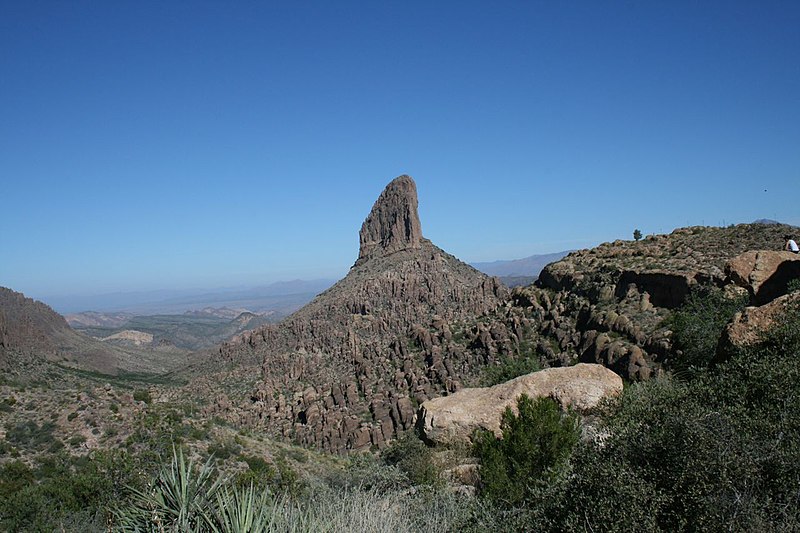
Weaver's Needle in the Superstition Mountains where the Dutchman hid his gold.
Photo by Alan English


Of all the lost mines in America the most famous is the Lost Dutchman Gold Mine that according to its legend is hidden away in the Superstition Mountains located near Apache Junction, east of Phoenix, Arizona.  Other people claim its way past the Superstitions in Mexico.  No one really knows where the mine is located.

The Superstition Mountains can be divided into three distinct groups that can be divided into (1) rock type, (2) structure and (3) process.  Most of the rock type consists of volcanic extrusives that are associated with volcanism.  The structure is consistent with the landform types found accompanying volcanic action and tectonic activity.  This is just the place where you would go looking for gold.  Erosion and mass wasting account for any placer gold that is present.  There are some small areas of sedimentary and metamorphic rocks as well as some Precambrian granite intrusions to be found.  Most of the volcanic activity is from fissure eruptions rather then volcanoes.
Another view of Weaver's Needle
Photo by Ihelewa


The Lost Dutchman Gold mine that is also known by many other similar names is the tale of a very rich gold mine hidden away in the Superstition Mountains, but because Jacob Waltz, the Dutchman, kept the secret of its location to himself.  There are several different tales about how to find the mine and each year there are people that go hunting for it.  Some of these gold seekers have even died in the process.

The mine itself was named after the German immigrant Jacob Waltz that the locals mistakenly called the “Dutchman” that was American slang for a German.  This is derived from the German word for German – “Deutsch.”  The Lost Dutchman is no doubt the most famous lost mine in American history rivaling tales of Captain Kidd’s lost treasure or the Lost Pegleg Mine in California.

Prior to Waltz’s reported discovery in the 1840s the Mexican family, the Peraltas were reported to mine gold in the Superstitions where in 1848 a large group of the Peraltas was ambushed by the Apaches with only one or two members escaping.  There is plenty of evidence of this massacre to be found in the Massacre Grounds where old mining equipment, old weapons, assorted gear and the remnants of a pack train have been found.

The legend goes on to say the Peraltas covered the mines with large rocks to hide their riches from others.  Since then many men have claimed to have found the hidden mines from the number of old maps that have surfaced.  However the men making such claims are unable to return to these mines due to any number of calamities and disasters.  These tales lend truth to the tales of the “Curse of the Superstitions.”

During the 1970’s “the Dutchman” aka Jacob Waltz supposedly found one of Peralta’s gold mines with his partner Jacob Weiser another German.  The story goes on to say they hid some of the gold they found in the area around Weaver’s Needle.  Later Weiser was killed either by the Apaches or Waltz himself.

Waltz later moved to Phoenix where he died in 1891.  Before he died he described the location of the mine to Julia Thomas his landlady.  She became one of the first treasure hunters in 1892, she or other treasure hunters have never been able to find the lost mine since.  Many of them came to a sudden end due to foul play, murder, death or the curse hanging over the Superstition Mountains.

It has been estimated that 8,000 treasure seekers a year have been looking for the Dutchman’s mine since 1892.  Many claim there is no basis to the tale and it is nothing more then a legend, although it is claimed there is some basis in fact to the tales.  Many versions of this tale claim the mine is either cursed, or protected by some kind of guards, usually the Apaches that keep the location of the mine secret.


Tuesday, May 31, 2011

Gold Occurrences in Arizona

Superstition Mountain the reported home of the Lost Dutchman Mine.
Photo by Doug Dolde


As the home of the famous Lost Dutchman Mine on Superstition Mountain as well as several other lost gold mines it is apparent that there is gold in Arizona. The gold runs across Arizona in a line from Greenleee County on the New Mexico border to the Nevada border in Mohave County. The greatest concentration of gold can be found in Yavapai County in central Arizona. This concentration of gold ore extends to the southwest into La Paz County. There is a fine map by the Arizona Department of Mines and Mineral Resources that depicts the known resources of metals found in the state.

Placer gold in Arizona is a resource that was mainly tapped by the first prospectors that came into the state because finding this gold is so easy that it is often called “poor man's gold.” Although this may be true it also be remembered that every flash flood that occurs in Arizona brings more gold down from the mountains. Although placer gold is not as plentiful now as it was during the pioneering days of the 19th century it is still possible to find placer gold. There are probably many places in the state where rich gold deposits are still able to be found that were overlooked by the original prospectors.

One of the greatest difficulties faced by prospectors in Arizona that are searching for placer gold is the lack of water. Although it is true in many places you can prospect for gold using the dry wash method, but it still leaves you with the problem of having sufficient gold in your prospector’s camp to pay your expenses.

During the summer months it becomes extremely hot in southern Arizona, so hot in fact that I once observed that coyote was chasing a jackrabbit; they were both walking. This extreme heat makes for difficult prospecting that requires a considerable amount of physical labor. The best time to prospect under these conditions is during the colder months of the year.

Although a few prospectors are making out very well, and even more are making expenses, but the majority are not even making enough money to pay for their food. In these days of high unemployment if a man has enough money to afford to go prospecting rather than lying around there is always the chance that may find some high-grade gold deposits that have been overlooked by the early prospectors. It is this chance for sudden riches that drives gold prospectors.

Placer gold is a product of weathering where the gold weathers out of some gold bearing veins founded in hard rock. The gold is concentrated by the action of running water or wind in placer deposits. In some places in Arizona for placer gold as soon trapped in a cement like soil called caliche where it is virtually impossible to recover unless the caliche is broken up in a crusher just like hard rock.

Gold on Quartz
Photo by Rob Lavinsky


The state of Arizona contains more than 219 known metallic mineral deposits. A total of 26 of these districts have produced more than 100,000 ounces of gold, and 46 more have produced more than 10,000 ounces. This gold is found in many different types of mineral deposits that either produce gold is the primary metal or as a byproduct from mining other metals principally copper.

The most recent producer of gold the state was the Copperstone deposit that produced over 500,000 ounces of gold before closing in 1998. Parity posits that the state that are capable of producing over 100,000 ounces each but it just been waiting for the price of gold to go up. It is probable that these resources are being ramped up for production as you read this article. Among the gold deposits are those at: Yarnell, Newsboy, Moss, Mexican Hat, Tiger, Golden Eagle and Copperstone underground.