Total Pageviews

Showing posts with label rock hounding. Show all posts

Sunday, June 24, 2012

Rock Hounding, or where you can go beyond Prospecting


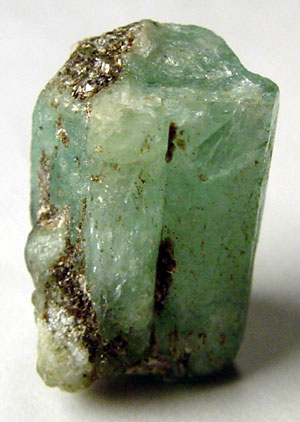
Uncut emerald one of the many members of the family of beryl minerals
Photo by Ryan Salisbury


Rock hounding is many faceted hobbies that make use of various earth materials as its objective.  Rock hounds can range in expertise from the rank amateur that collects pretty pebbles to world class experts on gemstones and minerals.  One of the branches of rock hounding is prospecting for gold and other precious metals.  There are many other fields of study that open to the rock hound as his level of knowledge increases.  Many rock hounds discover that over time rock hounding becomes a full time job.

One of the first things that have to be considered is the number of actual minerals there are, and of the latest count there were over 2000. Another thing that deserves a great deal of study is the number of minerals contained in each of the primary rack systems igneous, metamorphic and sedimentary. Each of these rocks systems contain some very specific minerals that are only found in one system. That being said has to be recognized that many mineral bridge more than one system. Probably one of the most outstanding examples of this is the occurrence of zircon they can be found in all three rock types.

Rhodocrosite from Argentina
Photo by Alberto Salguero


No doubt the most important thing most rockhounds want to learn is the identity of the different minerals they have found. This can be quite difficult considering the number of minerals that are recognized, but if you gold belt this systematically it becomes much simpler. All minerals have specific characteristics that are readily recognized that can take several forms. Many of these ways of recognizing minerals and trace their origin back to ancient times. The ancient Egyptians were quite adept at this practice and their knowledge of chemistry and mineral recognition was quite advanced.

There are a number of different ways of identifying a specific mineral among them are: hardness, color, specific gravity, transparency and fracture. One of the most accurate ways of identifying all minerals is by a process called x-ray diffraction spectrometry or what is commonly called a powder camera that is used by professional mineralogists. A powder camera admittedly is beyond the realm of rock hounds, but there are several tools that are still available to them.
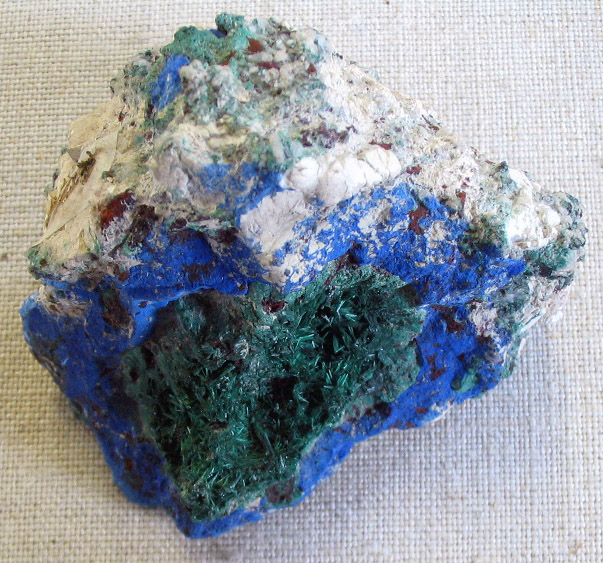
Azurite the blue mineral with malachite the green mineral from Russia
Photo by Aramgutang

The most common of these tools are the hardness testing kit that you can build yourself that are based on being able to scratch a sample. The hardness testing kit is based upon Moh’s Scale of Hardness that ranges from 1 to 10 with talc being the softest and diamond the hardest. Although you can purchase hardness testing kits you can easily make your own from readily available minerals. You can Google Moh's Hardness Scale on the Internet that will give you a list of the different minerals by hardness that are in the scale.

The next most important thing to consider is the mineral's specific gravity. The law of specific gravity was discovered by Archimedes in the city of Syracuse, Sicily during the days of the Romans. Each mineral is first weighed in the air and then weighed in water the difference between the two numbers is the specific gravity of the mineral. Once again a complete explanation of this can be found by Googling the phrase specific gravity.

Color and transparency are self-explanatory and most books on mineral identification are set up to show minerals by their color and chemical composition. Fracture is yet another important tool used in mineral identification.

Friday, May 13, 2011

Nancy Twinkie goes Shopping for Prospector’s Supplies

It finally came to pass that Nancy Twinkie became so hooked on gold prospecting she decided that she should own her own prospecting gear.  So on one Saturday morning when it was raining off we went to a rock shop that carried the kind of gear she wanted.  It was quite a drive to the rock shop since the nearest one to where we lived in Connecticut was about forty-five miles away on the other side of the Connecticut River in East Hampton.  Although Connecticut isn’t exactly rock hounding country there are enough to support a few rock shops; this one is the largest in the state. 

While I was talking to the owner Nancy was poking around in the store for what she wanted, and they had enough of fixings to satisfy her wants.  The first thing she bought was a gold panning kit that included two pans one was 14 inches in diameter and the other was 10 inches.  The kit also had a 14 inch classifier along with a pair of tweezers, a small magnifying glass, and a snuffer bottle for snuffing up small flakes of gold from a goldpan.  There were even a couple of plastic vials to hold the gold.

Then she bought a folding shovel like the kind you use in the army to dig a foxhole.  Although many people would call this a folding shovel I learned the hard way that it is also known in certain quarters as a “hip spoon.”

Nancy went whole hog that day, and bought some other gear for rock hounding.  This collection included a 22 ounce Estwing rock pick, a four pound Estwing cracking hammer, a 1 inch chisel about a foot long, and a bull point of the same length. 

After collecting this gear we stopped at one of those Big Box stores and bought a pair of work boots and a zipper overnight case to carry all this gear in.  The goldpans didn’t fit, so she also bought a backpack.  That finished her collection, so with that we spent the rest of the day rock hounding. 

This is the part of Connecticut where there are several large pegmatite mines many of which have some really rare minerals, so we went to the Strickland Quarry for collecting.  (At the time Strickland was open for collecting, but has since morphed into a golf course, and is closed to collectors.)

After parking the truck we noticed there was a large boulder composed mostly of cleavelandite just on the edge of the parking area.  From the looks of that boulder it probably weighed more then two tons.  By examining the boulder I could see the blades of cleavelandite sticking out in all directions.  Knowing this was one of the signs that there might be pockets inside the boulder we decided to see what was inside and went to work on the boulder with my 8 pound sledge.   

It didn’t take long to find out that the sledge hammer wasn’t going to work so I went back to the truck for a single jack stone drill and a striking hammer.  This was some mining equipment I had inherited from my great grandfather along with some ¾ inch feather wedges. 
A single jack drill it pretty easy to use, and you can drill a hole with one in a hurry by hitting its upper end with a four pound hammer. Each time you strike the drill you have to rotate the drilling steel a quarter turn so that every time the cutting edge of the drill is cutting into a new part of the stone.  We had to make four holes into the rock that were about six inches deep to hold the feather wedges.  It probably took agout 15 minutes to drill the holes and set the feather wedges.  After the wedges were set and tapped into place the boulder was split in half in less then a half hour from when we started drilling. 

Feather wedges can still be bought at mason supply stores, but old fashioned stone drills are no longer sold.  However you can make your own from a star drill by grinding off two of the flutes, or by grinding a radius on the cutting edge of a cold chisel.

Once we were inside the boulder there were many interesting specimens as the pegmatite was an LCT type.  In some of the cavities we found nice specimens of columbite,  but the best specimen was a nice crystal of blue beryl.  Most of the specimen was badly flawed, but there were some areas that were faceting grade that would probably have made gems weighing more then 10 carets.  That stone is still in Nancy’s private collection!