Total Pageviews

Showing posts with label miners. Show all posts

Thursday, May 26, 2011

Gold Occurrences in Colorado

The Argo Gold Mine and Mill in Colorado
Photo by Dustin Moore


Whatever you may say about gold it sure attracts people's attention in a hurry so it was with the Colorado Gold Rush. The gold miners were egged on by the cries of, “Pike’s Peak or bust.” Rumors of gold date back to 1807 when the Mountain Man Zebulon Pike heard rumors of gold in the South Platte River. By 1859 rich deposits of gold were discovered in the mountains west of Denver when the miners abandoned the plains. The first placer mines were around Denver sparking the first Goldrush in 1858.  Gold was found in the following plains counties Adams, Arapahoe, Douglas, Denver, Elbert  and Jefferson. Small amount of placer gold is still produced from Sand & Gravel banks around Denver as a byproduct of gravel washing operations by the aggregate producers.

The district around Central City and Blackhawk was another important gold mining district that produced enough gold to bankroll the modern city of Denver with several hardrock mines being in the district.  At one time the author had dibs on part of the Bates - Hunter mine in Blackhawk. This is officially called the Central City – Idaho Springs District. 

The Teller House in Central City Colorado. Central City was the site of several goldmines during the 19th Century.
Photo by Hustvedt


Gold was originally discovered in this area on January 5, 1859, by a former California prospector named George A. Johnson during the Pike's Peak gold rush. He made his discovery at Chicago Creek where it empties into Clear Creek; this marked the first significant Gold strike that was made in Colorado. Jackson who originally came from Missouri was able to conceal his strike for several months until he paid for some supplies with gold dust then the word was out. What had attracted Jackson in the first place were the large number of hot springs that belched columns of steam into the air. Jackson's discovery eventually led to a gold rush.

 The presence of hot springs in the area is an indication that hydrothermal water sent shed themselves of their gold content into the surrounding rocks. The same hot springs gave the settlement a new name that was to be known as Idaho Springs. On May 5, 1859 another miner named John Gregory discovered a gold bearing vein but was later called the Gregory Lode between Black Hawk and Central City that was called Gregory Gulch. Within two months of this discovery several other gold bearing veins were also unearthed. These discoveries gave rise to the establishment of other mining towns in the area including Nevadaville and Russell Gulch.

This is Pike's Peak that gave rise to the cries of Pike's Peak or Bust during the Colorado Gold Rush


For a few years hardrock mining prevailed in the district until the miners exhausted the free milling gold that was prevalent in the shallower parts of the deposits. This Friday of gold or worked fine for the amalgamation process, but the miners could not recover any gold once they reached the sulfide ore at a deeper depth.

It wasn't until the invention of an effective smelter for the sulfide ore by Nathaniel P. Hill in 1868. This was an achievement that allowed hard rock mining to continue in the district where several other smelters were also built. It is estimated that by 1959 this district produced about 6,300,000 troy ounces of gold mainly from sulfide veins that were found in gneiss and granodiorite.

The early miners made their discoveries at the northeast end of the Colorado Mineral Belt, but it wasn't too long before they started heading southwest across the mountains from Idaho Springs the miners traced the Colorado mineral belt west along Clear Creek, then over the mountain passes to South Park and from there to head waters of the Blue River.

This was the Breckenridge district where the miners first discovered gold in the 1880s, By following the placer gold to its sources at the miners discovered that were veins in the hills containing gold. The miners even recovered some placer gold from the gravel benches to the north of the Blue River. Although gold production Peter now during the late 1800s, but was revived by gold dredging in 1908 along the Blue River. During its lifetime the Breckenridge district produced about 1 million troy ounces of gold. Today the gold mines around Breckenridge are all closed, but there are a few that remain open for tourists.

As early as 1859 prospectors had already found rich placer deposits on the west side of South Park in the valleys on the east side of the Mosquito Range in the principle districts of Fairplay and Alma.  These deposits were located at the headwaters of the South Platte River with others in the Tarryall District alongside Tarryall Creek. Later they found lode gold deposits in the mountains above Alma.  Some of these deposits were worked with floating dredges until 1952.  These gold miners left behind them the gravel ridges seen today. It has been estimated that production from these operations recovered about 67,000 troy ounces of gold. Altogether the Alma-Fairplay district produced about 1.55 million troy ounces of gold with over two=thirds coming from lode deposits.

The discovery of placer gold at Oro City in 1860 opened the pages on the colorful history of the Leadville District.  The placer deposits were exhausted within four years, but the discovery of lode gold in 1868 that later lead to the discovery of large silver deposits in 1877.  It was also in 1877 that the city of Leadville was founded.

The gold and silver deposits at Leadville were deposited in a paleo-karst environment where the rich ores were deposited in ancient river valleys that were later covered by volcanic deposits. The ore here acted as a replacement of limestone that is a common association for gold.  The ore was in the form of lead/silver sulfides with gold being produced as a byproduct.  It has been estimated that there were about 3.2 million troy ounces of gold produced from the Leadville District.

In 1870 gold was discovered by prospectors along the Wrightman Fork of the Alamosa River and a year later they found lode gold in veins where full scale production commenced in 1875 once they had build a mill.  In this district gold production continued until 1906, but became sporadic after that until all production ceased in 1990.  There were about 520,000 troy ounces produced in the life of this district.

At the southwest end of the Colorado gold belt gold is found in Telluride District where the gold is associated with several Tertiary volcanic calderas including the remains of the largest eruption ever discovered “La Garita.” Here the deposits are found associated with intrusives in the older sedimentary rocks as well as chimneys and veins in the volcanic rocks themselves. It is estimated that this district has produced about 6.8 million troy ounces of gold while it was productive. The same district also produced sizable amounts of silver, lead and copper during the same period.

The Cripple Creek district has produced the most gold in Colorado was not discovered until 1891.  After the discovery the towns of Cripple Creek and Victor were settled to take care of the needs of the mines as well as the miners. Altogether this district has produced more then 21 million troy ounces of gold. 

The Cripple Creek and Victor Gold Mining Co. was formed in 1979 with the idea of starting gold production in the district by working mine tailings from the old mines. In the period when they were active from 1979 to 1986 they produced around 150,000 troy ounces of gold.

In an exclusive interview with Jim Burnell of the Colorado Geological survey it was revealed that there are several hard rock deposits of gold that are ramping-up to resume production.  There has also been a considerable amount of activity from the small scale miners that don’t have to report their findings to the state.  According to Mr. Burnell there have been several exploration companies that have expressed an interest in Colorado gold, but for proprietary reasons they don’t want to have their names revealed.

To a limited extent gold mining is still going on in a large scale in Colorado, but the difficulties in permitting a large scale mine today make it extremely difficult to open a new mine. Several mining companies have tried opening some of the older mines that are grandfathered.

Wednesday, March 9, 2011

Gold Occurrences in Alabama:

The history of mining in Alabama goes back to the early 1800s when they actually had a Goldrush that occurred 20 years before the California Goldrush. Many of the Alabama gold miners went to California because there was more gold although at one time the state had thousands of miners that were searching for gold.

The gold in Alabama is found in the Southern Gold belt that enters the state from Georgia in an area in central Alabama but is about 60 miles wide and 100 miles long. This Gold belt has the appearance of looking like an old sock, but it is a scenario where both placer and lode gold deposits are located.

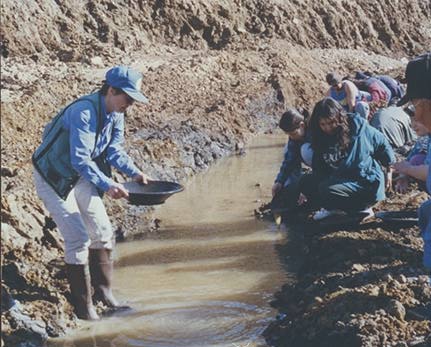
Panning for gold

There are many creeks and rivers in Alabama where you can pan for gold, but many of these places are populated with water moccasins so be extremely careful where you put your hands when you are panning for gold. A bite from one of these critters may not kill you, but it hurts like the blue blazes and will cause you to be very sick. If you have misfortune to be bitten by one of these critters don't panic and get yourself immediately to a hospital or doctor. Don't try to treat the bite yourself let the doctors deal with it they know what they're doing.

This is a cottonmouth water moccasin a highly poisonous snake found in Alabama.
The reason thay are called cottonmouths is because of the white color of the inside of their moutns.
This one is coiled and ready for action. 

Nowadays most of the mining in Alabama is being practiced by amateur prospectors that are either using a gold pan or a sluice box. Although in the past there was a considerable amount of hard rock mining that occurred at the state but now for the most part any gold production in Alabama is in the hands of hobbyists, and small-scale miners.

Gold Ore

The gold deposits in Alabama occur as part of the Southern Gold belt that reaches all away from Maryland to Alabama. The western end of the gold bearing rocks in Alabama plunge under the sediments of the Mississippi River where they reappear again in Arkansas located in the Ouachita Mountains that had its own Goldrush in the 1800s.

In addition to look regular river and creek deposits there is another type of placer gold that is mined in Alabama that occurs in what is called a saprolite this is rock that has undergone deep weathering that at times can exceed 100 feet in depth. The gold in one of these deposits can be found loose in the red clay associated with the remnants of quartz veins.

Wednesday, February 23, 2011

Gold Occurrences in Pennsylvania

Pennsylvania has a long and rich tradition of mining especially for anthracite and bituminous coal as well as iron. What is not generally known however is the state is also produced a considerable amount of gold. It has a well-trained workforce of miners many of whom have a tendency to be prospectors. Because of this some iron miners down around Cornwall have actually produced more than 61,000 ounces of gold while they were mining the magnetite iron ore. Aside from the mine at Cornwall another mine that reportedly produced gold from magnetite was the Grace mine in Morgantown.

There were a series of three openings to the iron deposit in Cornwall located at Big Hill, Middle Hill and Grassy Hill that were originally owned by the Cornwall Ore Banks Co., but were eventually owned by Bethlehem Steel who eventually closed the mines in 1979.  This deposit of magnetite was produced by the replacement of limestone by hydrothermal activity during the Jurassic from a diabase intrusive, so in effect the deposit is a skarn.

The eastern part of the state is covered with crystalline rocks producing potential gold lodes as well as placer gold. This gold weathers out of the crystalline rocks and is collected in the rivers and streams of eastern Pennsylvania. This is not the only source of gold however, in the northern part of the state the last glacier left placer gold in the terminal moraines found in Pennsylvania.

There are several streams producing placer gold that came in Lancaster and York Counties in glaciers that have advanced into the state during the past million years. Any of these glaciers were capable of bringing gold down from Canada where one of the richest gold belts the world the Abitibi is found in Québec and Ontario. According to some geologists there have been as many as 24 episodes of glaciation that have affected the northern part of the United States in the past 2.5 million years.
Although the eastern part of the state is mostly covered with crystalline rocks that produce gold as lode gold that weathers out so it becomes placer gold that collects in the rivers and streams found in eastern Pennsylvania.
One of the places where gold has been found is along the Susquehanna River where it has been found as both nuggets and flakes of gold. Generally Wyoming County has been a good place to look for gold as well as in the surrounding counties.  In York County  placer gold is associated with the deposits of diabase that make up the tops of many ridges. The action of weathering releases the gold from bedrock allowing it to migrate downhill into the streams and rivers in the area.
During the Civil War the great battle at Gettysburg was fought on some of these diabase ridges with names like Little Round Top or Cemetery Ridge. There is no doubt that the rivers and streams around the Gettysburg Battle Site undoubtedly contain gold. 
The best way to find out where the gold is in Pennsylvania is to research old newspapers and town histories.  The state only keeps track of commercial mining operations and not that of individual prospectors. Old newspapers are often the source of stories about where one of the local citizens has found gold in their town.
Helpful Links:


There are several gold prospecting clubs that are active in Pennsylvania that can supply more information about Pennsylvania gold.

Our thanks to Stephen Shanks of the Pennsylvania Geological Survey for additional information.