Total Pageviews

Showing posts with label magnetic sands. Show all posts

Wednesday, February 23, 2011

Sand and Gravel

According to the USGS sand & gravel is one of the most accessible natural resources in the United States second only to crushed stone in value.  It has had an explosive growth rate since the beginning of the 20th century when relatively little was used.  Sand and gravel is mainly used in the construction industry in the form of construction sand & gravel mainly used in the production of concrete and in bituminous concrete (blacktop).
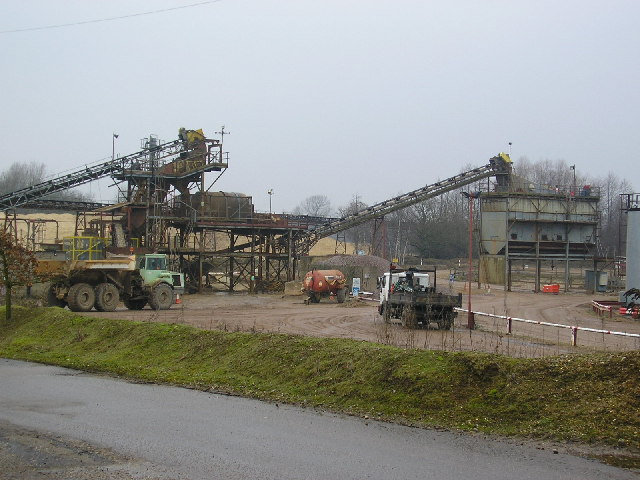

A sand & gravel pit
Photo by Roger W. Hayworth

Annual production of sand & gravel in the United States today it ranks as second in tonnage in the non-fuel minerals after crushed stone.  It is the only mineral commodity that is produced in all fifty states.  In general the United States is self sufficient in the amount of sand & gravel that is produced annually by producing enough to meet all its domestic needs, and is a small net exporter mainly to places where sand & gravel is used to a certain extent in the areas along the borders with Canada and Mexico.
Demand for sand & gravel is mainly controlled by the level of construction activity that controls its demand.  In the United States the production of sand and gravel has grown significantly since the end of WW II with production in 1950 at 320 metric tons increasing to  approximately 900 million metric tons by 2000.  The level of production has dropped since that time.


Sand that has been processed and stored
Photo by Claus Ablieter

Mining sand & gravel is mainly a clean operation in comparison to your local corner bakery although to many people it is unsightly.  This has led to a great misunderstanding on the part of the general public where the perception is that sand & gravel mining is harmful to the environment.  This has caused many sand & gravel deposits to be withdrawn from mining for demographic reasons that in many areas has caused shortages of sand & gravel to occur.
Sand & gravel is a product having a high in-place value that considering the present business conditions costs approximately 50 cents per ton mile.  The further it is necessary to transport the material the more it costs.  Sand & gravel that costs less then $2.00 to produce per ton is apt to cost more then $20.00 per ton delivered. 
A great deal of the problem that was the cause of a special investigation by the governors of the Northeast States was brought about by the mistaken perception that sand & gravel mining was environmentally hazardous; it isn’t.  This misplaced perception has done nothing more then increase the cost of virtually all construction projects throughout the United States.

Friday, December 31, 2010

How to Build a Simple Magnetometer for finding Gold

The earth is nothing more then a giant magnet as attested by its magnetic poles that attract a magnetic needle to magnetic North and South. The same phenomenon of magnetic attraction can be used to detect magnetic minerals even as small as what are termed micro-mounts, or for that matter large masses of magnetic mineral like magnetite below the surface of the earth. Although gold itself is not magnetic that often occurs in the company of different minerals that are; one example is granular magnetite.

This deceptively simple magnetometer can be used both at home or in the field. Its materials are also simple consisting of a very few parts that are obtainable anywhere. The core of this magnetometer is nothing more complicated than an ordinary soda straw with a small magnet glued on one end. There is a needle shoved through the straw at approximately its balance point with the magnet attached. The needle rests on two parallel sides are far enough apart to allow the straw to present up and down.

The best kind of magnet that you can use as a so-called rare earth magnet that is far more powerful than an ordinary magnet. Small maintenance of this type can be found in auto parts stores, sources say are part of an automobile alternator they can also be found in your local junkyard. The best kind of soda straw to use is one that has a flexible joint near its upper end, so you can bend the straw to get it perfectly balanced.

At home your magnetometer is used to detect magnetic minerals that is accomplished by passing the near the magnetic tip to see if the magnet is attracted. If it is you know immediately whether or not the mineral is magnetic, conversely if the magnet is not attracted to the specimen then it is not magnetic. This is important because many minerals look alike and the magnetometer test is one step in identifying the mineral.

In the field; all you have to do is walk a straight line while watching the straw, if the magnet is attracted to a magnetic mass in the ground the straw will move up or down. This is also important because many different mineral deposits are magnetic and have other minerals that are associated with them including gold. A simple method of measuring the amount of dip is by placing a quadrant next to the straw allowing you to measure the amount of dip the straw undergoes.

A simple magnetometer of the type described can be seen by following this URL: