Total Pageviews

Showing posts with label diamond. Show all posts

Monday, June 18, 2012

Gold Occurrences in Botswana


Mining in Botswana


Although gold is mined in Botswana since the early 1990s diamond production has led the pack with most of the diamonds produced were of gem quality.  This made the country the world’s leading producer of diamonds by dollar value.  Other minerals produced included gold, copper-nickel matte and soda ash.  During 2005, mining accounted for about 38% of the country’s Gross Domestic Product (GDP) with more then 50% of the government’s revenue coming from the mining industry.

Almost two thirds of Southern Africa including Botswana is composed of rocks of the Karoo Supergroup and most of the rest of Southern Africa.  The rocks are deposited in a series of basins in which the deposits had their origin in the formation and breakup of Pangea. The strata in the main crew consists mainly of shales and sandstones that record an almost continuous sequence of marine deposits ranging from glacial to terrestrial the presentation from the late Carboniferous through the early Jurassic for a period of about 100 million years.

The sediments accumulated in a retroarcforeland basin, these sediments are called the named Main Karoo with a thickness of about 12,000 km. They are overlain by basaltic lavas of the Drakensberg group. The basin was formed by the subduction and orogenesis that occurred along the boundary of Gondwana and the Panthalassan Sea, paleo – Pacific. The basalt layers are approximately 1.4 km thick.

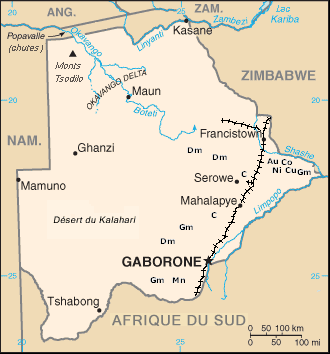
A subsidiary of Gallery Gold called Mupane Gold operated the Mupane gold mine that was located about 30 km south of Francistown. This gold came from the Tau pit, and after mid-year production came from the oxide zone of the Tholo pit. Gallery gold continued exploring other gold prospect in the area of the Mupane mine including several other prospects.

One company suspects there are outlaying members of the Witwatersrand underlying parts of the Karoo formation, but that are and there is an active drilling program that is being undertaken.

Sunday, June 3, 2012

Gold Occurrences in Angola


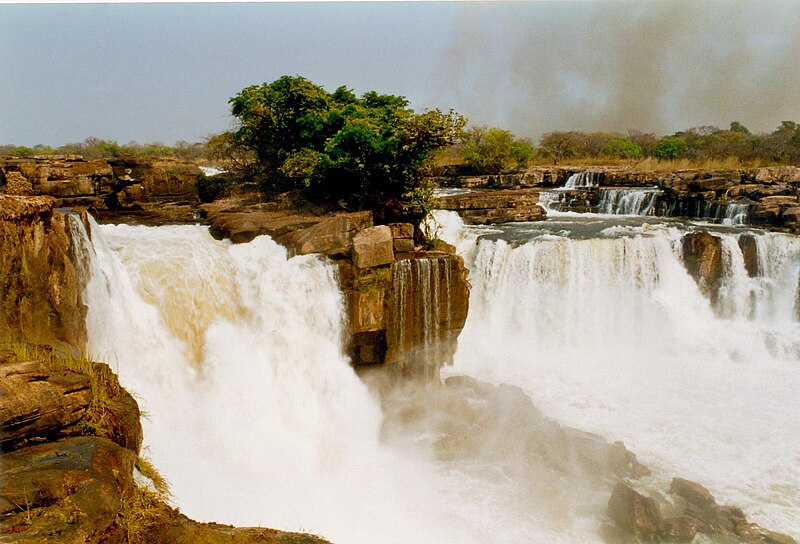
Tazua Falls on the Rio Cuango is one of the richest diamond and gold rivers in Angola
Photo by Brian Harrington Spier


Gold and base metal potential remains in Angola, but because of the ongoing civil war in Angola much of this potential remains unexploited.  Even though the country has been wracked by this conflict mining still provides the country with some foreign exchange with about 98% of it coming from diamonds.  The rest of the countries earnings are from oil.  Before the civil war Angola was an important producer of gold and other metals.  Because of the ongoing civil war it is difficult to reach much of the country from the outside.  No doubt there are world class deposits of gold waiting to be discovered in Angola.

Geologically Angola was once part of Southern Brazil until the Atlantic Ocean commenced opening during the Triassic period 220 million years ago; today the two countries are separated by the Atlantic Ocean.

Twelve billion barrels of oil have been found in the deep waters off the coast of Angola since it was first discovered in 1955.  Officials at Sonangol, the country’s oil company say this is only a small part of the total potential.

Upper Proterozoic Fold Belts of the Pan African are found along the margins of Angola’s Precambrian shield.  Among the most important are the West Congo, Damara and the Maiombe-Macongo.  This fold belt displays the occurrence of both gold and base metals along with a wide variety of industrial minerals.

The Lower Protozoic and Archean rocks are composed of the Angloan, Maiombe, Cassai and Bangwelo shields along with the granitic, gneissic rocks sedimentary (greenstone) belts from the Angolan, Maiombe, Cassai and Bangwelo shields and the Kwanza meta-
Volcanic sedimentary (greenstone) belts are present in the south-central part of the country as the Cassinga and Menonque greenstone belts.  These rocks go on to the Cunene basic to ultra basic complex that occupies more then 20,000 sq. km in southwestern Angola.

Angola is blessed with mineral riches with most of the rivers flowing down from these areas bearing lode gold and there is plenty of areas bearing lode gold waiting to be explored.