
 |
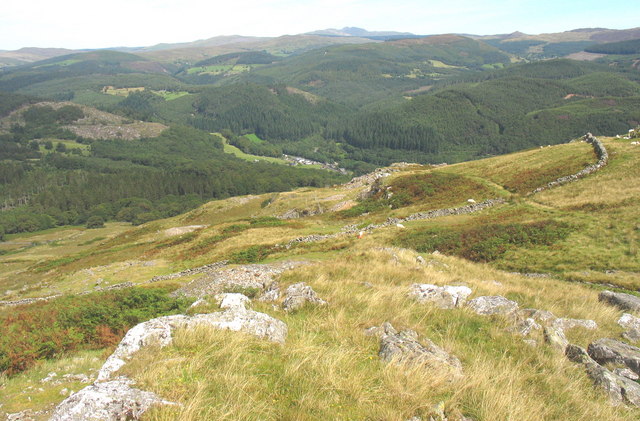
| A view of an undeveloped lode gold deposit. The gold is in the white veins in the photo. Photo by Eric Jones |
The first thing you have too do after finding a potential deposit of lode gold is to be sure that it legally is yours either by ownership of the land, by a legal claim or by working out a deal with the rightful owner of the land. The best type of deal is when you are the owner of the land where the deposit has been found. In some jurisdictions where it is permitted is the mineral claim whereby you come into ownership of the mineral rights by expending a certain amount of money on the claim per year for several years until it finally becomes a patented claim that in effects gives you the ownership of the claim. If it is on private property that does not belong to you, and you can’t file a claim then you will have to work out some kind of agreement with the lawful landowner.
Most lode gold deposits are found in quartz veins that commonly called “Bull Quartz” by miners that are usually emplaced in a fault zone that might consist of one large vein or a whole series of quartz veins holding gold, or both. It should be kept in mind that all showings of gold are not developed into gold mines in fact very few of them are. During the 19th century this situation was called “Gamblers Ruin” that was the title of a book about mine appraisal. The chances of developing your find into a working mine are about 1 in 300.
 |
| Gold in Quartz Photo by Rob Lavinsky |
If there is gold present you can find it in a brook adjacent to the suspected deposit. This is done by panning in the brook a few feet on either side of the deposit, and another sample from the brook right at the point where the deposit is, or as close as you can get. Another way for detecting gold deposits is by using a metal detector some of them can be set specifically for gold. In some places you can rent a metal detector. There are times when the gold in quartz is visible to the naked eye or with a magnifying glass.
An important step in developing a find into a mine is finding out if it actually contains gold and other valuable minerals this is done by taking a representative sample across the exposure by chiseling a line right across the exposure using a hammer and chisel. This is hard work, but is necessary to get some kind of idea about what you have. The rock chips are all saved and submitted to a licensed assayer for analysis. This determines if you have discovered anything worth further exploratory work by determining how much gold is present per ton. Remember gold showing as little as a few grams per ton is a payable deposit under the present price for gold. You have a bonanza deposit when you measure the amount of gold present in troy ounces of gold per ton.
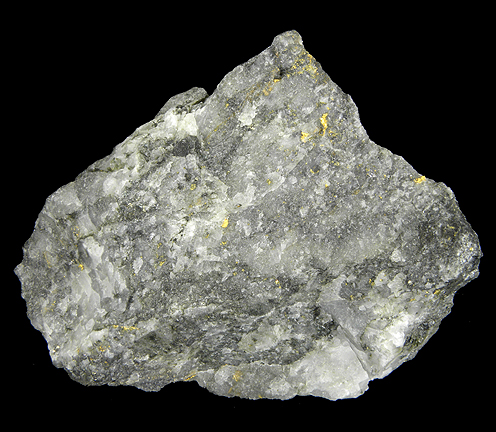 |
| Another view of lode gold. Photo by Rob Lavinsky |
Once you have established that there is indeed gold present it is time to call for a diamond drilling program because there is nothing more convincing to bankers and other members of the financial world that is more convincing them a set of core samples. The truth is you are pretty much on the hook for the first core sample that is taken at the point of discovery. Further cores are taken by offsetting from the original discovery site by a predetermined distance in initial investigations this is usually 50 meters in each direction around the point of initial discovery. It is not unusual for a drilling program to consist of several thousand meters of core drilling.
Core drilling also determines whether or not a find can be developed into a commercially viable mine, and there are any number of reasons why it isn’t. One of the big finds we made during the 1960s was a deposit of copper that was drilled proving a resource worth $100,000,000 at the time. It was never developed into a mine because It would have required the expenditure of $1,000,000,000 to get the ore out of the find. In other words it wasn’t commercially viable, so no mine was developed. The area was just too remote, and it still is. We wound up calling this find the $100,000,000 nuisance.


.jpg)