Total Pageviews

Showing posts with label South Dakota. Show all posts

Thursday, May 31, 2012

The Homestake Gold Mine of South Dakota


The open pit portion of the Homestake Gold Mine in Lead, South Dakota.  This is only a small part of the mine because it extends into the earth for thousands of feet making it at one time the deepest mine in the western hemisphere.
Photo by Rachel Harris


This mine traces its origins all the way back to 1876 when it was discovered by Fred and Moses Manuel, Alex Engh, and Hark Harney in April, during the Black Hills Gold Rush.  The following year it was sold to a trio of gold entrepreneurs, George Hearst, Lloyd Tevis and James Ben Ali Haggin who bought the mine from the group that discovered it for the sum of $70,000.  In October 1877 George Hearst appeared at the scene of the mine where he took active control.  All the mining equipment used at the mine had to be hauled in by oxcart from the nearest railhead in Sidney, Nebraska.  Even though the mine had a remote location by July 1878 the 80-stamp mill started to crush the ore from the mine.

The mine is located in a domal uplift that is about 100 kilometers long and 60 kilometers wide straddling the border of South Dakota and Wyoming.  The Black Hills were uplifted during the Laramide orogeny that occurred between 60 and 65 million years ago, and are an outlier of the Rocky Mountains.  The rocks exposed in this range are from 2.7 billion years old to 60 million years old.  The core of the mine is composed of Precambrian phyllite, cummingtonite schist and granite with the Black Hills surrounded by younger sedimentary rocks.  Most of the gold deposits are associated with a Precambrian banded iron formation.

Hearst and his partners sold shares in the Homestake Mine and had it listed on the New York Stock Exchange in 1879 where it is too this day as one of the longest-listed stocks on the exchange.  The stock that has been listed the longest is Con Edison, whose original name was New York Gas Light whose listing dates back to 1824.

Under their control the mine’s holdings were increased sometimes by fair means or if that didn’t work by foul means.  They bought out some of the adjacent claims, but weren’t adverse about using the courts to obtain others.  There is even evidence that one man was murdered by one of the group’s men because he refused to sell his claim to them.  The case was dropped when all the witnesses to the murder vanished.  Hearst bought out the newspaper in Deadwood to sway public opinion his way, with the editor of the opposing newspaper was beaten up while walking down a Deadwood street.  Hearst himself realized that he could be murdered and asked his partners to take care of his family if he was; in the end though it was Hearst that walked away smiling, still alive and very rich.

Although the gold ore mined at Homestake was always low grade averaging less then an ounce per ton it existed in vast quantities.  During its lifetime the mine produced 39.8 million ounces of gold along with 9 million ounces of silver.  The mine is the only one in the Lead mining district was the second largest producer of gold in the United States.  The largest producer of gold is the Carlin Trend in Nevada.

At the end of 2001 production at the Homestake ceased for several reasons including low gold prices, poor ore quality combined with high operating costs.  There had been a merger with Barrick Gold Corporation and Homestake Mining Company in mid-2001.  They agreed to keep the mine dewatered while negotiations for its further use continued with DUSEL, but progress along these lines continued at a snails pace.  As negotiations dragged on it was costing Barrick $250,000 for maintaining the pumps and ventilation system so on June 10, 2003 Barrick threw the switch and closed the mine completely.

After being closed for six years researchers at Berkeley announced that the Homestake Mine would be used as a research facility causing it be reopened for the study of neutrinos and dark matter particles.


Wednesday, April 20, 2011

Gold Occurrences in South Dakota

Before it closed in 2002 the Homestake Mine in Lead, South Dakota was the deepest gold mine in North America. It had operated almost continuously since 1874 where the gold was found in association with cummingtonite schist. The depressed price of gold at the time the mine was closed in 2002. The mine has been since converted by the National Science Foundation into an underground laboratory devoted to the search for neutrinos and other subatomic particles from space.

Until the recent discoveries of large gold deposits in the Carolinas and Georgia South Dakota had the distinction of being the eastern most state that was a large producer of gold. It also has the distinction of having a war between the Indians and Whites over the gold deposits in the Black Hills, an area that was considered sacred by the Sioux. This led to the Battle of Little Bighorn in eastern Montana where the 7th Cavalry under George Armstrong Custer was virtually wiped out by the Sioux warriors.

Airforce One flying over Mt. Rushmore in the Black Hills of South Dakota

Within a year of the Battle of Little Bighorn the Black Hills were swarmed with thousands of gold seekers. Although gold was known to occur in the Black Hills it was not a safe place for white men to venture because it was considered as sacred ground by the Sioux. The gold discoveries came fast and furious until he finally culminated in the discovery of the Homestake mine in 1876.

During the early days of the gold rush in the Black Hills mostly action was centered around Deadwood where the famous Western gunfighter Wild Bill Hickok was gunned down while playing poker holding the dead men hand of aces and eights.  It wasn't too long before gold was discovered on the other side of the mountain in Lead that was developed into the Homestake mine. The mine is now owned by Barringer Gold and they have not decided to reopen gold-mining here, but there were plenty of other gold mines in the Black Hills that over the years also produced gold.

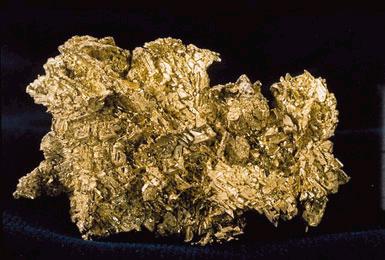
Crystalline Gold from South Dakota

There are still plenty of opportunities for small-scale miners in the Black Hills, but you have to keep in mind that the early prospectors were pretty thorough in their search for gold. What they lacked were some of the modern devices for finding gold that we now have. These new devices make it possible to find gold that the old-time prospectors missed. Placer gold can be found in many of the rivers and streams of the Black Hills as well as rivers that lead out of the Black Hills.

Another place where metal detector comes in handy is prospecting in rivers and creeks. Every year more gold is eroded from the banks of creeks that finds its way into the water courses. This does not mean that you shouldn’t overlook the use of more conventional tools like gold panning kits and dredges for mining placer gold.
The other gold that is present here is what is termed lode gold that is found throughout the bedrock of the central Black Hills. This is an area of pre-Cambrian rock that was thrust up through the sedimentary rocks that surround it by earth actions in four different geologic episodes in the past.
Erosion from the rocks of the Black Hills has reached as far east as Minnesota in the form of a conglomerate. Gold is often associated with conglomerates as fossilized placer deposits. The conglomerates east of the Black Hills may prove to be another area containing gold. The largest gold mining district in the world is the Witwatersrand in South Africa that has produced more gold than all the other mining districts in the world combined is also hosted by an ancient deposit of conglomerate.